Termo do glossário: Titã
Descrição: Titã é a maior lua de Saturno. É maior do que a Lua da Terra e Mercúrio, e é a segunda maior entre as luas do Sistema Solar. É o único corpo, além da Terra, conhecido por possuir oceanos, mares e rios líquidos na superfície. No entanto, estes são compostos por substâncias químicas chamadas hidrocarbonetos. Acredita-se que Titã tenha um núcleo rochoso e uma crosta de gelo feita de água. Acredita-se que a água líquida sob a crosta de gelo possa possivelmente abrigar vida. Ela possui uma atmosfera espessa, composta principalmente por nitrogênio, que a faz parecer muito suave nas imagens.
Termos relacionados:
Ver este termo em outros idiomas
Status do termo e da definição: A definição original deste termo em inglês foi aprovada por um astrônomo(a) pesquisador(a) e um(a) professor(a) A tradução deste termo e de sua definição ainda aguarda aprovação
O Glossário Multilíngue da OAE é um projeto do Escritório da IAU de Astronomia para a Educação (OAE) em colaboração com o Escritório da IAU para Divulgação da Astronomia (OAO). Os termos e definições foram selecionados, escritos e revisados por meio de um esforço coletivo da OAE, dos Centros e Nós da OAE, dos Coordenadores Nacionais de Educação em Astronomia (NAECs) da OAE e de outros voluntários. Você pode encontrar uma lista completa dos créditos aqui. Todos os termos do glossário e suas definições são disponibilizados sob uma licença Creative Commons CC BY-4.0 e devem ser creditados à "IAU OAE".
Se você notar algum erro factual ou de tradução neste termo do glossário ou em sua definição, por favor entre em contato.
Mídia relacionada
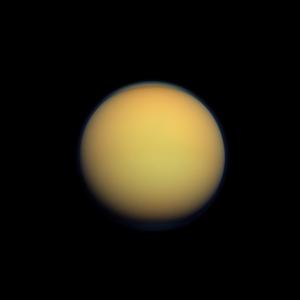
Titã em cores naturais
Legenda: Esta imagem, obtida pela sonda Cassini da NASA em janeiro de 2012, mostra a lua Titã de Saturno em cores quase naturais. A coloração laranja-amarelada provém de uma camada de compostos de hidrocarbonetos parcialmente carregados. Na luz visível, a superfície de Titan permanece em grande parte escondida abaixo de sua atmosfera opaca.
Crédito: NASA/JPL-Caltech/Space Science Institute
link do crédito
License: PD Domínio Público ícones
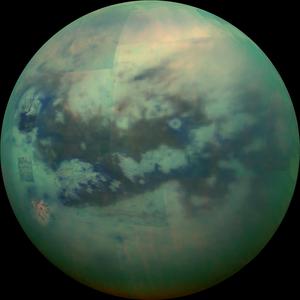
Titã com características superficiais
Legenda: Esta imagem composta, captada pela sonda Cassini da NASA em novembro de 2015, mostra a radiação infravermelha da lua Titã, de Saturno. A luz infravermelha consegue penetrar a sua atmosfera enevoada e revelar algumas das características da sua superfície. Durante a sua descida até à superfície, a sonda Huygens da ESA, transportada pela Cassini, descobriu lagos formados por hidrocarbonetos líquidos.
Crédito: NASA/JPL/Universidade do Arizona/Universidade de Idaho
link do crédito
License: PD Domínio Público ícones
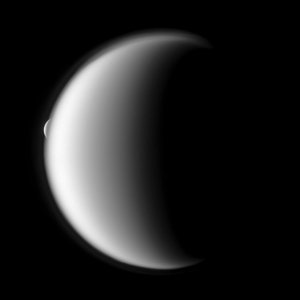
Rhea reappearing after occultation by Titan
Legenda: On October 27, 2009, NASA’s Cassini spacecraft orbiting around Saturn captured this view of Saturn's moon Rhea as it began to emerge after being hidden by Saturn's largest moon Titan during an occultation. An occultation is a celestial event in which one object moves in front of another and temporarily blocks the first object from view.
In this image, Titan — about 5,150 km across — was closer to the spacecraft at about 1 million km, while Rhea — roughly 1,528 km in diameter — was farther away at about 2.3 million km. Titan’s high-altitude atmospheric haze is visible as a faint glow around its limb, showing the difference in surface and atmospheric properties between these two moons.
Scientists study occultations like this because watching how one moon disappears behind or reappears from another helps refine our understanding of their orbits and physical characteristics.
Crédito: NASA/JPL/Space Science Institute
link do crédito
License: PD Domínio Público ícones
Atividades relacionadas
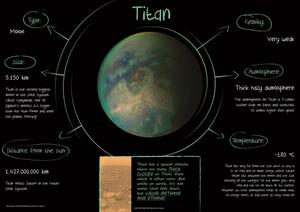
Children's Planetary Maps: Titan
astroEDU educational activity (links to astroEDU website) Description: Learn about the only other known body in the Solar System with Seas and Lakes
License: CC-BY-4.0 Creative Commons Attribution 4.0 International (CC BY 4.0) ícones
Tags:
Maps
, Planetary cartography
, Spatial thinking
Faixas etárias:
6-8
, 8-10
, 10-12
Nível de ensino:
Ensino fundamental
, Básico
, Médio
Áreas de aprendizagem:
Aprendizagem por investigação estruturada
Custos:
Baixo custo
Duração:
2 hours
Tamanho do grupo:
Grupo
Habilidades:
Analisar e interpretar dados
, Fazer perguntas
, Comunicar informações
, Construir explicações
, Desenvolver e usar modelos
, Engajar-se em argumentação com base em evidências
, Planejar e realizar pesquisas