Termo do glossário: Sagitário A*
Descrição: As observações dos movimentos das estrelas e do gás ao redor do centro da Via Láctea fornecem evidências indiretas de um buraco negro supermassivo com uma massa cerca de 4,5 milhões de vezes maior que a do Sol e aproximadamente 40 milhões de quilômetros de diâmetro, localizado a cerca de 27.000 anos-luz de distância da Terra. Sagitário A* (lê-se Sagitário A-estrela) é a fonte de rádio compacta associada ao buraco negro supermassivo. Ela foi observada em uma variedade de comprimentos de onda, principalmente em rádio. O nome Sagitário se deve ao fato de estar localizado na constelação de Sagitário, conforme observado da Terra; a letra A se deve ao fato de ser a mais brilhante e a primeira fonte de rádio extrassolar descoberta na constelação; o asterisco se deve ao fato de que, na física, os átomos em estados excitados são denotados por * e Sagitário A* foi uma descoberta empolgante.
Em 2022, a Colaboração do Telescópio do Horizonte de Eventos divulgou a primeira imagem da silhueta ("sombra") do buraco negro associado a Sagitário A*.
Termos relacionados:
Ver este termo em outros idiomas
Status do termo e da definição: A definição original deste termo em inglês foi aprovada por um astrônomo(a) pesquisador(a) e um(a) professor(a) A tradução deste termo e de sua definição ainda aguarda aprovação
O Glossário Multilíngue da OAE é um projeto do Escritório da IAU de Astronomia para a Educação (OAE) em colaboração com o Escritório da IAU para Divulgação da Astronomia (OAO). Os termos e definições foram selecionados, escritos e revisados por meio de um esforço coletivo da OAE, dos Centros e Nós da OAE, dos Coordenadores Nacionais de Educação em Astronomia (NAECs) da OAE e de outros voluntários. Você pode encontrar uma lista completa dos créditos aqui. Todos os termos do glossário e suas definições são disponibilizados sob uma licença Creative Commons CC BY-4.0 e devem ser creditados à "IAU OAE".
Se você notar algum erro factual ou de tradução neste termo do glossário ou em sua definição, por favor entre em contato.
Em outros idiomas
- Árabe: القوس أ*
- Alemão: Sagittarius A*
- Inglês: Sagittarius A*
- Espanhol: Sagitario A*
- Francês: Sagittarius A*
- Hindi: सॅजीटेरीअस ए*
- Italiano: Sagittario A*
- Japonês: いて座A* (link externo)
- Coreano: 궁수자리에이*
- Marathi: सॅजीटेरीअस A* (Sgr A*)
- Chinês Simplificado: 人马座 A*
- Chinês Tradicional: 人馬座 A*
Diagramas relacionados
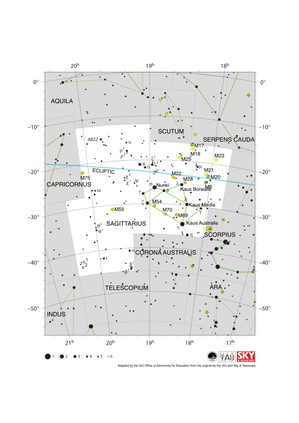
Sagittarius Constellation Map
Legenda: The constellation Sagittarius along with its bright stars and surrounding constellations. Sagittarius is surrounded by (going clockwise from the top) Aquila, Scutum, Serpens Cauda, Ophiuchus, Scorpius, Corona Australis, Telescopium, Microscopium and Capricornus. The brighter stars in Sagittarius form a distinctive teapot shape. Sagittarius lies on the ecliptic (shown here as a blue line), this is the path the Sun appears to take across the sky over the course of a year. The Sun is in Sagittarius from mid December to mid January. The other planets of the Solar System can often be found in Sagittarius.
Sagittarius lies south of the celestial equator. The famous teapot asterism is visible for all but the most arctic regions of the world but the most southerly parts of the constellation are not visible in northern parts of Asia, Europe and North America. Sagittarius is most visible in the evenings in the northern hemisphere summer and southern hemisphere winter.
The supermassive black hole Sagittarius A* which lies at the center of our Milky Way Galaxy is sits on the western (here right-hand) edge of Sagittarius. Due to it covering an area at the center of our Galaxy, Sagittarius is home to many star clusters including open clusters (marked here with yellow circles) and globular clusters (marked here with yellow circles with + signs superimposed on them). Three nebulae are also marked here with green squares.
The y-axis of this diagram is in degrees of declination with north as up and the x-axis is in hours of right ascension with east to the left. The sizes of the stars marked here relate to the star's apparent magnitude, a measure of its apparent brightness. The larger dots represent brighter stars. The Greek letters mark the brightest stars in the constellation. These are ranked by brightness with the brightest star being labeled alpha, the second brightest beta, etc., although this ordering is not always followed exactly. The dotted boundary lines mark the IAU's boundaries of the constellations and the solid green lines mark one of the common forms used to represent the figures of the constellations. Neither the constellation boundaries, nor the line marking the ecliptic, nor the lines joining the stars appear on the sky.
Crédito: Adapted by the IAU Office of Astronomy for Education from the original by IAU/Sky & Telescope
License: CC-BY-4.0 Creative Commons Attribution 4.0 International (CC BY 4.0) ícones