Termo do glossário: Mercúrio
Descrição: Mercúrio é o planeta mais próximo do Sol e o menor dos oito planetas principais do Sistema Solar. É um planeta rochoso e terrestre com um raio de cerca de 2.500 quilômetros (km), o que o torna ligeiramente maior que a Lua da Terra. Sua massa é 0,055 vezes a massa da Terra. Devido à sua proximidade, o Sol é sete vezes mais brilhante quando visto de Mercúrio, e a superfície do planeta é fortemente afetada pelo vento solar. Sua exosfera, muito fina, é composta por material produzido por essa interação, além de matéria ejetada da superfície devido à queda frequente de objetos. A atmosfera rarefeita não consegue reter o calor do planeta, de modo que a superfície fica extremamente fria (-180 graus Celsius) durante a noite e extremamente quente (400 graus Celsius) durante o dia, sendo, portanto, muito seca.
Sua distância típica do Sol é de cerca de 58 milhões de km, aproximadamente 0,39 unidades astronômicas (distâncias Terra–Sol), levando pouco menos de 88 dias para completar uma órbita. Não se conhece nenhuma lua orbitando Mercúrio.
Como Mercúrio orbita o Sol mais perto do que a Terra, ele sempre aparece próximo ao Sol no céu. Mercúrio recebeu esse nome em homenagem ao veloz deus mensageiro romano, devido ao seu movimento rápido pelo céu. Duas sondas espaciais (Mariner 10 e MESSENGER) já visitaram Mercúrio, e a missão BepiColombo deve chegar lá em meados da década de 2020.
Termos relacionados:
Ver este termo em outros idiomas
Status do termo e da definição: A definição original deste termo em inglês foi aprovada por um astrônomo(a) pesquisador(a) e um(a) professor(a) A tradução deste termo e de sua definição ainda aguarda aprovação
O Glossário Multilíngue da OAE é um projeto do Escritório da IAU de Astronomia para a Educação(OAE) em colaboração com o Escritório da IAU para Divulgação da Astronomia (OAO). Os termos e definições foram selecionados, escritos e revisados por meio de um esforço coletivo da OAE, dos Centros e Nós da OAE, dos Coordenadores Nacionais de Educação em Astronomia (NAECs) da OAE e de outros voluntários. Você pode encontrar uma lista completa dos créditos aqui. Todos os termos do glossário e suas definições são disponibilizados sob uma licença Creative Commons CC BY-4.0 e devem ser creditados à "IAU OAE".
Se você notar algum erro factual ou de tradução neste termo do glossário ou em sua definição, por favor entre em contato.
Mídia relacionada
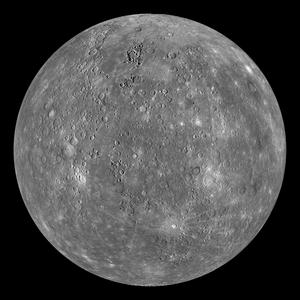
Mercúrio
Legenda: Esta imagem é uma composição de um mosaico de fotos da superfície do planeta Mercúrio obtidas pela sonda espacial MESSENGER (Mercury Surface, Space Environment, Geochemistry and Ranging). A MESSENGER foi lançada pela NASA em 2004 e explorou Mercúrio de 2011 a 2015.
Crédito: NASA/Laboratório de Física Aplicada da Universidade Johns Hopkins/Instituição Carnegie de Washington
link do crédito
License: PD Domínio Público ícones
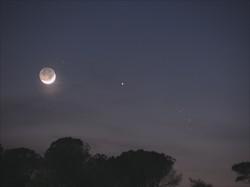
Moon-Mercury-Pleiades Conjunction
Legenda: Honourable mention in the 2022 IAU OAE Astrophotography Contest, category Still images of celestial patterns.
This photograph shows the young lunar crescent, some of the nine brightest stars of the Pleiades (with one behind a cloud) on the right, and the planet Mercury, looking slightly red, in the middle of the image.
This picture is rather suggestive of the idea that the Pleiades might possibly consist of seven stars. However, the viewer is misled by the clouds; five of the stars form a tiny chariot, one is next to the handle, and three are at the other end of the quadrilateral. Eight stars would be clearly visible if there were no clouds.
This configuration of the young Moon next to the Pleiades is visible only in the northern hemisphere spring. Thus it was used by the ancient Babylonians to determine the second month of their year and to judge whether or not an intercalary month was necessary. At least as early as the second millennium before the common era, the Babylonians used several asterisms for each month, with another one of them reappearing every five days after invisibility during daylight. To determine the necessity of intercalation in order to synchronise the solar and the lunar year, the Babylonians used several asterisms, not only the Pleiades. For instance, they also made use of the bright stars Arcturus and Sirius, and they observed a configuration with the Moon as well as heliacal phenomena. The modern Jewish and modern Islamic traditions still make use of some of the Babylonian astronomical rules. However, given that the constellations have shifted as a result of precession, and the fact that nowadays we also have computational means to calculate our calendars, this configuration of the small crescent Moon and the Pleiades is less useful, though it remains exceptionally beautiful. Thus the ancient Babylonian and middle Babylonian tradition survives only rudimentarily. Furthermore, it is unlikely that it is depicted in the Nebra Disc from Bronze Age Europe, as has long been claimed.
This image was taken on Elba Island, Italy, in May 2022.
Crédito: Giulio Colombo/ IAU OAE
License: CC-BY-4.0 Creative Commons Attribution 4.0 International (CC BY 4.0) ícones
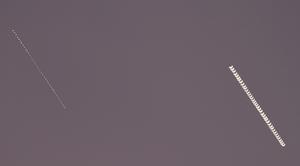
Venus and Mercury Trails
Legenda: Honorable mention in the 2023 IAU OAE Astrophotography Contest, category of Still images of phases of Venus.
In this composite image, both Mercury (left) and Venus (right) can be seen heading into the sunset. The phases of each are beautifully captured as they descend. Not all planets or moons in the Solar System show phases as viewed from Earth. This phenomenon occurs because the orbits of Venus and Mercury are positioned between Earth’s orbit and the Sun, sometimes allowing us to see only part of the illuminated portion of each planet. These phases are similar to the phases we see of our own Moon.
Crédito: Marcella Giulia Pace (CC BY 4.0)
License: CC-BY-4.0 Creative Commons Attribution 4.0 International (CC BY 4.0) ícones
Atividades relacionadas

Meet our neighbours: Mercury
astroEDU educational activity (links to astroEDU website) Description: Let's explore Mercury with a tactile, low-cost version!
License: CC-BY-4.0 Creative Commons Attribution 4.0 International (CC BY 4.0) ícones
Faixas etárias:
6-8
, 8-10
, 10-12
Nível de ensino:
Básico
Áreas de aprendizagem:
Atividade divertida
, Modelagem
Duração:
1 hour
Tamanho do grupo:
Grupo
Habilidades:
Analisar e interpretar dados
, Desenvolver e usar modelos