Glossary term: 별
Description: 별은 전자와 분리된 원자핵으로 이루어진 플라즈마 덩어리입니다. 별은 자기 자신의 중력으로 뭉쳐 있으며, 중심부에서 일어나는 핵융합 반응으로 생기는 내부 압력 덕분에 스스로 붕괴하지 않습니다.
천문학자들은 때때로 “플라즈마”와 “기체”를 같은 뜻으로 사용하기도 해서, 별을 기체 덩어리라고 부르기도 합니다. 별의 대기에서는 플라즈마가 완전히 이온화되지 않을 수 있으며, 별의 온도에 따라 일부 원자가 남아 있을 수도 있습니다.
지구에서 가장 가까운 별은 태양입니다.
좀 더 넓은 의미에서 “별”이라는 말은 아직 핵융합이 시작되지 않은 원시별, 그리고 핵융합이 끝난 후 남은 항성 잔해까지 포함합니다. 항성 잔해에는 백색왜성과 중성자별이 있으며, 별이 어떤 잔해가 될지는 질량에 따라 달라집니다. 이들은 일반적인 별처럼 플라즈마 덩어리가 아닙니다. 예를 들어 백색왜성은 수십억 년 동안 식으면서 특이한 고체 상태로 변할 수 있고, 중성자별은 거대한 원자핵과 비슷한 모습을 가지고 있습니다.
밤하늘에서 별은 맨눈이나 가시광선 망원경으로도 가장 쉽게 볼 수 있는 천체입니다. 대부분의 별은 은하에 속해 있으며, 별 주위에는 보통 하나 이상의 행성이 함께 존재합니다. 별이 어떻게 형성되고 진화하는지를 연구하는 분야는 천체물리학의 중요한 한 부분입니다.
Related Terms:
See this term in other languages
Term and definition status: The original definition of this term in English have been approved by a research astronomer and a teacher The translation of this term and its definition is still awaiting approval
The OAE Multilingual Glossary is a project of the IAU Office of Astronomy for Education (OAE) in collaboration with the IAU Office of Astronomy Outreach (OAO). The terms and definitions were chosen, written and reviewed by a collective effort from the OAE, the OAE Centers and Nodes, the OAE National Astronomy Education Coordinators (NAECs) and other volunteers. You can find a full list of credits here. All glossary terms and their definitions are released under a Creative Commons CC BY-4.0 license and should be credited to "IAU OAE".
If you notice a factual or translation error in this glossary term or definition then please get in touch.
Related Media
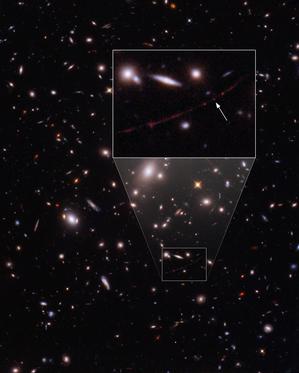
A gravitational lens magnifies one of the first stars
Caption: This image zooms in on a star formed within the first billion years after the birth of the Universe (at a redshift of 6.2). The Hubble Space Telescope detected this light using a technique called gravitational lensing. A massive galaxy cluster between the observer and the imaged star creates a distorted and warped image of the parent galaxy and reveals its features.
Credit: NASA, ESA, B. Welch (JHU), D. Coe (STScI), A. Pagan (STScI)
credit link
License: CC-BY-4.0 Creative Commons 저작자표시 4.0 국제 (CC BY 4.0) icons
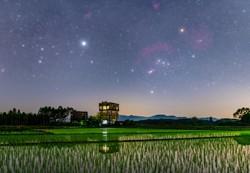
Watchtower and Paddy Fields Under the Starry Sky
Caption: Winner in the 2022 IAU OAE Astrophotography Contest, category Still images of celestial patterns.
This image, taken in April 2022, shows the sky over a plantation field around a century-old watchtower guarding a village in the province of Guangdong, China. Throughout the ages, the sky has been used as a tool for navigation and also as a calendar. By watching the apparent movement of the stars, it is possible to follow the passing of time, thereby understanding the change of the seasons which in turn helps to plan out the best timings of agricultural work.
The most prominent constellations in this image are Orion and Canis Major, the Great Dog. Commonly associated with a giant hunter in Greek mythology, Orion is followed by his hound in the shape of the constellation Canis Major.
In China, the seven bright stars of the constellation Orion are paradoxically called Three Stars (Shen) and this is one of the 28 Lunar Mansions. The Babylonian pre-zodiac, the so-called “Path of the Moon”, had 17 constellations and included Orion (therein named “True Shepherd of the Heavens”). This is not really surprising because, even in the system of the 88 modern constellations, the Moon sometimes stands in the constellation Orion. The modern constellation boundaries were defined in the 1920s in such a way that the area of Orion ends a half degree south of the ecliptic, in order to avoid the Sun entering it. Still, the Moon and the planets do occasionally. Therefore, Orion is part of the Zodiac (a stripe 5 to 10 degrees around the ecliptic), part of the path of the Moon and, of course, also used by many cultural calendars all over the world.
Sirius, the bright star in the left half of the photograph, is the brightest star in the night sky, and has been used by many indigenous cultures to determine their calendars; the Egyptians awaited the Nile flood with Sirius’s heliacal rise, while the Romans connected its reappearance after its invisibility in daylight with the hottest summer time. In Old China, Sirius was considered a single-star asterism called The Wolf. The adjacent area was called The Market for Soldiers and the area in the southern part of Canis Major was imagined as the Bow with an Arrow.
The reddish bright star in the top right corner is Betelgeuse, a red supergiant and one of the largest stars that can be seen with the naked eye. Orion’s Great Nebula below Orion’s Belt should be mentioned, but also the fainter huge red arc that is called Barnard’s Loop is clearly shown in this photograph. This galactic nebula and the circular red nebula around Orion’s not-so-bright head are both parts of star-forming regions, while the red nebula to the upper left of Orion is the Rosette Nebula in the unrecognisable constellation of Monoceros.
Credit: Likai Lin/IAU OAE
License: CC-BY-4.0 Creative Commons 저작자표시 4.0 국제 (CC BY 4.0) icons
Related Activities
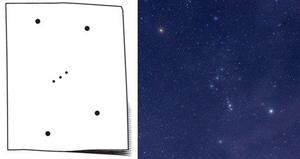
What is a Constellation?
astroEDU educational activity (links to astroEDU website) Description: Investigate three dimensional objects and perspective using constellations
License: CC-BY-4.0 Creative Commons 저작자표시 4.0 국제 (CC BY 4.0) icons
Tags:
Hands-on
Age Ranges:
6-8
, 8-10
Education Level:
Primary
Areas of Learning:
Modelling
, Structured-inquiry learning
Costs:
Medium Cost
Duration:
1 hour 30 mins
Group Size:
Group
Skills:
Analysing and interpreting data
, Asking questions
, Constructing explanations
, Developing and using models
Star in a Box: Advanced
astroEDU educational activity (links to astroEDU website) Description: Explore the life-cycle of stars with Star in a Box activity.
License: CC-BY-4.0 Creative Commons 저작자표시 4.0 국제 (CC BY 4.0) icons
Tags:
Hands-on
, Interactive
, Software
Age Ranges:
10-12
, 12-14
, 14-16
, 16-19
Education Level:
Middle School
Areas of Learning:
Technology-based
Costs:
Low Cost
Group Size:
Group
Skills:
Communicating information
, Constructing explanations
Star in a Box: High School
astroEDU educational activity (links to astroEDU website) Description: Explore the life-cycle of stars with Star in a Box activity.
License: CC-BY-4.0 Creative Commons 저작자표시 4.0 국제 (CC BY 4.0) icons
Tags:
Hands-on
, Interactive
, Software
Age Ranges:
10-12
, 12-14
, 14-16
, 16-19
Education Level:
Middle School
Areas of Learning:
Technology-based
Costs:
Low Cost
Group Size:
Group
Skills:
Communicating information
, Constructing explanations
Star Hats
astroEDU educational activity (links to astroEDU website) Description: Make your star hat, learning about the stars
License: CC-BY-4.0 Creative Commons 저작자표시 4.0 국제 (CC BY 4.0) icons
Tags:
Art
, Creativity
, Hands-on
Age Ranges:
4-6
Education Level:
Pre-school
Areas of Learning:
Fine Art focussed
, Interactive Lecture
Costs:
Low Cost
Duration:
30 mins
Group Size:
Individual
Skills:
Asking questions
, Communicating information
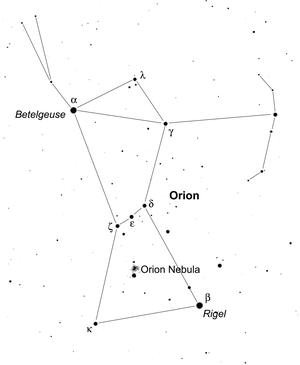
How Light Pollution Affects the Stars: Magnitude Readers
astroEDU educational activity (links to astroEDU website) Description: Build a Magnitude Reader to explore the magnitude of stars.
License: CC-BY-4.0 Creative Commons 저작자표시 4.0 국제 (CC BY 4.0) icons
Tags:
Hands-on
, Dark skies
, ecology
Age Ranges:
10-12
, 12-14
, 14-16
, 16-19
Education Level:
Middle School
Areas of Learning:
Modelling
, Observation based
Costs:
Medium Cost
Duration:
1 hour
Group Size:
Group
Skills:
Asking questions
, Planning and carrying out investigations