Glossary term: 북극성
Description: 북극성은 천구의 북극에 가장 가까이(1도 이내) 위치한 밝은 별입니다. 공식 명칭은 작은곰자리 알파성이지만, 북극성으로 더 잘 알려져 있습니다. 북반구의 모든 별이 북극성 주위로 회전하는 것처럼 보이기 때문에 항법이나 천체관측과 관련한 측정에서 고정 기준점으로서 중요한 역할을 합니다. 또한 지평선으로부터의 북극성의 고도를 알면 관측 지점의 대략적인 위도를 알 수 있습니다. 그러나 천구 상에서 북극성의 위치는 지구 자전축의 세차운동으로 인해 서서히 변하고 있으므로 몇 세기 후에는 북극성이 그 이름의 본래 의미와는 달리 더 이상 천구의 북극에 위치해 있지 않을 것입니다.
북극성은 세 개의 별로 이루어진 삼중성계인데, 주성인 폴라리스 Aa는 황색의 초거성으로서 그보다 작은 동반성인 주계열성 폴라리스 Ab에 매우 가까운 궤도(공전주기는 약 29.3년)에서 돌지만, 또다른 동반성인 주계열성 폴라리스 B는 이 두 별의 쌍으로부터 2400천문단위의 거리에 있는 아주 먼 궤도를 돌고 있습니다. 폴라리스 B는 작은 망원경으로도 구분해서 볼 수 있지만, 허블 우주 망원경에 의해서야 비로소 북극성 삼중성계의 세 구성원을 모두 구분해서 볼 수 있었습니다. 북극성의 겉보기 안시등급은 시간에 따라 변동하는데, 주성인 폴라리스 Aa가 세페이드변광성이기 때문입니다. 북극성 삼중성계는 지구에서 약 447광년 떨어져 있습니다.
Term and definition status: The original definition of this term in English have been approved by a research astronomer and a teacher The translation of this term and its definition is still awaiting approval
The OAE Multilingual Glossary is a project of the IAU Office of Astronomy for Education (OAE) in collaboration with the IAU Office of Astronomy Outreach (OAO). The terms and definitions were chosen, written and reviewed by a collective effort from the OAE, the OAE Centers and Nodes, the OAE National Astronomy Education Coordinators (NAECs) and other volunteers. You can find a full list of credits here. All glossary terms and their definitions are released under a Creative Commons CC BY-4.0 license and should be credited to "IAU OAE".
If you notice a factual or translation error in this glossary term or definition then please get in touch.
In Other Languages
- 아랍어: النجم القطبي
- 독일어: Polarstern
- 영어: Polaris
- 스페인어: Polaris
- 프랑스어: Polaris
- 이탈리아어: Polaris
- 일본어: 北極星 (external link)
- 브라질 포르투갈어: Polaris
- 중국어 간체: 北极星
- 중국어 번체: 北極星
Related Media

Dreamlike Starry Sky and Airglow
Caption: Winner in the 2022 IAU OAE Astrophotography Contest, category Still images of celestial patterns.
This spectacular image shows a range of prominent constellations visible in the night sky over the desert of inner Mongolia, taken in August 2019. The yellowish star in the bottom left side is Arcturus, one of the brightest stars in the night sky, and the brightest in the constellation Boötes. The handle of the Big Dipper points towards this bright star and the Dipper is also visible above Boötes. The Northern Dipper (Bei Dou) is a traditional Chinese constellation. It is considered a chariot in which the Judges for Nobility are sitting. Arcturus is considered a single-star asterism, named the Horn, which forms part of the Chinese super-constellation for the spring, the Azure Dragon of the East. The front of the Northern Dipper points towards the star at the top of the photograph which is now called Polaris, the northern Pole Star. In ancient China, there was no bright star at the pole, so the stars in the nearest vicinity of the pole were considered to belong to the emperor and his family in the constellation the Purple Forbidden Palace. At least as early as mediaeval times, Polaris was considered part of the constellation of the Great Emperor of Heaven.
Corona Borealis is also visible in the top right corner of this image, although not in its completeness. It is called the Coiled Thong in China. With its characteristic semi-circular shape, this is one of the smaller constellations of the 88 modern ones, but also can be traced back at least three or four millennia through the Roman “Crown”, the Greek wedding “Wreath”, and the Babylonian “Asterism of Dignity”. The modern name literally means “Northern Crown” in Latin.
At the upper-right edge of the image, we find the part of the modern constellation Cassiopeia that is considered the Flying Corridor and an Auxiliary Road in ancient China. The W-shape of Cassiopeia is cut off by the edge of the photograph but the constellations to its south and southeast, Andromeda and Perseus, are clearly recognisable. Prominently we see the Andromeda galaxy, the most distant object that is visible to the unaided eye. It is located at the outermost outliers of the band of the Milky Way, which could explain why it has not been mentioned explicitly in ancient star catalogues, as it was mistakenly thought to be part of the Milky Way. The photograph also shows clearly reddish parts of the Milky Way that don’t appear bright to the naked eye, and also open clusters that are formed from the same molecular cloud, i.e., groups of stars with similar ages. This region is part of many big and small asterisms in traditional Chinese uranology.
Credit: Likai Lin/IAU OAE
License: CC-BY-4.0 Creative Commons 저작자표시 4.0 국제 (CC BY 4.0) icons
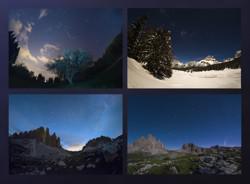
Big Dipper in Four Seasons
Caption: Winner in the 2022 IAU OAE Astrophotography Contest, category Still images of celestial patterns.
As Earth moves around the Sun, the positions of the stars in the night sky appear to change over the course of the year. This is well exemplified in this mosaic, with images taken in all four seasons throughout 2020 in the region of Veneto, Italy, showing the apparent motion of the Ursa Minor and Ursa Major constellations.
Ursa Minor, the Little Bear, is a constellation of the northern hemisphere, and it contains the northern celestial pole, in our current epoch marked by a bright star called Polaris or the Pole Star. For centuries Polaris has been used for navigation in the northern hemisphere, as it has been almost at the exact pole position for roughly 200 years. In the Middle Ages and antiquity, there was no pole star; the celestial north pole lay in a dark region and the Greeks considered the “Little She-Bear” as a companion of the “Great She-Bear”, which is more easily recognizable. The brightest stars of these constellations were alternatively also considered as chariots by the Greeks, as written in Aratus’s famous didactic poem from the 3rd century before the common era. The most famous asterism in Ursa Major, composed of seven stars, has different names across the (northern) world. While considered as a chariot by the Greeks, it is “The Northern Dipper” in China, and “The Seven Oxen” for the ancient Romans.
It was also the navigational purpose that led to the name The Great She-Bear, Ursa Major; for the Greeks, travelling towards the direction of the horizon above which Ursa Major appears meant moving towards the land of the bears (northern Europe). An animal is clearly recognizable when taking into account all the fainter stars in the vicinity of the seven bright ones. They considered it a female bear because Greek mythology connects this animal with the nymph Callisto, whose story describes the initiation rituals for women.
In the top left, we see an image taken on a spring evening, while the image below shows the same portion of the sky on a summer evening. Going counterclockwise, we see the sky during autumn in the bottom right image, while the top right finally shows this portion of the sky in the winter. Note that the relative positions of Ursa Minor and the Big Dipper don’t change, but all stars appear to be moved in a circle around Polaris. This star pointing due north lies at the point where Earth’s rotational axis intersects the celestial sphere.
The shift of constellations throughout the year is therefore a globe-clock or a globe-calendar, used by ancient civilizations to measure the year, and to predict the changes of seasons. It helps to establish, for instance, the best time for sowing and sailing as winds change with the seasons.
Credit: Giorgia Hofer/IAU OAE
License: CC-BY-4.0 Creative Commons 저작자표시 4.0 국제 (CC BY 4.0) icons

Big Dipper and Comet Neowise C2020 F3
Caption: Honorable mention in the 2023 IAU OAE Astrophotography Contest, category of Time-lapses of rotation of Big Dipper or Southern Cross.
This time-lapse documents the trajectory of the iconic Big Dipper across three frames taken in July 2020. Captured from three locations in Italy, Tre Cime di Lavaredo Auronzo di Cadore, Monte Rite, Cibiana di Cadore, and Casera Razzo, Vigo di Cadore, this visual odyssey showcases the captivating journey of the Big Dipper with the addition of trails of stars painting a celestial canvas. It not only traces the path of this renowned asterism but also features the rare appearance of comet Neowise C/2020 F3, an extraordinary event that graced our skies during July 2020.
Credit: Giorgia Hofer/IAU OAE (CC BY 4.0)
License: CC-BY-4.0 Creative Commons 저작자표시 4.0 국제 (CC BY 4.0) icons
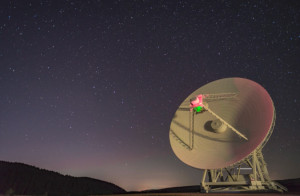
The Big Dipper with the Sardinia Radio Telescope SRT
Caption: Honorable mention in the 2023 IAU OAE Astrophotography Contest, category of Time-lapses of rotation of Big Dipper or Southern Cross.
This time-lapse captures the movement of the stars alongside the majestic 64-metre Sardinia Radio Telescope (SRT) from the National Institute of Astrophysics (INAF), with special attention to the renowned Big Dipper against the backdrop of the celestial sphere. The camera pans as the famous asterism sinks in the sky while planes fly past and the radio telescope rotates. The harmonious interplay between the stellar pathways and the colossal dish of the radio telescope creates a mesmerising visual ode to the cosmic ballet taken in September 2019.
Credit: Antonio Finazzi/IAU OAE (CC BY 4.0)
License: CC-BY-4.0 Creative Commons 저작자표시 4.0 국제 (CC BY 4.0) icons

Big Dipper Over the Mono Lake
Caption: Honorable mention in the 2023 IAU OAE Astrophotography Contest, category of Time-lapses of rotation of Big Dipper or Southern Cross.
The Big Dipper asterism gracefully moves above the otherworldly tufa formations of Mono Lake, California. The time-lapse captures the Big Dipper’s movement across the northern horizon until its inferior conjunction. At Mono Lake’s latitude (+38°), the stars of the Big Dipper remain circumpolar, except for Alkaid. The North Star sits 38° above the horizon, just outside the field of view in the top right. The lunar illumination bathes the landscape in a soft glow, gradually fading as the Moon sets, cloaking the scene in darkness.
Credit: Fabrizio Melandri/IAU OAE (CC BY 4.0)
License: CC-BY-4.0 Creative Commons 저작자표시 4.0 국제 (CC BY 4.0) icons
Related Diagrams
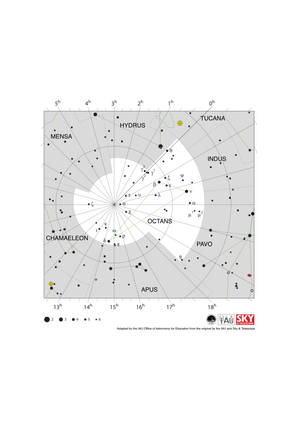
Octans Constellation Map
Caption: The constellation Octans along with its bright stars and its surrounding constellations. Octans is surrounded by (going clockwise from the top): Hydrus, Indus, Pavo, Apus, Chameleon and Mensa. Octans is a relatively faint constellation that is notable as it lies at the south celestial pole. While the northern pole star is the relatively bright Polaris, sigma Octans, the southern pole star, is barely visible with the naked eye.
Octans lies at the south celestial pole and is thus visible from the whole southern hemisphere with some of the constellation visible from equatorial regions of the northern hemisphere. The constellation is circumpolar for most of the southern hemisphere. It is best viewed in the evening in the northern hemisphere autumn and southern hemisphere spring.
This diagram maps an area around the south celestial pole. Here lines of constant right ascension converge. The right ascension values of these lines (in hours) are marked on the x-axis above and below the diagram. The solid circle around the pole marks a line of -80° declination with the larger, incomplete circle to the right marking -70° declination. The sizes of the stars marked here relate to the star's apparent magnitude, a measure of its apparent brightness. The larger dots represent brighter stars. The Greek letters mark the brightest stars in the constellation. These are ranked by brightness with the brightest star being labeled alpha, the second brightest beta, etc., although this ordering is not always followed exactly. The dotted boundary lines mark the IAU's boundaries of the constellations and the solid green lines mark one of the common forms used to represent the figures of the constellations. Neither the constellation boundaries, nor the lines joining the stars appear on the sky.
Credit: Adapted by the IAU Office of Astronomy for Education from the original by IAU/Sky & Telescope
License: CC-BY-4.0 Creative Commons 저작자표시 4.0 국제 (CC BY 4.0) icons
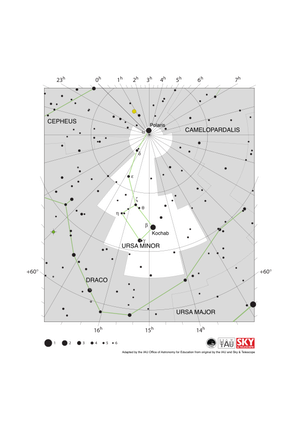
Ursa Minor Constellation Map
Caption: The constellation Ursa Minor along with its bright stars and its surrounding constellations. Ursa Minor is surrounded by (going clockwise from the top): Cephus, Camelopardalis and Draco. Ursa Minor is notable as its brightest star, Polaris is the northern pole star.
Ursa Minor is visible from the entire northern hemisphere with some parts of the constellation being visible from equatorial regions of the southern hemisphere. It is also circumpolar for temperate and arctic regions of the northern hemisphere. Polaris, lying very close the north celestial pole is circumpolar for the whole of the northern hemisphere. The constellation is most visible in the evenings in the northern hemisphere summer and southern hemisphere winter.
This diagram maps an area around the north celestial pole. Here lines of constant right ascension converge. The right ascension values (in hours) of these lines are marked on the x-axis above and below the diagram. Some of the lines of constant declination (in degrees) are marked on the y-axis. The sizes of the stars marked here relate to the star's apparent magnitude, a measure of its apparent brightness. The larger dots represent brighter stars. The Greek letters mark the brightest stars in the constellation. These are ranked by brightness with the brightest star being labeled alpha, the second brightest beta, etc., although this ordering is not always followed exactly. The dotted boundary lines mark the IAU's boundaries of the constellations and the solid green lines mark one of the common forms used to represent the figures of the constellations. Neither the constellation boundaries, nor the lines joining the stars appear on the sky.
Credit: Adapted by the IAU Office of Astronomy for Education from the original by IAU/Sky & Telescope
License: CC-BY-4.0 Creative Commons 저작자표시 4.0 국제 (CC BY 4.0) icons
Related Activities

Navigating with the Kamal – Northern Hemisphere
astroEDU educational activity (links to astroEDU website) Description: How did Arabian sailors navigate at sea?
License: CC-BY-4.0 Creative Commons 저작자표시 4.0 국제 (CC BY 4.0) icons
Tags:
History
, Geography
, Coordinates
, Celestial navigation
, Arabia
, Kamal
Age Ranges:
14-16
, 16-19
Education Level:
Middle School
, Secondary
Areas of Learning:
Modelling
, Structured-inquiry learning
Costs:
Low Cost
Duration:
1 hour 30 mins
Group Size:
Group
Skills:
Analysing and interpreting data
, Asking questions
, Communicating information
, Developing and using models
, Planning and carrying out investigations