This page describes an image Scoperto un sistema binario di nane brune
Scarica File ( immagine 1.98 MB)
Didascalia:
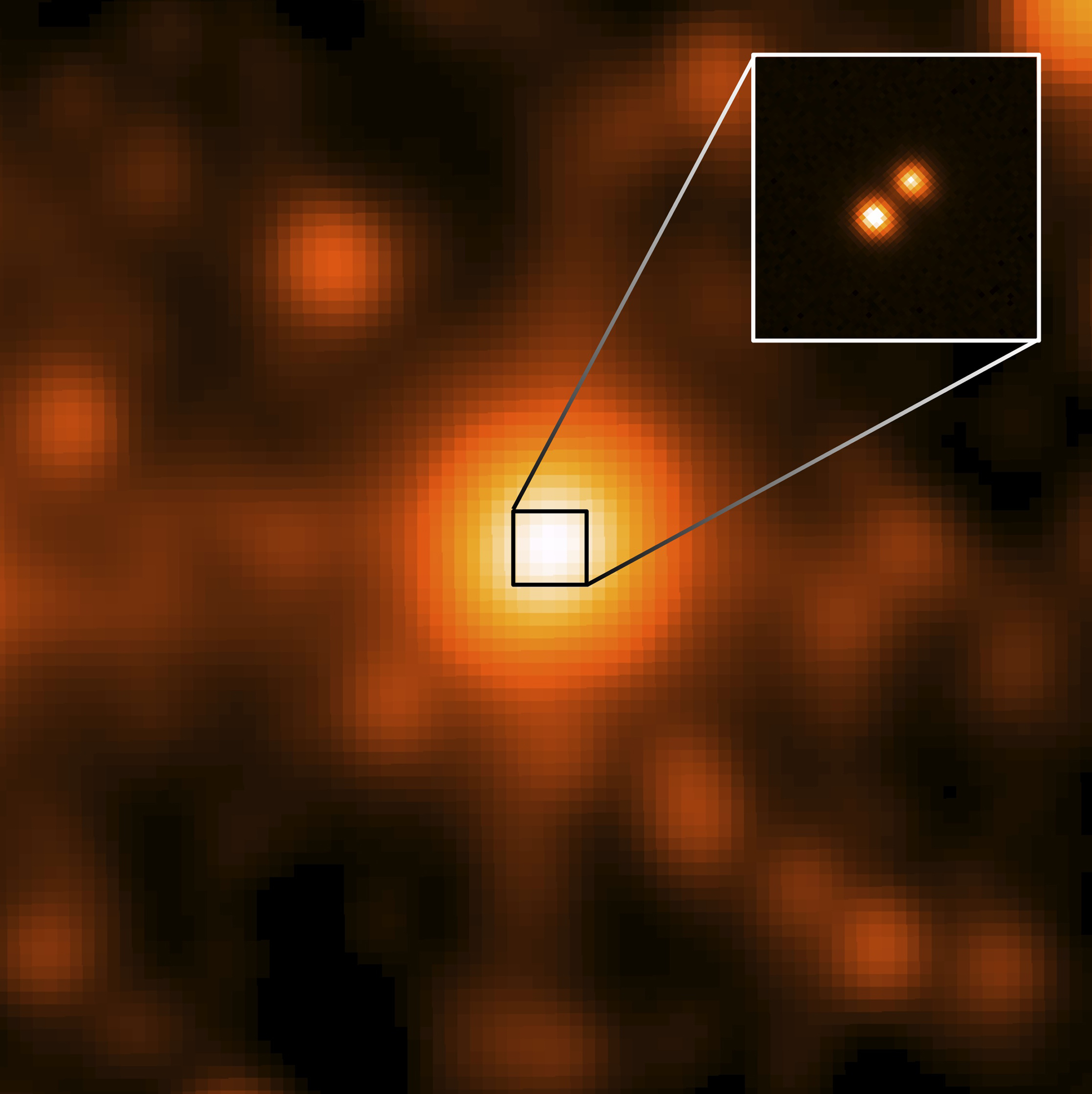
Questa immagine mostra un sistema vicino di nane brune, oggetti che per massa si collocano a metà strada tra i pianeti e le stelle e che non mantengono una fusione nucleare a lungo termine nei loro nuclei. Situato a circa 6,5 anni luce dalla Terra, questo sistema (noto come Luhman 16) è il terzo sistema più vicino al Sistema Solare dopo il sistema di Alpha Centauri e la Stella di Barnard. Inizialmente è stato osservato come quella che sembrava essere una singola e debole fonte di luce infrarossa. Le nane brune sono spesso difficili da studiare a causa della loro scarsa luminosità, specialmente nella luce visibile. Tuttavia, brillano di più nella luce infrarossa grazie alle loro temperature effettive più fredde.
Il confronto evidenzia l'importanza della risoluzione osservativa. L'immagine al centro, scattata dal Wide-field Infrared Survey Explorer (WISE) della NASA, mostra il sistema come un unico oggetto sfocato a causa della sua risoluzione inferiore (WISE ha una risoluzione di circa 6 secondi d'arco). Una vista ingrandita e evidenziata dall'Osservatorio Gemini Sud in Cile rivela che questa "singola" sorgente è in realtà un sistema binario di due nane brune. La risoluzione angolare migliorata (circa 0,6 secondi d'arco) permette agli astronomi di separare chiaramente i due oggetti, dimostrando come le osservazioni ad alta risoluzione rivelino strutture nascoste nell'universo. Sebbene il telescopio Gemini sia situato sulla Terra e sia quindi soggetto agli effetti di sfocatura dell'atmosfera terrestre, ha uno specchio sostanzialmente più grande rispetto al telescopio WISE (8 metri di diametro contro 40 centimetri), il che significa che può raggiungere risoluzioni molto più elevate.
Didascalie in altre lingue
Crediti per l'immagine:
NASA/JPL/Osservatorio Gemini/AURA/NSF Link per i Crediti
Stato di traduzione della didascalia: Non ancora approvato da un revisore
Traduttori della didascalia: Giuliana Giobbi
Termini di glossario connessi:
Nana bruna
, Risoluzione
, Risoluzione angolare
, Stella binaria
Licenza per l'immagine: Dominio Pubblico Dominio Pubblico icone
Le didascalie di file multimediali presentate sul sito web OAE sono state scritte,Tradotte e riviste tramit Sun impegno collettivo dell'OAE, dei Centri e Nodi OAE, iCoordinatori Nazionali per la Didattica dell'Astronomia e altri volontari. Trovatel'elenco completo dei crediti per il nostro progetto di traduzione. Tutte le didascaliedei file multimediali sono pubblicate sotto Creative Commons CC BY-4.0 licenza di traduzione, e dovrebbero essereaccreditate all'IAU OAE.I file multimediali stessi possono avere licenze diverse (vedi sopra) eDovrebbero essere accreditate come specificato al paragrafo "crediti"
Se noti un errore di fatto in questa didascalia o un errore in una delle sue traduzioni, per favore contattaci.
Didascalie in lingue diverse:
Didascalia: Dieses Bild zeigt ein nahes System aus Braunen Zwergen – Objekte, deren Masse zwischen der von Planeten und Sternen liegt und in deren Kernen keine langfristige Kernfusion stattfindet. Dieses System (bekannt als Luhman 16) befindet sich etwa 6,5 Lichtjahre von der Erde entfernt und ist nach dem Alpha-Centauri-System und Barnards Stern das drittnächstgelegene System zum Sonnensystem. Es wurde zunächst als eine scheinbar einzelne, schwache Infrarotstrahlungsquelle beobachtet. Braune Zwerge sind aufgrund ihrer geringen Helligkeit oft schwer zu untersuchen, insbesondere im sichtbaren Licht. Im Infrarotlicht leuchten sie jedoch aufgrund ihrer niedrigeren effektiven Temperaturen heller.
Der Vergleich verdeutlicht die Bedeutung der Auflösung einer Aufnahme. Das mittlere Bild, aufgenommen vom Wide-field Infrared Survey Explorer (WISE) der NASA, zeigt das System aufgrund seiner geringeren Auflösung (WISE hat eine Auflösung von etwa 6 Bogensekunden) als ein einziges verschwommenes Objekt. Die hervorgehobene, vergrößerte Ansicht vom Gemini-South-Observatorium in Chile zeigt, dass es sich bei dieser „einzigen“ Quelle tatsächlich um ein Doppelsternsystem aus zwei Braunen Zwergen handelt. Die verbesserte Winkelauflösung (etwa 0,6 Bogensekunden) ermöglicht es Astronomen, die beiden Objekte klar voneinander zu unterscheiden und verdeutlicht, wie Beobachtungen mit höherer Auflösung verborgene Strukturen im Universum aufdecken. Das Gemini-Teleskop befindet sich zwar auf der Erde und unterliegt daher den Unschärfeeffekten der Erdatmosphäre, verfügt jedoch über einen wesentlich größeren Spiegel als das WISE-Teleskop (8 m Durchmesser gegenüber 40 cm), wodurch es deutlich höhere Auflösungen erzielen kann.
Crediti per l'immagine: NASA/JPL/Gemini-Observatorium/AURA/NSF
Termini di glossario connessi: Auflösung , Auflösungsvermögen , Brauner Zwerg , Doppelsternsystem Stato di traduzione della didascalia: Non ancora approvato da un revisore
Traduttori della didascalia: Simon Kraus
Didascalia: This image presents a nearby system of brown dwarfs, objects that fall between planets and stars in mass and do not sustain long-term nuclear fusion in their cores. Located about 6.5 light-years from Earth, this system (known as Luhman 16) is the third closest system to the Solar System after the Alpha Centauri system and Barnard's Star. It was initially observed as what seemed to be a single faint source of infrared light. Brown dwarfs are often difficult to study because of their low brightness, especially in visible light. However they shine brighter in infrared light due to their cooler effective temperatures.
The comparison highlights the importance of observational resolution. The image at the center, taken by NASA’s Wide-field Infrared Survey Explorer (WISE), shows the system as a single blurred object due to its lower resolution (WISE has a resolution of roughly 6 arcseconds). A highlighted zoomed-in view from the Gemini South Observatory in Chile reveals that this “single” source is actually a binary system of two brown dwarfs. The improved angular resolution (roughly 0.6 arcseconds) allows astronomers to separate the two objects clearly, demonstrating how higher-resolution observations uncover hidden structures in the universe. While the Gemini telescope is situated on the Earth and thus is affected by the blurring effects of the Earth's atmosphere, it has a substantially larger mirror than the WISE telescope (8m wide vs. 40cm wide) meaning it can achieve much higher resolutions.
Crediti per l'immagine: NASA/JPL/Gemini Observatory/AURA/NSF
Termini di glossario connessi: Angular Resolution , Binary Star , Brown Dwarf , Resolution