This page describes an image The Classical Nova GK Persei
Télécharger le fichier ( image 5.84 MB)
Légende d'image :
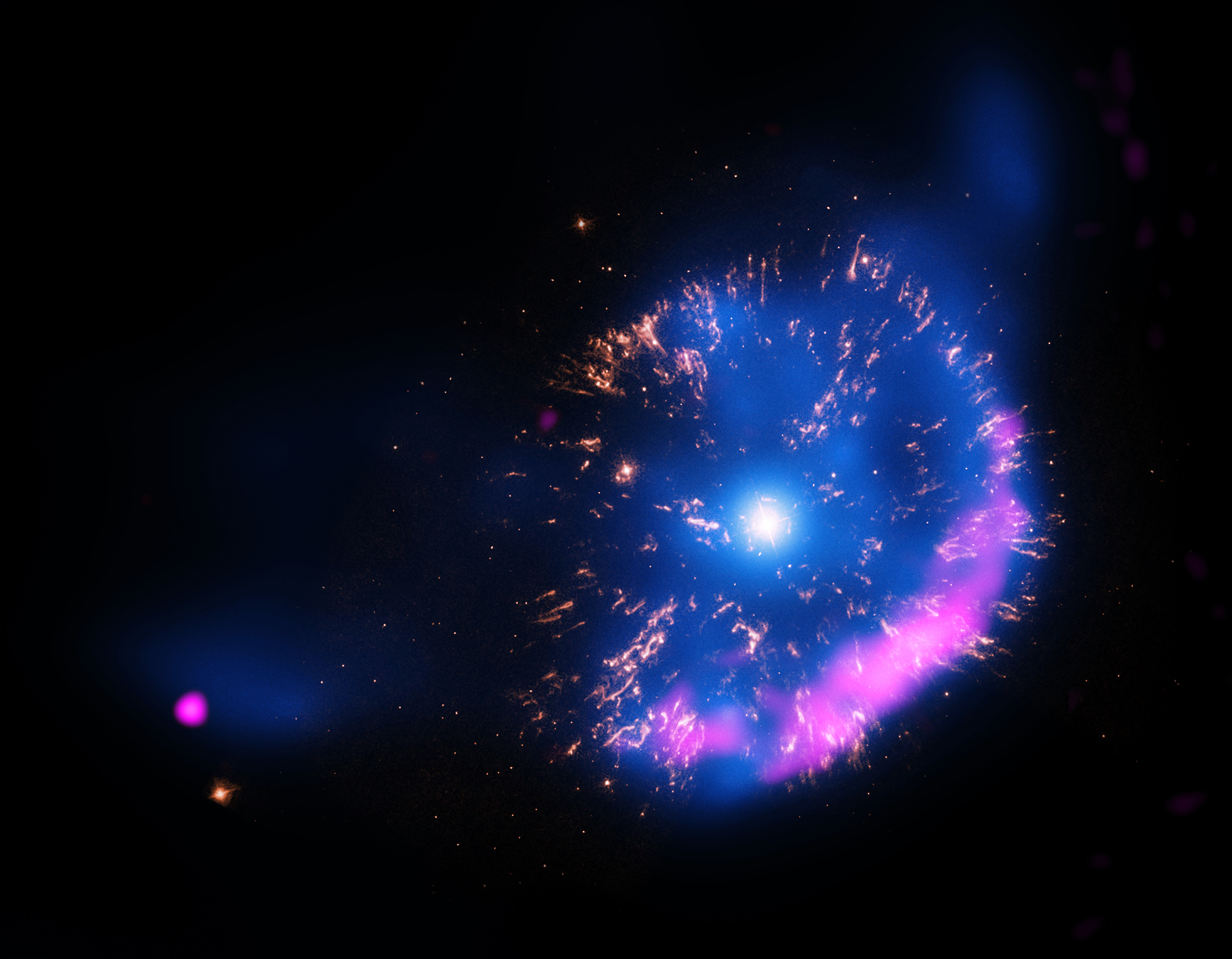
This composite image shows the aftermath of a stellar explosion known as a nova, specifically the remnant of a classical nova called GK Persei. A nova occurs when a very dense star called a white dwarf pulls hydrogen-rich gas from a companion star in a binary system until the accumulated material ignites in a powerful thermonuclear explosion. This sudden release of energy sweeps material outward and produces bright X-ray, optical, and radio emission that can be studied long after the blast.
GK Persei was for a very short time in 1901 one of the brightest stars in the sky. Classical novae like GK Persei temporarily brighten dramatically — sometimes to thousands of times their usual luminosity — before fading over months or years as the expanding shell moves through space. In this image taken over 100 years since the nova's 1901 brightening, X-rays (shown in blue) reveal very hot gas left behind by the explosion, optical data (yellow) show clumps of matter ejected from the star’s surface, and radio information (pink) highlights high-energy electrons energized by the expanding nova shock wave. Studying novae helps scientists learn about how stars interact in binary systems and how powerful bursts of energy shape the material around them.
The nature of the pink blob in the lower left is not known.
Faire défiler pour afficher les légendes dans d'autres langues
Crédits pour l'image : X-ray: NASA/CXC/RIKEN/D.Takei et al; Optical: NASA/STScI; Radio: NRAO/VLA Lien du crédit
Termes du glossaire en rapport :
Nova
Catégories :
Étoiles
Licence de l'image : Domaine Public Domaine Public Icônes
Les légendes des fichiers média présents sur le site de l'OAE ont été écrites, traduites et relues grâce à un effort collectif de l'OAE, les Centres et les Noeuds de l'OAE, les Coordinateurs Nationaux de l'Astronomie pour l'Education de l'OAE(NAECs) et d'autres volontaires. La liste complète des crédits pour ce projet est disponible ici . Toutes les légendes des fichiers média sont déposés sous licence Creative Commons CC BY-4.0 et doivent être créditées au nom de "IAU OAE". Les fichiers média eux-mêmes peuvent avoir des licences différentes (voir plus haut) et et doivent être crédités comme indiqué ci-dessus sous le terme "credit".
Si vous constatez une erreur dans cette légende ou dans un de ses traductions, veuillez nous contacter veuillez nous contacter.
Légendes proposées dans différentes langues :
Légende d'image : Dieses zusammengesetzte Bild zeigt die Folgen einer als Nova bezeichneten Sternexplosion, genauer gesagt den Überrest einer klassischen Nova namens GK Persei. Eine Nova entsteht, wenn ein sehr dichter Stern, ein sogenannter Weißer Zwerg, wasserstoffreiches Gas von einem Begleitstern in einem Doppelsternsystem ansaugt, bis sich das angesammelte Material in einer gewaltigen thermonuklearen Explosion entzündet. Diese plötzliche Freisetzung von Energie schleudert Material nach außen und erzeugt helle Röntgen-, optische und Radioemissionen, die noch lange nach der Explosion untersucht werden können.
GK Persei war 1901 für eine sehr kurze Zeit einer der hellsten Sterne am Himmel. Klassische Novae wie GK Persei hellen sich vorübergehend dramatisch auf – manchmal auf das Tausendfache ihrer üblichen Leuchtkraft –, bevor sie über Monate oder Jahre hinweg wieder verblassen, während sich die expandierende Hülle durch den Weltraum bewegt. Auf diesem Bild, das über 100 Jahre nach dem Aufhellen der Nova im Jahr 1901 aufgenommen wurde, zeigen Röntgenstrahlen (blau dargestellt) sehr heißes Gas, das von der Explosion zurückgelassen wurde, optische Daten (gelb) zeigen Materieklumpen, die von der Sternoberfläche ausgestoßen wurden, und Radiodaten (rosa) heben hochenergetische Elektronen hervor, die durch die sich ausbreitende Nova-Schockwelle angeregt wurden. Die Erforschung von Novae hilft Wissenschaftlern zu verstehen, wie Sterne in Doppelsternsystemen interagieren und wie gewaltige Energiestöße die Materie um sie herum formen.
Die Natur des rosa Flecks unten links ist unbekannt.
Crédits pour l'image : Röntgen: NASA/CXC/RIKEN/D. Takei et al.; Optisch: NASA/STScI; Radio: NRAO/VLA
Termes du glossaire en rapport : Nova Statuts de la traduction de la légende: Pas encore approuvé par un·e relecteur(rice)
Traducteurs de la légende: Simon Kraus
Légende d'image : This composite image shows the aftermath of a stellar explosion known as a nova, specifically the remnant of a classical nova called GK Persei. A nova occurs when a very dense star called a white dwarf pulls hydrogen-rich gas from a companion star in a binary system until the accumulated material ignites in a powerful thermonuclear explosion. This sudden release of energy sweeps material outward and produces bright X-ray, optical, and radio emission that can be studied long after the blast.
GK Persei was for a very short time in 1901 one of the brightest stars in the sky. Classical novae like GK Persei temporarily brighten dramatically — sometimes to thousands of times their usual luminosity — before fading over months or years as the expanding shell moves through space. In this image taken over 100 years since the nova's 1901 brightening, X-rays (shown in blue) reveal very hot gas left behind by the explosion, optical data (yellow) show clumps of matter ejected from the star’s surface, and radio information (pink) highlights high-energy electrons energized by the expanding nova shock wave. Studying novae helps scientists learn about how stars interact in binary systems and how powerful bursts of energy shape the material around them.
The nature of the pink blob in the lower left is not known.
Crédits pour l'image : X-ray: NASA/CXC/RIKEN/D.Takei et al; Optical: NASA/STScI; Radio: NRAO/VLA
Termes du glossaire en rapport : Nova
Légende d'image : Questa immagine composita mostra le conseguenze di un'esplosione stellare nota come nova, in particolare il residuo di una nova classica denominata GK Persei. Una nova si verifica quando una stella molto densa, chiamata nana bianca, attira gas ricco di idrogeno da una stella compagna in un sistema binario, fino a quando il materiale accumulato non si infiamma in una potente esplosione termonucleare. Questo improvviso rilascio di energia spinge il materiale verso l’esterno e produce intense emissioni di raggi X, ottiche e radio che possono essere studiate anche molto tempo dopo l’esplosione.
Nel 1901, per un brevissimo periodo, GK Persei fu una delle stelle più luminose del cielo. Le novae classiche come GK Persei aumentano temporaneamente di luminosità in modo spettacolare — a volte fino a migliaia di volte la loro luminosità abituale — prima di affievolirsi nel corso di mesi o anni, man mano che il guscio in espansione si muove nello spazio. In questa immagine scattata a oltre 100 anni dall’illuminarsi della nova nel 1901, i raggi X (in blu) rivelano il gas molto caldo lasciato dall’esplosione, i dati ottici (in giallo) mostrano agglomerati di materia espulsi dalla superficie della stella e le informazioni radio (in rosa) evidenziano gli elettroni ad alta energia accelerati dall’onda d’urto della nova in espansione. Lo studio delle novae aiuta gli scienziati a comprendere come le stelle interagiscono nei sistemi binari e come potenti esplosioni di energia modellano il materiale che le circonda.
La natura della macchia rosa in basso a sinistra non è nota.
Crédits pour l'image : Raggi X: NASA/CXC/RIKEN/D. Takei et al.; Ottico: NASA/STScI; Radio: NRAO/VLA
Termes du glossaire en rapport : Nova Statuts de la traduction de la légende: Pas encore approuvé par un·e relecteur(rice)
Traducteurs de la légende: Giuliana Giobbi








- Ressources
- Moteur de recherche des ressources pédagogiques
- Parcourir les ressources pédagogiques par Sujet
- Parcourir les images
- AstroEdu - Activités en classe
- Grandes Idées - Littéracie en astronomie
- Glossaire
- Rapports de l'OAE
- L'astronomie pour l'Education à travers le monde
- Sélection de ressources externes