Término del glosario: Color
Descripción: El color de un objeto astronómico puede aportar información importante sobre sus propiedades físicas. Incluso a simple vista, una estrella que se ve azulada en el cielo, como Alkaid, situada al final del «mango» de la Osa Mayor, será considerablemente más caliente que una estrella rojiza, como Betelgeuse, situada en el hombro de Orión. Para cuantificar el color, los astrónomos suelen determinar el brillo de una estrella cuando se observa a través de uno de los diversos filtros azules especializados disponibles y lo comparan con el brillo que se observa a través de un filtro rojo. Se utilizan varias definiciones de color distintas de este tipo, que comparan el brillo en distintos filtros específicos. Los resultados pueden utilizarse en análisis estadísticos. Un ejemplo son los diagramas de color-magnitud, en los que se representa gráficamente el color de un objeto en función de su brillo.
Términos relacionados:
Ver este término en otros idiomas
Estado del término y la definición: La definición original de este término en inglés ha sido aprobada por unastrónomo o astrónoma investigadora y un docente La traducción de este término y su definición aún están pendientes de aprobación
El Glosario multilingüe de la OAE es un proyecto de la Oficina de Astronomía para la Educación de la UAI (OAE) en colaboración con la Oficina de Divulgación de Astronomía de la UAI (OAO). Los términos y definiciones fueron seleccionados, redactados y revisados gracias al esfuerzo colectivo de la OAE, los Centros y Nodos de la OAE, los Coordinadores Nacionales de Educación Astronómica (NAECs) y otros voluntarios. Puedes encontrar una lista completa de créditos aquí. Todos los términos del glosario y sus definiciones se publican bajo la licencia Creative Commons CC BY-4.0 y deben atribuirse a la "IAU OAE".
Si detectas algún error de contenido o de traducción en este término del glosario o en ladefinición, ponte en contacto con nosotros.
Contenidos relacionados
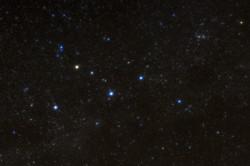
Portrait of a Bat
Pie de foto: Honourable mention in the 2022 IAU OAE Astrophotography Contest, category Still images of celestial patterns.
Taken in November 2019 from the Doi Inthanon National Park, Chiang Mai, Thailand, this image captures the notable northern constellation Cassiopeia, in the shape of the letter M. Although the official constellation name is the Latinised version of the name of queen “Kasseipeia” from Greek mythology, these five bright stars were considered a constellation in many cultures around the world and they are associated with diverse stories. In Thailand, for example, the constellation represents a Bat, while in Hawaiian culture it is called 'Iwa Keli'i, the chief frigate bird.
For the Navajo in North America, the bright stars are the central part of the celestial mother (of all stars and humans) revolving around the celestial pole together with her husband, the celestial father (of all stars and humans) seen in the constellation of Ursa Major. For the Maya it was part of the huge constellation of the Hole-Backed Caiman, and for the Inuit a Lamp Stand and a Blubber Container.
In ancient China, the bottom-left star was associated with the mythological general Wangliang who drove four horses, represented by the two bright and two fainter stars of the M’s next stroke (from upper-left to lower-middle). The remaining two bright stars and a couple of the other fainter ones are considered a Flying Corridor, a sort of highway, next to the Emperor’s Forbidden Palace that is located at the northern polar region.
On the island of Tonga in the South Pacific, this asterism is considered the Wing of Tafahi and it is not clear if this refers to the shape of the island of Tafahi, or if it is based on an error and originally referred to a wing of the Polynesian hero Tafaki.
The various colours of the stars indicate their temperatures, with redder stars being relatively cooler on their surface than blue and white stars.
Crédito: Thanakrit Santikunaporn/IAU OAE
License: CC-BY-4.0 Creative Commons Reconocimiento 4.0 Internacional (CC BY 4.0) íconos
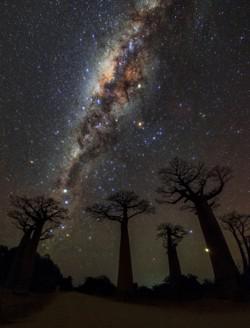
Milky Way over Avenue of Baobabs
Pie de foto: Winner in the 2022 IAU OAE Astrophotography Contest, category Still images of celestial patterns.
This image, taken from the Avenue of Baobabs, Morondava, Madagascar, in July 2017, shows the majestic band of the Milky Way, our home galaxy, together with a rich collection of constellations and asterisms: Crux, Centaurus, Scorpius, Sagittarius and the Teapot asterism. Towards the bottom left of the image we can see the Southern Cross and the pointer stars Alpha (the brighter of the two) and Beta Centauri, which help to distinguish it from similar-looking configurations. Some cultures in Africa associate the Southern Cross with a giraffe, while others associate the constellations with a pride of lions or even with the Tree of Life.
Antares, the brightest star in the constellation Scorpius, is the orange-red star straight up from the middle baobab tree.
To the Pokomo people from southwestern Kenya, Africa, the Milky Way is associated with the smoke emanating from a campfire lit by ancient people. The various people in South Africa, in contrast, have different star tales; the Khoikhoi from the region around Cape Town explained the colours of the red and white stars as red and white roots that were roasted on a fire and thrown towards the sky together with the ashes of the fire. The Xhosa from further east consider the Milky Way the raised bristle of a huge angry dog, while the Zulu from near Johannesburg interpret it as a stream of spears of their strongest warriors.
Polynesian people, who were adept seafarers and navigators, see the constellation Scorpius as a fish hook, and refer to it as the demigod Maui’s Fish Hook. For the Djab Wurrung and the Jardwadjali people, the Southern Cross is part of a Dreamtime Story involving Tchingal, the Bram-bram-bult brothers (the pointer stars), their mother Druk (Delta Crux), and Bunya, the hunter who gets changed into a possum (Gacrux, red star at the top of the Southern Cross).
In this image, the planets Saturn (the bright point above Antares) and Jupiter (the bright point at the bottom-right of the image close to the trunk of the baobab tree) are visible. Indigenous cultures have various stories associated with the planets, for example Kamilaroi and Wailan people associate Saturn with wunygal, a small bird. The Boorong people of Western Victoria associate Jupiter with Ginabongbearp, the chief of the old spirits (Nurrumbunguttias), who takes the totemic form of the sulphur-crested white cockatoo.
Crédito: Amirreza Kamkar/IAU OAE
License: CC-BY-4.0 Creative Commons Reconocimiento 4.0 Internacional (CC BY 4.0) íconos

Watchtower and Paddy Fields Under the Starry Sky
Pie de foto: Winner in the 2022 IAU OAE Astrophotography Contest, category Still images of celestial patterns.
This image, taken in April 2022, shows the sky over a plantation field around a century-old watchtower guarding a village in the province of Guangdong, China. Throughout the ages, the sky has been used as a tool for navigation and also as a calendar. By watching the apparent movement of the stars, it is possible to follow the passing of time, thereby understanding the change of the seasons which in turn helps to plan out the best timings of agricultural work.
The most prominent constellations in this image are Orion and Canis Major, the Great Dog. Commonly associated with a giant hunter in Greek mythology, Orion is followed by his hound in the shape of the constellation Canis Major.
In China, the seven bright stars of the constellation Orion are paradoxically called Three Stars (Shen) and this is one of the 28 Lunar Mansions. The Babylonian pre-zodiac, the so-called “Path of the Moon”, had 17 constellations and included Orion (therein named “True Shepherd of the Heavens”). This is not really surprising because, even in the system of the 88 modern constellations, the Moon sometimes stands in the constellation Orion. The modern constellation boundaries were defined in the 1920s in such a way that the area of Orion ends a half degree south of the ecliptic, in order to avoid the Sun entering it. Still, the Moon and the planets do occasionally. Therefore, Orion is part of the Zodiac (a stripe 5 to 10 degrees around the ecliptic), part of the path of the Moon and, of course, also used by many cultural calendars all over the world.
Sirius, the bright star in the left half of the photograph, is the brightest star in the night sky, and has been used by many indigenous cultures to determine their calendars; the Egyptians awaited the Nile flood with Sirius’s heliacal rise, while the Romans connected its reappearance after its invisibility in daylight with the hottest summer time. In Old China, Sirius was considered a single-star asterism called The Wolf. The adjacent area was called The Market for Soldiers and the area in the southern part of Canis Major was imagined as the Bow with an Arrow.
The reddish bright star in the top right corner is Betelgeuse, a red supergiant and one of the largest stars that can be seen with the naked eye. Orion’s Great Nebula below Orion’s Belt should be mentioned, but also the fainter huge red arc that is called Barnard’s Loop is clearly shown in this photograph. This galactic nebula and the circular red nebula around Orion’s not-so-bright head are both parts of star-forming regions, while the red nebula to the upper left of Orion is the Rosette Nebula in the unrecognisable constellation of Monoceros.
Crédito: Likai Lin/IAU OAE
License: CC-BY-4.0 Creative Commons Reconocimiento 4.0 Internacional (CC BY 4.0) íconos

The Milky Way Over Anglers Reach
Pie de foto: Winner in the 2022 IAU OAE Astrophotography Contest, category Still images of celestial patterns.
The Milky Way and several astronomical objects are seen in this image taken from the southern hemisphere, in Anglers Reach, Australia, in April 2022.
On the bottom-left side we can identify the constellation Scorpius with its brightest star, Antares, the reddish spot just above the arc. Some prominent but small southern constellations can also be seen: the dominating bright stars in the middle-left of the image in the Milky Way are the four bright stars of Crux (the Southern Cross) and to its left the two pointer stars, alpha and beta Centauri. Crux points towards the southern celestial pole, which is not marked by a bright star, and The pointer stars point towards Crux, distinguishing it from the asterism of the False Cross in the constellation Argo.
Crux features on the national flags of Australia, Brazil, Papua New Guinea, Samoa and New Zealand. As Crux lies in the brightest parts of the Milky Way, the dark cloud of the famous Coalsack Nebula is prominent next to the bright stars. It forms one of the dark constellations in South American, South African and Australian indigenous cultures. The huge Australian dark constellation of the Emu is almost completely above the horizon in this image, stretching from its head in the Coal Sack to the horizon.
In Greek antiquity, the stars of Crux also belonged to the constellation Centaurus, a hybrid creature with a human torso and head attached to a horse body with four legs. The Greek centaur represents Chiron, the wise teacher of all Greek heroes. Its brightest star is Rigil Kentaurus (Alpha Centauri), the front hoof of the centaur. Just below it, we find the small constellation Triangulum Australe. The triple star system of Alpha Centauri is our Sun’s nearest stellar neighbour.
Along the Milky Way in the middle-right of the picture we find the huge constellation Argo, the Ship. The smaller ancient constellation Argo was extended by Dutch navigators around 1600, and the number of stars in this constellation was then so big that the 18th-century French mathematician Lacaille needed to introduce subtitles for Argo in his star catalogue. In doing so, he invented the constellations Puppis, Carina and Vela. In Carina, the Keel of the ship, this reddish photograph clearly displays the Carina Nebula.
At the right edge of the image we can spot the brightest star in the night sky, Sirius, while the second brightest star, Canopus, the rudder of Argo, the Ship, dominates the area under the arch of the Milky Way.
Also below the Milky Way arc, we can see the Large Magellanic Cloud and the Small Magellanic Cloud, which are small satellite galaxies of our own Galaxy.
Crédito: Lucy Yunxi Hu/IAU OAE
License: CC-BY-4.0 Creative Commons Reconocimiento 4.0 Internacional (CC BY 4.0) íconos
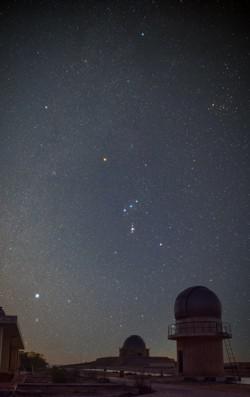
Winter Constellations
Pie de foto: Winner in the 2022 IAU OAE Astrophotography Contest, category Still images of celestial patterns.
Taken from the Kottamia Astronomical Observatory, Cairo, Egypt, in December 2021, this image shows a few prominent winter constellations of the northern sky above the largest telescope in North Africa.
The photograph depicts the constellation of Orion (prominently in the middle of the image) with its belt of stars pointing up to Aldebaran in Taurus and down to Sirius in Canis Major. Aldebaran is a reddish star that we see in front of the open star cluster of the Hyades (at the upper right edge of the image), which is the face of Taurus, the bull. The bright white star is Sirius, the brightest star in the night sky. Its Greek name (Seirios) means “the burner” and can be understood metaphorically as “the brightest”.
This constellation has been represented in a variety of different cultures from all over the world. The ancient Egyptian religion also associates the constellation of Orion with a male figure, namely the god Osiris. It is told that Osiris was murdered by his envious brother Seth, who then dismembered the body and scattered the pieces all over the land. Fortunately, Osiris’s sister-wife Aset (Greek: Isis) is the most powerful sorceress and protective mother goddess. She collected the pieces, put them back together and breathed life back into the god. Aset is seen in the star pattern around the bright star Sirius at the bottom of the photograph. The Egyptian name for Sirius (and adjacent areas) is Sopdet (Greek: Sothis). The heliacal rise of Sirius in summer was a harbinger of the Egyptian new year.
Going north, we can spot a bluish star. This is Alhena, one of the stars in the feet of the zodiacal constellation Gemini, the twins, whose bright head stars would be beyond the upper left edge of the photograph. In the top centre we can see the star Elnath, in the constellation of Auriga, the charioteer. It is associated with Erichthonius, a hero of Greek mythology believed to be the inventor of the four-horse chariot. This same star is also considered the tip of the upper horn of Taurus, the bull. In Greek mythology Taurus is associated with the god Zeus who had sent him to rob a princess. It is commonly known that this Greek story was invented in order to include the Babylonian constellation in Greek mythology. In the Mesopotamian Gilgamesh saga, which is one of the oldest pieces of literature that we know (being traced back to the 3rd millennium), Taurus is the bull of heaven, sent by a jealous goddess and defeated by the king of Uruk to save his people. In the sky it harbours several interesting astronomical objects.
Crédito: Mohamed Aboushelib/IAU OAE
License: CC-BY-4.0 Creative Commons Reconocimiento 4.0 Internacional (CC BY 4.0) íconos
Diagramas relacionados
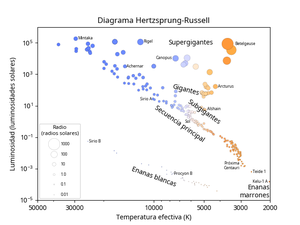
Diagrama Hertzsprung-Russell
Pie de foto: Este diagrama muestra la temperatura y luminosidad de diferentes estrellas. El tamaño de cada punto representa el radio de la estrella y su color es el que vería el ojo humano. El color de las estrellas oscila entre un azul apagado y un naranja rojizo apagado. Ninguna estrella tiene un color puro como el rojo, el verde o el azul, ya que los espectros de las estrellas incluyen luz de muchos colores diferentes. Sin embargo, las estrellas más rojas suelen denominarse rojas y las más azules, azules. La muestra de estrellas utilizada para hacer este diagrama se eligió para mostrar una amplia gama de estrellas de diferentes tipos, por lo que el número relativo de cada tipo de estrella no es representativo de la frecuencia con la que cada tipo se encuentra.
Desde arriba a la izquierda hasta abajo a la derecha hay una larga línea de estrellas que queman hidrógeno en sus núcleos. Ésta es la llamada secuencia principal. En esta línea se encuentran las estrellas Mintaka, Achernar, Sirio A, el Sol y Próxima Centauri. Los objetos situados alrededor de Próxima Centauri, en el extremo inferior derecho de la secuencia principal, se denominan enanas rojas. En la parte inferior derecha de las enanas rojas se encuentran Teide 1 y Kelu-1 A. Estos dos objetos son enanas marrones, objetos de masa demasiado baja para tener núcleos lo suficientemente calientes como para fusionar hidrógeno durante un periodo de tiempo prolongado. Como no queman hidrógeno, las enanas marrones no se consideran estrellas de la secuencia principal. El nombre de enana marrón no está relacionado con su color.
Por encima de la secuencia principal se encuentran las subgigantes, gigantes y supergigantes. Se trata de estrellas que han terminado de quemar hidrógeno en su núcleo y han evolucionado hasta convertirse en objetos de mayor tamaño. El brillo de una estrella depende de su temperatura y tamaño, de modo que las gigantes son más brillantes que las estrellas de radio más pequeño pero con la misma temperatura. Con el tiempo, estos objetos se acercarán al final de su vida y atravesarán una fase de nebulosa planetaria o se convertirán en supernovas. Las estrellas que terminan su vida con una fase de nebulosa planetaria se convierten en un tipo de remanente estelar denominado enana blanca. Estos objetos son mucho más pequeños que las estrellas de la misma temperatura, por lo que son más débiles y se encuentran muy por debajo de la secuencia principal. Las estrellas que terminan su vida como supernovas se convierten en agujeros negros o estrellas de neutrones. Éstas no se muestran en este gráfico.
Crédito: IAU OAE/Niall Deacon
License: CC-BY-4.0 Creative Commons Reconocimiento 4.0 Internacional (CC BY 4.0) íconos
Actividades relacionadas

Reading the Rainbow
astroEDU educational activity (links to astroEDU website) Description: By understanding how rainbows work, you can discover about light and its properties, learning about stars, nebulae, galaxies, and our Universe.
License: CC-BY-4.0 Creative Commons Reconocimiento 4.0 Internacional (CC BY 4.0) íconos
Rango de edades:
14-16
, 16-19
, 19+
Nivel educativo:
Educación no forma
, Educación secundaria
, Secondary
, Universitario
Áreas de aprendizaje:
Clase interactiva
, Basado en la observación
, Aprendizaje basado en la investigación estructurada
Costos:
Bajo coste
Duración:
1 hora y 30 minutos
Tamaño del grupo:
Grupo
Competencias:
Analizar e interpretar datos
, Plantear preguntas
, Participar en debates basados en pruebas