Término del glosario: Tauro
Descripción: Tauro, «el toro», es una constelación del zodíaco, por lo que se encuentra cerca de la eclíptica —la intersección de la esfera celeste con el plano definido por la órbita de la Tierra alrededor del Sol—. Por lo tanto, desde nuestro punto de vista aquí en la Tierra, podemos ver con frecuencia a los planetas, y también al Sol, en esta constelación; en el caso del Sol, del 14 de mayo al 21 de junio. (Por supuesto, si el Sol está allí, no podemos ver las estrellas de la constelación). Tauro es una de las 88 constelaciones modernas definidas por la Unión Astronómica Internacional, y también una de las 48 constelaciones clásicas nombradas por el astrónomo del siglo II Claudio Ptolomeo. En el hemisferio norte, es muy visible en el cielo nocturno durante el invierno. Su estrella más brillante es la rojiza Aldebarán.
Términos relacionados:
Ver este término en otros idiomas
Estado del término y la definición: La definición original de este término en inglés ha sido aprobada por unastrónomo o astrónoma investigadora y un docente La traducción de este término y su definición aún están pendientes de aprobación
El Glosario multilingüe de la OAE es un proyecto de la Oficina de Astronomía para la Educación de la UAI (OAE) en colaboración con la Oficina de Divulgación de Astronomía de la UAI (OAO). Los términos y definiciones fueron seleccionados, redactados y revisados gracias al esfuerzo colectivo de la OAE, los Centros y Nodos de la OAE, los Coordinadores Nacionales de Educación Astronómica (NAECs) y otros voluntarios. Puedes encontrar una lista completa de créditos aquí. Todos los términos del glosario y sus definiciones se publican bajo la licencia Creative Commons CC BY-4.0 y deben atribuirse a la "IAU OAE".
Si detectas algún error de contenido o de traducción en este término del glosario o en ladefinición, ponte en contacto con nosotros.
Contenidos relacionados

Winter Constellations
Pie de foto: Second place in the 2022 IAU OAE Astrophotography Contest, category Time lapses of celestial patterns.
Sirius, the brightest star in the night sky, is shown rising, setting and passing by. Sometimes constellations and asterisms are also visible, including Orion, Taurus and the Pleiades. In the first scene, the aforementioned constellations are covered by a semi-transparent golden veil. The next scenes show it rising in a dark blue night sky. In one of the scenes, a planet brightly decorates the faint constellation Pisces.
The videos were taken above various landscapes and places of cultural heritage on Earth. Some of them simply show monuments in the desert, while others show palm trees with waving leaves.
Crédito: Amirreza Kamkar/IAU OAE
License: CC-BY-4.0 Creative Commons Reconocimiento 4.0 Internacional (CC BY 4.0) íconos
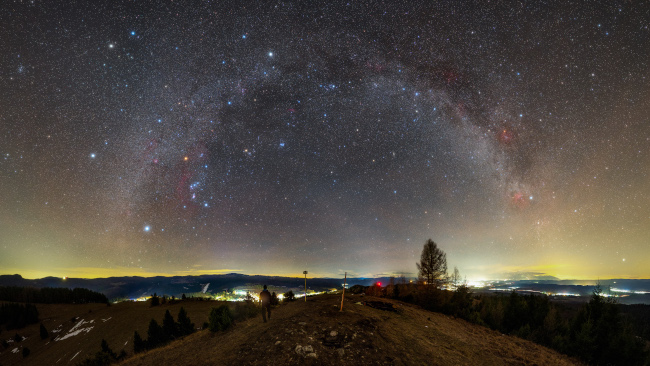
Warm Winter Night Over Spiš Region
Pie de foto: Winner in the 2022 IAU OAE Astrophotography Contest, category Still images of celestial patterns.
This image, taken in Slovakia in January 2022, shows regions of the Milky Way and a rich variety of constellations. The summer constellations of the northern hemisphere are very low in the sky towards the bottom-right. The bright stars of Cygnus and Lyra shine through the artificial lights at the horizon. The huge array of northern winter and autumn constellations with many bright stars are associated with diverse cultural stories.
For the Lakota people in North America the belt of the Orion constellation represents the spine of a bison (“Tayamnicankh”). Orion, the Hunter of Greek mythology, is sometimes described chasing the Seven Sisters, the Pleiades. The Arabs transformed this view by considering the follower of the Pleiades only one star instead of a constellation. Aldebaran, the star in the right eye of Taurus, the Bull, comes from this interpretation, because the name Aldebaran derives from al-dabaran, The Follower.
At the bottom-right, on the horizon, we can see the milky lightcone of the Zodiacal light stretching from the constellation Pisces through Aries, almost reaching the Pleiades, indicating the path of the planets and the Moon in this area. The Pleiades and the Hyades together form a gate on this path, where the heavenly bodies occasionally pass before entering the Milky Way. The planets were considered sheep in ancient Babylon and the modern constellation Orion was considered the “True Shepherd” of the Sky, with his shepherd’s tool reaching the ecliptic. In Roman tradition, the bright white star above the Pleiades and the Milky Way is called Capella, the Goat, which can be traced back to an Egyptian constellation in this area.
Above the treetop in the middle-right part of the image, we see the autumn square, the Andromeda Galaxy and the W-shaped pattern of Cassiopeia. To the left of this group, in the central part of the visible Milky Way, is the constellation Perseus, with Cepheus in the dark area above Cassiopeia completing the celestial family. The Andromeda saga is a Greek story from the area that is now called Israel, and is rooted in Syrian traditions. The location of Andromeda was considered by the ancient Babylonians as the location of the goddess of sexual love, and by the Syrians as the location of the goddess of fertility. According to the saga, Andromeda was chained to a rock at the coast of Jaffa (Tel Aviv) in order to protect her land from a sea monster. The name of the hero who rescued her is Perseus, probably meaning “from Persia” (today’s Iran).
Noticeable in the valley are the lights from towns. The yellow light above the horizon indicates larger cities there, which are given away by their light pollution.
Crédito: Robert Barsa/IAU OAE
License: CC-BY-4.0 Creative Commons Reconocimiento 4.0 Internacional (CC BY 4.0) íconos
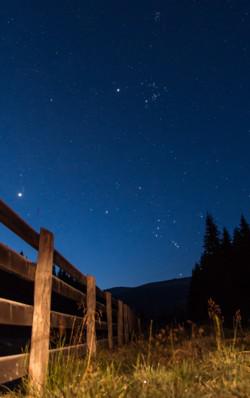
Romanian Orion
Pie de foto: Winner in the 2022 IAU OAE Astrophotography Contest, category Still images of celestial patterns.
Taken in Romania in August 2012, this image shows two of the most recognisable constellations in the sky, Orion and Taurus.
Orion, the Hunter, is found near the horizon. The most prominent star visible in this image is Betelgeuse, while the asterism of Orion’s belt is formed by three aligned bright stars. Just above Orion we can find Taurus, one of the constellations of the Zodiac. As the Zodiac is inherited from Babylon, The Bull of Heaven represents a mighty but dangerous creature that was defeated by King Gilgamesh and his friend Enkidu. They cut the Bull in half and sacrificed the animal to the gods in order to protect their people. Taurus is also home to the star cluster Pleiades, also known as the Seven Sisters. Two planets are visible: Venus, the bright spot near the fence, and Jupiter, the bright spot at the top, next to the Bull’s face.
Different cultures have included the stars of these constellations in their own mythology. The Romanians, for instance, after Christianisation identified four other constellations using some of the stars of Orion and others surrounding it. One such constellation is called Trisfetitele (the Three Saints), which is associated with the three stars comprising Orion's Belt, representing the Three Hierarchs Basil, Gregory and John. This same asterism is also called Three Wise Men, Kings from the East or just Three Kings — all of these names being rooted in the Christian religion.
The agricultural calendar, in contrast, led farmers to define two other constellations, the Little Plough and the Sickle. Both are seen in the southern half of the Orion rectangle; the Little Plough is drawn by connecting the southern quadrilateral with Orion’s left shoulder, and the Sickle is formed by connecting Orion’s left foot (Rigel) with the belt stars, forming an arch and completing the form of a hoe. In the cultural calendar, these constellations were used to announce the harvest of wheat/grain. Finally, the fourth Romanian constellation is the Great Auger, where Orion’s belt represents the handle of the auger, and Betelgeuse is the tip, facing towards Pollux in Gemini. This constellation is associated with treasure, as Romanian peasants believe that the Auger points to the treasure when they approach the end of the world.
Most of the official star names in Orion are Arabic; Mintaka (meaning “belt”) is at the waist; Alnitak (meaning “girdle”) and Alnilam (meaning “string”) are at the belt; and Rigel (meaning foot) is at the left foot. The star on the left shoulder is named Bellatrix, the Latin term for a female warrior. The star at the right leg is called Saiph, for the sword or sabre of the Arabic Orion.
Crédito: Alex Conu/IAU OAE
License: CC-BY-4.0 Creative Commons Reconocimiento 4.0 Internacional (CC BY 4.0) íconos

Winter Milky Way
Pie de foto: Winner in the 2022 IAU OAE Astrophotography Contest, category Still images of celestial patterns.
Taken near Lake Misurina in the Veneto region of Italy in February 2019, this image shows a clear and starry sky over a winter landscape.
We can see part of the Milky Way arc. From the left side, towards the south-east, we see Sirius, "The Burner" in Greek, the brightest star in the night sky. It is part of the constellation Canis Major, The Great Dog, one of the dogs of Orion, the great hunter, in Greek mythology. Orion’s other dog, Canis Minor, the Small Dog, is represented by the bright star Procyon and its fainter neighbours. The Greek star name means “The One [rising] before The Dog” and the star is seen at the top left side of the image just above the arc of the Galaxy. Orion lies to the right of Canis Major. We can spot its characteristic “belt”, an asterism composed of three bright stars aligned in a straight line.
Above the treetops to the right of Orion, the open star clusters of the Hyades and the Pleiades in the constellation Taurus, the Bull, are visible. According to ancient lore, these two clusters form a Celestial Gate directly next to the intersection of the great circles of the ecliptic and the Milky Way. In Greco-Roman mythology, Taurus is associated with the god Zeus who is said to have used a bull to seduce the Phoenician princess Europa.
Above the constellation Taurus, we can see a bright star just above the arc of the Galaxy. This is Capella, the brightest star of the constellation Auriga, The Charioteer. This is one of the 88 modern constellations and is associated with the Greek hero Erichthonius of Athens. Hindu astronomy considers Capella as the heart of Brahma, one of the three major gods. The indigenous people of Bororo in Brazil have a constellation representing a cayman, comprising some of the stars of Auriga and some stars from neighbouring constellations.
To the right of Taurus, we find the modern constellation Perseus with the bright double star cluster h+chi Perseii, which represents the metal of Perseus’s sabre in Greek mythology. Perseus is the hero who was sent out to prove himself, and happened to rescue Andromeda from the sea monster Cetus as the Roman poet Ovid wrote. We can also see the constellation Cassiopeia, associated with the queen and mother of Andromeda in Greek mythology. It is composed of five bright stars in the shape of a W, which was considered the asterism of The Key by the Greeks according to the poet Aratus. The recognisable shape is also associated with other mythologies: for instance, it represents the princess Sharmishtha in Hindu astronomy, a bat in Thailand, and a camel in native Arabic astronomy.
In the gap between the trees, the Andromeda Galaxy is visible.
Crédito: Giorgia Hofer/IAU OAE
License: CC-BY-4.0 Creative Commons Reconocimiento 4.0 Internacional (CC BY 4.0) íconos
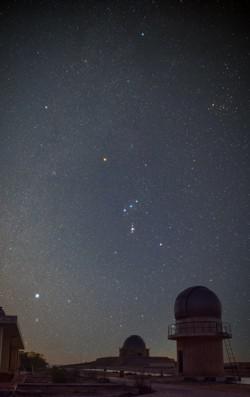
Winter Constellations
Pie de foto: Winner in the 2022 IAU OAE Astrophotography Contest, category Still images of celestial patterns.
Taken from the Kottamia Astronomical Observatory, Cairo, Egypt, in December 2021, this image shows a few prominent winter constellations of the northern sky above the largest telescope in North Africa.
The photograph depicts the constellation of Orion (prominently in the middle of the image) with its belt of stars pointing up to Aldebaran in Taurus and down to Sirius in Canis Major. Aldebaran is a reddish star that we see in front of the open star cluster of the Hyades (at the upper right edge of the image), which is the face of Taurus, the bull. The bright white star is Sirius, the brightest star in the night sky. Its Greek name (Seirios) means “the burner” and can be understood metaphorically as “the brightest”.
This constellation has been represented in a variety of different cultures from all over the world. The ancient Egyptian religion also associates the constellation of Orion with a male figure, namely the god Osiris. It is told that Osiris was murdered by his envious brother Seth, who then dismembered the body and scattered the pieces all over the land. Fortunately, Osiris’s sister-wife Aset (Greek: Isis) is the most powerful sorceress and protective mother goddess. She collected the pieces, put them back together and breathed life back into the god. Aset is seen in the star pattern around the bright star Sirius at the bottom of the photograph. The Egyptian name for Sirius (and adjacent areas) is Sopdet (Greek: Sothis). The heliacal rise of Sirius in summer was a harbinger of the Egyptian new year.
Going north, we can spot a bluish star. This is Alhena, one of the stars in the feet of the zodiacal constellation Gemini, the twins, whose bright head stars would be beyond the upper left edge of the photograph. In the top centre we can see the star Elnath, in the constellation of Auriga, the charioteer. It is associated with Erichthonius, a hero of Greek mythology believed to be the inventor of the four-horse chariot. This same star is also considered the tip of the upper horn of Taurus, the bull. In Greek mythology Taurus is associated with the god Zeus who had sent him to rob a princess. It is commonly known that this Greek story was invented in order to include the Babylonian constellation in Greek mythology. In the Mesopotamian Gilgamesh saga, which is one of the oldest pieces of literature that we know (being traced back to the 3rd millennium), Taurus is the bull of heaven, sent by a jealous goddess and defeated by the king of Uruk to save his people. In the sky it harbours several interesting astronomical objects.
Crédito: Mohamed Aboushelib/IAU OAE
License: CC-BY-4.0 Creative Commons Reconocimiento 4.0 Internacional (CC BY 4.0) íconos
Diagramas relacionados
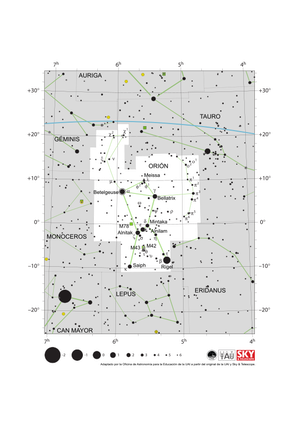
Mapa de la constelación de Orión
Pie de foto: La constelación de Orión junto con sus estrellas brillantes y las constelaciones circundantes. Orión está rodeada (en el sentido de las agujas del reloj desde arriba) por Tauro, Eridanus, Lepus, Monoceros y Géminis. Las estrellas más brillantes de Orión, Betelgeuse y Rígel, aparecen en los extremos norte (arriba en este diagrama) y sur (abajo) de la constelación, respectivamente, con el famoso "cinturón" de tres estrellas en el centro.
Orión atraviesa el ecuador celeste y, por tanto, es visible en algún momento del año desde todo el planeta Tierra. En las regiones más árticas o antárticas del mundo, algunas partes de la constelación pueden no ser visibles. Orión es más visible por las tardes en el invierno del hemisferio norte y en el verano del hemisferio sur. La línea azul sobre Orión marca la eclíptica, el camino que el Sol parece recorrer a través del cielo en el transcurso de un año. El Sol nunca pasa por Orión, pero ocasionalmente se pueden encontrar los demás planetas del Sistema Solar y la Luna en Orión.
Justo al sur del cinturón de Orión se encuentran dos objetos Messier, M42 (la nebulosa de Orión) y M43, marcados con cuadrados verdes. Estas nebulosas, junto con M78 (aquí el cuadrado verde a la izquierda del cinturón), forman parte del enorme Complejo de Nubes Moleculares de Orión. Éste cubre la mayor parte de la constelación e incluye regiones donde estas nubes moleculares están colapsando para formar estrellas jóvenes.
El eje-y de este diagrama está en grados de declinación con el norte hacia arriba y el eje-x está en horas de ascensión recta con el este a la izquierda. El tamaño de las estrellas marcadas aquí está relacionado con la magnitud aparente de la estrella, una medida de su brillo aparente. Los puntos más grandes representan estrellas más brillantes. Las letras griegas indican las estrellas más brillantes de la constelación. Están ordenadas según su brillo: la estrella más brillante se denomina alfa, la segunda más brillante beta, etc., aunque este orden no siempre se sigue con exactitud. El círculo alrededor de Betelgeuse indica que se trata de una estrella variable. Las líneas punteadas marcan los límites de las constelaciones de la UAI y las líneas verdes sólidas marcan una de las formas comunes utilizadas para representar las figuras de las constelaciones. Ni los límites de las constelaciones, ni la línea que marca la eclíptica, ni las líneas que unen las estrellas aparecen en el cielo.
Crédito: Adaptado por la Oficina de Astronomía para la Educación de la UAI a partir del original de UAI/Sky & Telescope
License: CC-BY-4.0 Creative Commons Reconocimiento 4.0 Internacional (CC BY 4.0) íconos
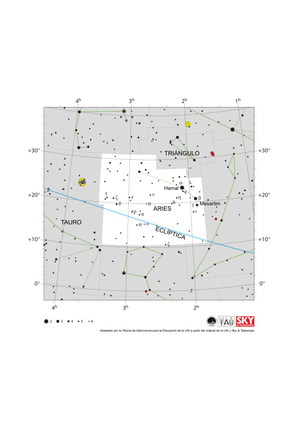
Mapa de la constelación de Aries
Pie de foto: La constelación de Aries junto con sus estrellas brillantes y las constelaciones circundantes. Aries está rodeada por (en el sentido de las agujas del reloj desde arriba) Triángulo, Piscis, Cetus, Tauro y Perseo. Aries se encuentra en la eclíptica (mostrada aquí como una línea azul), que es la trayectoria que el Sol parece seguir a través del cielo en el transcurso de un año. El Sol está en Aries desde mediados de abril hasta mediados de mayo. Los demás planetas del Sistema Solar se encuentran a menudo en Aries.
Aries se encuentra justo al norte del ecuador celeste y, por tanto, es visible en algún momento del año desde todo el planeta Tierra, excepto desde las regiones más antárticas del mundo. Aries es más visible por las tardes en invierno en el hemisferio norte y en verano en el hemisferio sur.
El eje-y de este diagrama está en grados de declinación con el norte hacia arriba y el eje-x está en horas de ascensión recta con el este a la izquierda. El tamaño de las estrellas marcadas aquí está relacionado con la magnitud aparente de la estrella, una medida de su brillo aparente. Los puntos más grandes representan estrellas más brillantes. Las letras griegas indican las estrellas más brillantes de la constelación. Están ordenadas según su brillo: la estrella más brillante se denomina alfa, la segunda más brillante beta, etc., aunque este orden no siempre se sigue con exactitud. Las líneas punteadas marcan los límites de las constelaciones según la UAI y las líneas verdes continuas marcan una de las formas habituales utilizadas para representar las figuras de las constelaciones. Ni los límites de las constelaciones, ni la línea que marca la eclíptica, ni las líneas que unen las estrellas aparecen en el cielo.
Crédito: Adaptado por la Oficina de Astronomía para la Educación de la UAI a partir del original de UAI/Sky & Telescope
License: CC-BY-4.0 Creative Commons Reconocimiento 4.0 Internacional (CC BY 4.0) íconos
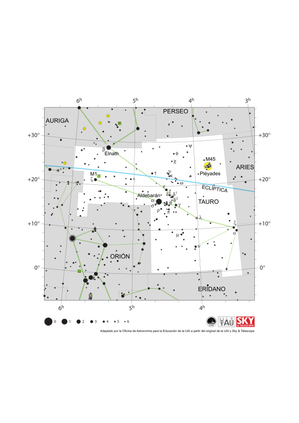
Mapa de la constelación de Tauro
Pie de foto: La constelación de Tauro junto con sus estrellas brillantes y las constelaciones circundantes. Tauro está rodeada por (en el sentido de las agujas del reloj desde arriba) Perseo, Aries, Cetus, Erídano, Orión, Géminis y Auriga. La estrella más brillante de Tauro, Aldebarán, aparece en el centro de la constelación. Tauro se encuentra en la eclíptica (mostrada aquí como una línea azul), que es la trayectoria que el Sol parece seguir a través del cielo en el transcurso de un año. El Sol está en Tauro desde mediados de mayo hasta finales de junio. Los demás planetas del Sistema Solar se encuentran a menudo en Tauro.
Tauro se encuentra principalmente al norte del ecuador celeste, con una pequeña parte en el hemisferio sur celeste. Toda la constelación es visible en algún momento del año para todo el planeta excepto la Antártida y una pequeña región alrededor del Polo Norte. Tauro es más visible por las tardes en invierno en el hemisferio norte y en verano en el hemisferio sur.
En la parte oriental de Tauro podemos encontrar el remanente de supernova M1 (comúnmente conocido como la Nebulosa del Cangrejo), marcado aquí con un cuadrado verde. En el noreste de Tauro se encuentra uno de los cúmulos abiertos de estrellas más famosos del cielo, M45 (las Pléyades), marcado aquí con un círculo amarillo. Muchas de las estrellas cercanas a Aldebarán (pero no Aldebarán) son miembros de otro cúmulo estelar, las Híades. Sin embargo, este cúmulo se encuentra cerca del Sistema Solar, por lo que está demasiado disperso en el cielo como para tener una designación de objeto Messier como la que tienen las Pléyades.
El eje-y de este diagrama está en grados de declinación con el norte hacia arriba y el eje-x está en horas de ascensión recta con el este a la izquierda. El tamaño de las estrellas marcadas aquí está relacionado con la magnitud aparente de la estrella, una medida de su brillo aparente. Los puntos más grandes representan estrellas más brillantes. Las letras griegas indican las estrellas más brillantes de la constelación. Están ordenadas según su brillo: la estrella más brillante se denomina alfa, la segunda más brillante beta, etc., aunque este orden no siempre se sigue con exactitud. Las líneas punteadas marcan los límites de las constelaciones según la UAI y las líneas verdes continuas marcan una de las formas habituales utilizadas para representar las figuras de las constelaciones. Ni los límites de las constelaciones, ni la línea que marca la eclíptica, ni las líneas que unen las estrellas aparecen en el cielo.
Crédito: Adaptado por la Oficina de Astronomía para la Educación de la UAI a partir del original de UAI/Sky & Telescope
License: CC-BY-4.0 Creative Commons Reconocimiento 4.0 Internacional (CC BY 4.0) íconos
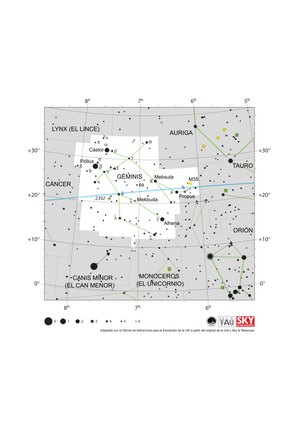
Mapa de la constelación de Géminis
Pie de foto: La constelación zodiacal de Géminis y las constelaciones que la rodean. Empezando por la parte superior del diagrama y siguiendo el sentido de las agujas del reloj, estas son Auriga, Tauro, Lince, Orión, Monoceros, Can Menor y Cáncer. Las estrellas más brillantes de Géminis, Cástor y Pólux, aparecen en la esquina superior izquierda (noreste) del diagrama. En la mitología griega, las estrellas de esta constelación se asemejan a dos gemelos que se rodean con los brazos, con Cástor y Pólux indicando sus cabezas. Géminis se encuentra en la eclíptica (mostrada aquí como una línea azul), que es la trayectoria que el Sol parece seguir a través del cielo en el transcurso de un año. El Sol está en Géminis desde finales de junio hasta finales de julio. Los demás planetas del Sistema Solar se encuentran a menudo en Géminis.
Géminis se encuentra al norte del ecuador celeste y es visible en todo el mundo, excepto en las regiones antárticas. Géminis es más visible por la noche en invierno en el hemisferio norte y en verano en el hemisferio sur.
Justo a la derecha del pie del gemelo Cástor se encuentra un cúmulo abierto de estrellas (mostrado aquí como un círculo amarillo con un borde de línea de puntos), Messier 35, también conocido como el Cúmulo de la Hebilla de Zapato. Este cúmulo se extiende sobre un área aproximadamente del tamaño de la Luna llena. Además de este cúmulo de estrellas, hay una nebulosa planetaria (mostrada aquí como un círculo verde con cuatro picos radiales) - NGC 2392 - cerca del ecuador celeste y justo a la izquierda del gemelo Pólux. Dos estrellas variables (Mekbuda y Propus; mostradas con dos círculos concéntricos) pueden encontrarse en las "piernas" de cada gemelo, pero son tan débiles que un observador necesitaría cielos oscuros para verlas.
El eje-y de este diagrama está en grados de declinación con el norte hacia arriba y el eje-x está en horas de ascensión recta con el este a la izquierda. El tamaño de las estrellas marcadas aquí está relacionado con la magnitud aparente de la estrella, una medida de su brillo aparente. Los puntos más grandes representan estrellas más brillantes. Las letras griegas indican las estrellas más brillantes de la constelación. Están ordenadas según su brillo: la estrella más brillante se denomina alfa, la segunda más brillante beta, etc., aunque este orden no siempre se sigue con exactitud. Las líneas punteadas marcan los límites de las constelaciones según la UAI y las líneas verdes continuas marcan una de las formas habituales utilizadas para representar las figuras de las constelaciones. Ni los límites de las constelaciones, ni la línea que marca la eclíptica, ni las líneas que unen las estrellas aparecen en el cielo.
Crédito: Adaptado por la Oficina de Astronomía para la Educación de la UAI a partir del original de UAI/Sky & Telescope
License: CC-BY-4.0 Creative Commons Reconocimiento 4.0 Internacional (CC BY 4.0) íconos
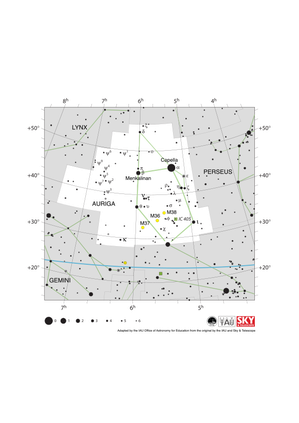
Auriga Constellation Map
Pie de foto: The constellation Auriga with its bright stars and surrounding constellations. Auriga is surrounded by (going clockwise from the top): Camelopardalis, Perseus, Taurus, Gemini and Lynx. Capella, the brightest star in Auriga, is the sixth brightest star in the night sky.
As a northern constellation, Auriga is visible from the whole of the northern hemisphere at some point in the year. The whole of the constellation is visible to equatorial regions of the southern hemisphere with parts of it visible to temperate southern regions. The whole constellation is circumpolar from arctic regions. The constellation is best viewed in the evening in the late northern hemisphere winter and late southern hemisphere summer.
Auriga lies in the plane of the Milky Way and thus hosts a number of open clusters. Of these M36, M37 and M38 are marked on this diagram with yellow circles. IC 405, also known as the flaming star nebula, is marked here with a green square.
The y-axis of this diagram is in degrees of declination with north as up and the x-axis is in hours of right ascension with east to the left. The sizes of the stars marked here relate to the star's apparent magnitude, a measure of its apparent brightness. The larger dots represent brighter stars. The Greek letters mark the brightest stars in the constellation. These are ranked by brightness with the brightest star being labeled alpha, the second brightest beta, etc., although this ordering is not always followed exactly. The dotted boundary lines mark the IAU's boundaries of the constellations and the solid green lines mark one of the common forms used to represent the figures of the constellations. The blue line at the bottom of the diagram marks the ecliptic. Neither the constellation boundaries, nor the line marking the ecliptic, nor the lines joining the stars appear on the sky.
Crédito: Adapted by the IAU Office of Astronomy for Education from the original by the IAU and Sky & Telescope
License: CC-BY-4.0 Creative Commons Reconocimiento 4.0 Internacional (CC BY 4.0) íconos