بلغات أخرى
- الألمانيّة: Schütze
- الإنجليزيّة: Sagittarius
- الإسبانيّة: Sagitario
- الفرنسيّة: Sagittaire
- الهندية: धनु
- الإيطاليّة: Sagittario
- المهاراتية: धनु
- البرتغاليّة البرازيليّة: Sagitário
- الصينيّة المبسطة: 人马座
- الصينيّة التقليدية: 人馬座
وسائط ذات صلة

قوس درب التبانة فوق حديقة أمبوسيلي الوطنية
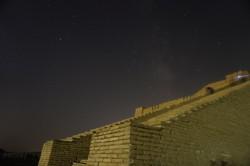
ذراع المجرة

Milky Way Arch over La Palma
الشرح: Winner in the 2022 IAU OAE Astrophotography Contest, category Still images of celestial patterns.
This image, which shows the majestic band of the Milky Way and a range of culturally significant patterns, was taken in May 2022 at a very high altitude from the Roque de los Muchachos Observatory in La Palma, from which one can see the clouds below. Some prominent star patterns include Scorpius, Sagittarius, Lyra, Cygnus, Aquila, the Summer Triangle asterism, and the Teapot asterism.
As the Canary Islands used to be a starting point for European sailors to explore the world, we use this place to point to the many indigenous cultures they encountered. Most notably it is the dark patterns within the band of the Milky Way that hold significance for many Indigenous cultures around the world. The dark patterns are in fact dense, cool clouds of gas and dust that block the light from stars. Indigenous people see caves, waterways and various patterns associated with the dark regions of the Milky Way.
The constellations and patterns hold different cultural significance and interpretations for different people. For example, the constellation Scorpius is referred to by Polynesian people as the demigod Maui’s Fishhook. The Yolnu people of Arnhem Land associate Scorpius with a crocodile called Ingalpir. Some Indigenous Australian groups associate stories with individual stars within Scorpius, most notably Antares, the orange-red star in the top right of the image above the band of the Milky Way. Next to the Scorpion and above the bright centre of the Milky Way, there is a prominent dark cloud that is called the Pipe Nebula by modern astrophotographers. The smoke of this pipe goes up to rho Ophiuchi. This and all the other dark clouds in the Milky Way together form the backbone of heaven for some tribes, and an animal with black-and-white skin for South African Zulu people.
The nomenclature of bright stars also has cross-cultural roots. For example, Vega (the bright blue star towards the top of the image) comes from the Arabic waqi, from al-nasr al-waqi, the Eagle who throws himself down (in order to hunt). This contrasts with the Flying Eagle, Altair, also derived from Arabic. Antares is a Greek word meaning “the one similar to Mars”, referring to its colour. The star name Shaula in the stinger of the Scorpion is a modern version of the Babylonian or even Sumerian star name.
المصدر: Amirreza Kamkar/IAU OAE
License: CC-BY-4.0 المشاع الإبداعي نَسب المُصنَّف 4.0 دولي (CC BY 4.0) أيقونات

The Moon and Milky Way arch Above the Golden Hall
الشرح: Winner in the 2022 IAU OAE Astrophotography Contest, category Still images of celestial patterns.
Taken in April 2021 from the top of the Laojun Mountain in China, this image shows a panoramic view of the Milky Way over the Golden Hall called “Yuhuangding” as a symbol of wealth. In China, the Milky Way is considered a huge stream like one of the big rivers. It separates the Cowherd (Altair) and his beloved Weaving Girl (Vega) and it has a Celestial Ford in the northern dark cloud in the modern constellation Cygnus.
The Milky Way appears as a whitish arch as we cannot distinguish all the individual stars, but instead see the accumulation of light from them. It is a disc-shaped galaxy and the Solar System is located within one of its spiral arms, so we see it from inside, which gives it the shape of a band in our sky. It is associated with the religions and mythologies of several cultures. The modern term Milky Way derives from Greek folklore as the milk spread in the sky by the mother goddess Hera, when she unwillingly breastfed young Heracles. This son of Zeus and a mortal woman was put next to her while she was asleep but from his strong sucking she woke up and realised she was feeding an unknown child, and immediately pushed the child away. Greek philosophers like Plato considered the glittering band in the sky to be the traces of a former path of the Sun.
Alternatively, for the Tupi-Guarani indigenous mythology from South America, the Milky Way represents the “path of tapir”. For some Australian native peoples, its dark clouds formed the shape of an emu if high in the sky, and of crocodiles if low on the horizon. For many southern African, South American and Australian cultures, it was considered a pathway to or from heaven. At the right edge of the image, we can recognise the modern constellation Scorpius with its most prominent star, Antares, the reddish star just above the Milky Way.
The brightest point seen in the centre bottom of the image is the rising Moon with Jupiter next to it. A few constellations can be distinguished in this image, including Corona Australis, a faint arc-shaped constellation located to the bottom right. Just above the Southern Crown, we can see the Teapot asterism as part of the Sagittarius constellation. Since Sagittarius lies next to the centre of the Milky Way, many structures such as star-forming regions, globular clusters and planetary nebulae can be found within its boundaries. In Sagittarius, we also find a supermassive black hole four million times as massive as our Sun.
At the left side of the band, we can identify the bright star Deneb in the constellation Cygnus, The Swan, through which the Milky Way runs, meaning that a variety of star clusters are found in this constellation.
المصدر: Likai Lin/IAU OAE
License: CC-BY-4.0 المشاع الإبداعي نَسب المُصنَّف 4.0 دولي (CC BY 4.0) أيقونات

Lyrid of the Lake
الشرح: Winner in the 2022 IAU OAE Astrophotography Contest, category Still images of celestial patterns.
Taken in the early hours of 24 April 2022, this image captures the sky of Yunnan Province, China, with a reflection on Lake Nian. The Milky Way is visible on the left side, while whitish Earth clouds are visible on the right. A Lyrid meteor crosses the sky along the Milky Way, its tail pointing back toward the shower's radiant in the constellation Lyra, which lies outside the image above the upper edge. The natural colours of the meteor are impressively clear.
A few constellations are also visible. In the top left corner we can recognise the small constellation of the Dolphin, in which five brightest stars comprise the asterism. This asterism forms the head-part of the larger Greek constellation of the Dolphin and was considered the Dolphin since Roman times, when Ptolemy formed the new constellation of Equuleus in the southern part of the original figure. In mediaeval China, this asterism was considered the Good and the Rotten Gourd, the good one being formed by the brighter rhombus on the top and the rotten one made of faint stars in the tail of the Roman dolphin.
The bright star to the right of the Dolphin and at the top of the image is Altair, the brightest star in the constellation Aquila. In Chinese uranology, Altair, together with some adjacent areas, forms the constellation of the Drum at the River. However, in Chinese folklore, the bright star stands for a boy in love with a girl, who is represented by the bright star Vega (in Lyra) on the other side of a huge celestial stream, the Milky Way. Vega is not visible in this image but the Lyrid meteor is like a teardrop of the unlucky girl who cannot reach her lover.
In the upper right of the image, the constellation Scorpius shines with its bright reddish star Antares. With some of its neighbouring stars, it was regarded in China as the asterism of The Heart, which was also one of the Lunar Mansions. It was considered the heart of the Azure Dragon, the super-constellation of spring, in ancient China.
Scorpius and Sagittarius, in the middle of the image, contain the brightest clouds of the Milky Way, the Galactic Centre, which also has clearly visible dark clouds in front of the bright ones.
There is no classical Greco-Roman constellation between Aquila and Scorpius, but in the 17th century, two Polish astronomers, the couple Jan and Elizabeta Hevelius, named this area of bright clouds in the Milky Way Scutum, the Shield, in memory of a Polish king. In China, however, this area directly outside the super-constellation (or heavenly enclosure) of the Celestial Market Place was seen as depicting Market Officers.
المصدر: Jianfeng Dai/IAU OAE
License: CC-BY-4.0 المشاع الإبداعي نَسب المُصنَّف 4.0 دولي (CC BY 4.0) أيقونات
الرسوم التوضيحية المرتبطة
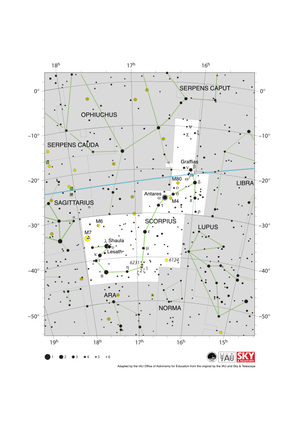
Scorpius Constellation Map
الشرح: The constellation Scorpius (often commonly called Scorpio) along with its bright stars and surrounding constellations. Scorpius is surrounded by (going clockwise from the top) Ophiuchus, Serpens Caput, Libra, Lupus, Norma, Ara, Corona Australis and Sagittarius. Scorpius’s brightest star Antares appears in the heart of the constellation with the famous tail of Scoprius in the south-east (lower left). Scorpius lies on the ecliptic (shown here as a blue line), this is the path the Sun appears to take across the sky over the course of a year. The Sun only spends a short amount of time in late November in Scorpius. The other planets of the Solar System can often be found in Scorpius.
Scorpius lies south of the celestial equator. The whole constellation is not visible from the most arctic regions of the world with parts of Scorpius obscured for observers in northern parts of Asia, Europe and North America. Scorpius is most visible in the evenings in the northern hemisphere summer and southern hemisphere winter.
The yellow circles mark the positions of the open clusters M6, M7 & NGC 6231 while the yellow circles with plus signs superimposed on them mark the globular clusters M4 and M80.
The y-axis of this diagram is in degrees of declination with north as up and the x-axis is in hours of right ascension with east to the left. The sizes of the stars marked here relate to the star's apparent magnitude, a measure of its apparent brightness. The larger dots represent brighter stars. The Greek letters mark the brightest stars in the constellation. These are ranked by brightness with the brightest star being labeled alpha, the second brightest beta, etc., although this ordering is not always followed exactly. The circle around Antares indicates that it is a variable star. The dotted boundary lines mark the IAU's boundaries of the constellations and the solid green lines mark one of the common forms used to represent the figures of the constellations. The blue line marks the ecliptic, the path the Sun appears to travel across the sky over the course of one year. Neither the constellation boundaries, nor the line marking the ecliptic, nor the lines joining the stars appear on the sky.
المصدر: Adapted by the IAU Office of Astronomy for Education from the original by IAU/Sky & Telescope
License: CC-BY-4.0 المشاع الإبداعي نَسب المُصنَّف 4.0 دولي (CC BY 4.0) أيقونات
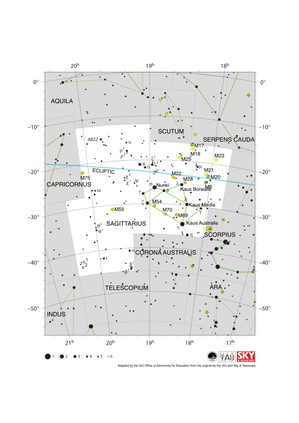
Sagittarius Constellation Map
الشرح: The constellation Sagittarius along with its bright stars and surrounding constellations. Sagittarius is surrounded by (going clockwise from the top) Aquila, Scutum, Serpens Cauda, Ophiuchus, Scorpius, Corona Australis, Telescopium, Microscopium and Capricornus. The brighter stars in Sagittarius form a distinctive teapot shape. Sagittarius lies on the ecliptic (shown here as a blue line), this is the path the Sun appears to take across the sky over the course of a year. The Sun is in Sagittarius from mid December to mid January. The other planets of the Solar System can often be found in Sagittarius.
Sagittarius lies south of the celestial equator. The famous teapot asterism is visible for all but the most arctic regions of the world but the most southerly parts of the constellation are not visible in northern parts of Asia, Europe and North America. Sagittarius is most visible in the evenings in the northern hemisphere summer and southern hemisphere winter.
The supermassive black hole Sagittarius A* which lies at the center of our Milky Way Galaxy is sits on the western (here right-hand) edge of Sagittarius. Due to it covering an area at the center of our Galaxy, Sagittarius is home to many star clusters including open clusters (marked here with yellow circles) and globular clusters (marked here with yellow circles with + signs superimposed on them). Three nebulae are also marked here with green squares.
The y-axis of this diagram is in degrees of declination with north as up and the x-axis is in hours of right ascension with east to the left. The sizes of the stars marked here relate to the star's apparent magnitude, a measure of its apparent brightness. The larger dots represent brighter stars. The Greek letters mark the brightest stars in the constellation. These are ranked by brightness with the brightest star being labeled alpha, the second brightest beta, etc., although this ordering is not always followed exactly. The dotted boundary lines mark the IAU's boundaries of the constellations and the solid green lines mark one of the common forms used to represent the figures of the constellations. Neither the constellation boundaries, nor the line marking the ecliptic, nor the lines joining the stars appear on the sky.
المصدر: Adapted by the IAU Office of Astronomy for Education from the original by IAU/Sky & Telescope
License: CC-BY-4.0 المشاع الإبداعي نَسب المُصنَّف 4.0 دولي (CC BY 4.0) أيقونات
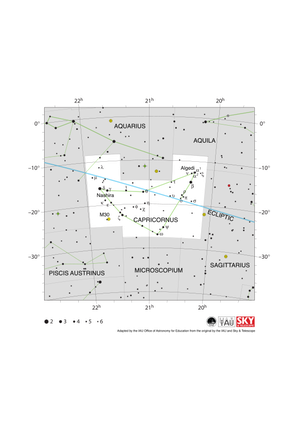
Capricornus Constellation Map
الشرح: The constellation Capricornus (commonly called Capricorn) including its bright stars and surrounding constellations. Capricornus is surrounded by (going clockwise from the top) Aquarius, Aquila, Sagittarius, Microscopium and Piscis Austrinus. Capricornus lies on the ecliptic (shown here as a blue line), this is the path the Sun appears to take across the sky over the course of a year. The Sun is in Capricornus from mid January to mid February. The other planets of the Solar System can often be found in Capricornus.
Capricornus lies just south of the celestial equator and is visible to all observers south of the Arctic Circle. Capricornus is most visible in the evenings in the northern hemisphere autumn and southern hemisphere spring.
In the south east (lower left on this diagram) of the constellation one can find the globular cluster M30 (shown here as a yellow circle with a plus sign superimposed on it).
The y-axis of this diagram is in degrees of declination with north as up and the x-axis is in hours of right ascension with east to the left. The sizes of the stars marked here relate to the star's apparent magnitude, a measure of its apparent brightness. The larger dots represent brighter stars. The Greek letters mark the brightest stars in the constellation. These are ranked by brightness with the brightest star being labeled alpha, the second brightest beta, etc., although this ordering is not always followed exactly. The dotted boundary lines mark the IAU's boundaries of the constellations and the solid green lines mark one of the common forms used to represent the figures of the constellations. Neither the constellation boundaries, nor the line marking the ecliptic, nor the lines joining the stars appear on the sky.
المصدر: Adapted by the IAU Office of Astronomy for Education from the original by IAU/Sky & Telescope
License: CC-BY-4.0 المشاع الإبداعي نَسب المُصنَّف 4.0 دولي (CC BY 4.0) أيقونات
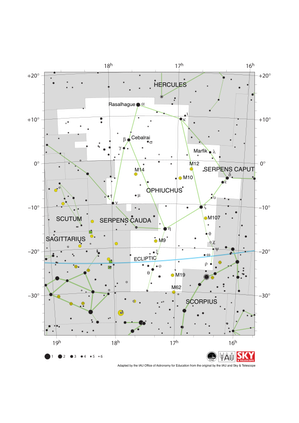
Ophiuchus Constellation Map
الشرح: The constellation Ophiuchus along with its bright stars and its surrounding constellations. Ophiuchus is surrounded by (going clockwise from the top): Hercules, Serpens Caput, Scorpius, Sagittarius and Serpens Cauda. Ophiuchus is not part of the traditional twelve zodiac constellations but it lies on the ecliptic (shown here as a blue line), this is the path the Sun appears to take across the sky over the course of a year. The Sun is in Ophiuchus from late November to mid December. The other planets of the Solar System can often be found in Ophiuchus.
Ophiuchus spans the celestial equator and thus part of the constellation is visible across the whole of the earth at some point in the year. However during the time it is most visible in the evenings (the southern hemisphere winter and northern hemisphere summer) much of the arctic is in perpetual daylight making the stars in the constellation impossible to see. The whole constellation is visible from equatorial and temperate regions of both hemispheres.
As Ophiuchus lies close to the galactic center it contains many globular clusters such as M9, M10, M12, M14, M19, M62, and M107. These are marked as yellow circles with plus symbols superimposed.
The y-axis of this diagram is in degrees of declination with north as up and the x-axis is in hours of right ascension with east to the left. The sizes of the stars marked here relate to the star's apparent magnitude, a measure of its apparent brightness. The larger dots represent brighter stars. The Greek letters mark the brightest stars in the constellation. These are ranked by brightness with the brightest star being labeled alpha, the second brightest beta, etc., although this ordering is not always followed exactly. The dotted boundary lines mark the IAU's boundaries of the constellations and the solid green lines mark one of the common forms used to represent the figures of the constellations. Neither the constellation boundaries, nor the line marking the ecliptic, nor the lines joining the stars appear on the sky.
المصدر: Adapted by the IAU Office of Astronomy for Education from the original by IAU/Sky & Telescope
License: CC-BY-4.0 المشاع الإبداعي نَسب المُصنَّف 4.0 دولي (CC BY 4.0) أيقونات
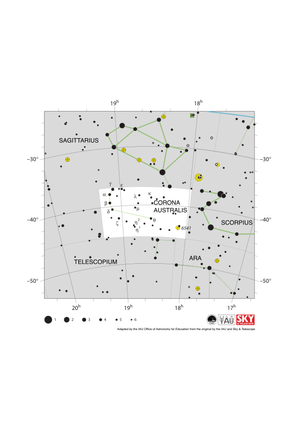
Corona Australis Constellation Map
الشرح: The constellation Corona Australis with its brighter stars and surrounding constellations. Corona Australis is surrounded by (going clockwise from the top): Sagittarius, Scorpius, Ara and Telescopium. This constellation has relatively few bright stars.
Corona Australis is a southern constellation and thus the whole constellation is visible in the southern hemisphere at some point in the year. The constellation can also be viewed from equatorial and some temperate regions of the northern hemisphere. The constellation is best viewed in the evening in the northern hemisphere summer and southern hemisphere winter.
The globular cluster NGC 6541 lies in Corona Australis and is marked here with a yellow circle with a plus sign superimposed on it.
The y-axis of this diagram is in degrees of declination with north as up and the x-axis is in hours of right ascension with east to the left. The sizes of the stars marked here relate to the star's apparent magnitude, a measure of its apparent brightness. The larger dots represent brighter stars. The Greek letters mark the brightest stars in the constellation. These are ranked by brightness with the brightest star being labeled alpha, the second brightest beta, etc., although this ordering is not always followed exactly. The dotted boundary lines mark the IAU's boundaries of the constellations and the solid green lines mark one of the common forms used to represent the figures of the constellations. Neither the constellation boundaries, nor the lines joining the stars appear on the sky. The blue line at the top right of the diagram marks the ecliptic.
المصدر: Adapted by the IAU Office of Astronomy for Education from the original by the IAU and Sky & Telescope
License: CC-BY-4.0 المشاع الإبداعي نَسب المُصنَّف 4.0 دولي (CC BY 4.0) أيقونات