Science Focus Session: Galaxies
Parallel Session
7th Shaw-IAU Workshop on Astronomy for Education
Session timeblocks
Tuesday Nov. 18, 2025
Galaxies: The Dark Side:
UTC: 8 p.m. -
9:30 p.m.
America/New_York:
3 p.m.-
4:30 p.m.
Wednesday Nov. 19, 2025
Galaxies: The Dark Side - repeated:
UTC: noon -
1:30 p.m.
America/New_York:
7 a.m.-
8:30 a.m.
Galaxy History:
UTC: 7 p.m. -
8:30 p.m.
America/New_York:
2 p.m.-
3:30 p.m.
Thursday Nov. 20, 2025
Milky Way:
UTC: 10:30 a.m. -
noon
America/New_York:
5:30 a.m.-
7 a.m.
Milky Way - repeated:
UTC: 6 p.m. -
7:30 p.m.
America/New_York:
1 p.m.-
2:30 p.m.
Friday Nov. 21, 2025
Galaxy History - repeated:
UTC: 10 a.m. -
11:30 a.m.
America/New_York:
5 a.m.-
6:30 a.m.
Chair

Samantha Brown-Sevilla
Share on:


This session will cover the latest scientific discoveries about galaxies, their formation and evolution, and how these topics can be effectively incorporated into educational settings.
Schedule
-
Seeing the Unseeable at the Heart of Galaxies
During Galaxies: The Dark Side : UTC: 8 p.m. - 9:30 p.m. America/New_York: 3 p.m.- 4:30 p.m.
Repeated during Galaxies: The Dark Side - repeated : UTC: noon - 1:30 p.m. America/New_York: 7 a.m.- 8:30 a.m.
Supermassive black holes lurking in the centers of galaxies generate the highest energy processes in the known Universe, ejecting jets of plasma that affect galaxy environments on large scales. These objects seem to have a strong connection with their host galaxies, but remain shrouded in mystery: where do these black holes come from, why are they at centers of galaxies, how do they accrete matter and form these jets? Understanding fundamental properties of black holes, how they feed and eject matter, requires a view of these objects at their very edge. In this talk, I will be giving an overview of the Event Horizon Telescope project: an ambitious global experiment pushing the boundaries of technological developments to finally capture the darkness at the heart of galaxies. The EHT has now obtained the first images of the shadow a supermassive black hole casts on a disk of glowing infalling material, in the giant elliptical galaxy of M87 and at the center of our own Milky Way galaxy. These images are consistent with Einstein‘s predictions from over a hundred years ago, and teach us about how gravity and matter interact in the extreme environment that is the edge of a black hole.
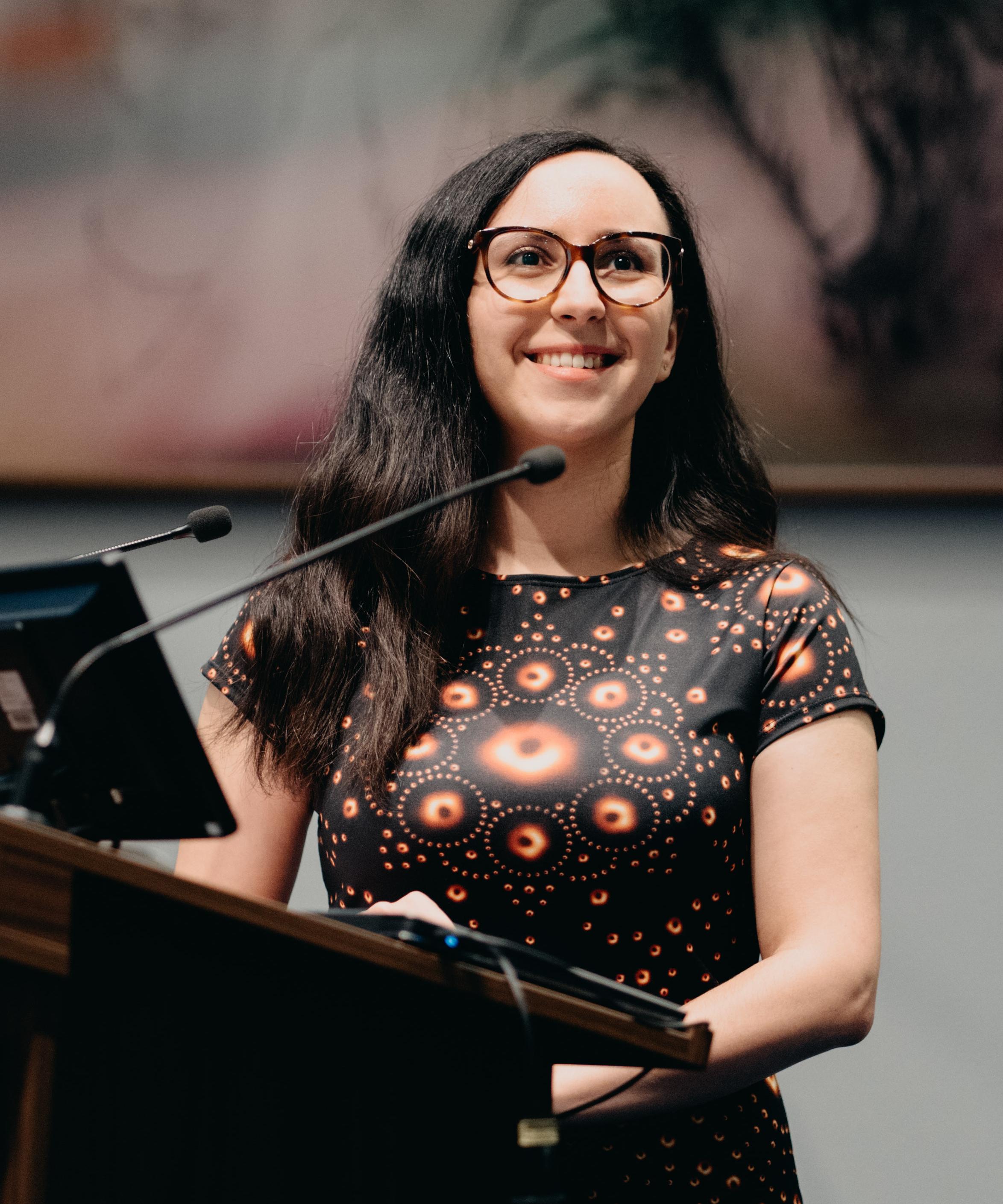
Sara Issaoun (Center for Astrophysics | Harvard & Smithsonian)
For more information about this talk click here
-
Euclid – The Dark Universe Detective
During Galaxies: The Dark Side : UTC: 8 p.m. - 9:30 p.m. America/New_York: 3 p.m.- 4:30 p.m.
Repeated during Galaxies: The Dark Side - repeated : UTC: noon - 1:30 p.m. America/New_York: 7 a.m.- 8:30 a.m.
Most of the energy and matter in the Universe is made up of two mysterious components: Dark Matter and Dark Energy. The first one is responsible for how matter structures like galaxies and galaxy clusters form, the other drives the accelerated expansion of the Universe. Their natures are currently completely unknown. In 2023, the ESA launched a new mission to shed light on this mysterious Dark Universe: The Euclid telescope, which aims to observe a third of the night sky with an unprecedented combination of wide images, spatial resolution, and sensitivity to low surface brightness objects. Its goal is to map the distribution of dark matter using both the positions and observed shapes of galaxies as tracers. In this talk I will explain the basic concepts behind this goal and explain why Euclid is the ideal tool for this science case. I will further show first results from the mission and give an outlook to what we can expect from the mission.

Laila Linke (University of Innsbruck)
For more information about this talk click here
-
Where Dark Bends Light: The Enchantments of Gravitational Lensing
During Galaxies: The Dark Side : UTC: 8 p.m. - 9:30 p.m. America/New_York: 3 p.m.- 4:30 p.m.
Repeated during Galaxies: The Dark Side - repeated : UTC: noon - 1:30 p.m. America/New_York: 7 a.m.- 8:30 a.m.
Gravitational lensing is one of the most fascinating phenomena predicted by general relativity. When light from distant astronomical sources travels through the warped space-time around massive objects, its path is bent, resulting in a variety of striking visual effects. This presentation introduces the physical principles underlying gravitational lensing and explores its most captivating manifestations. These include image multiplication, the distortion and magnification of background sources, and the ability to map the invisible distribution of dark matter. The presentation also discusses the time delay experienced by light as it traverses gravitational potentials, a property that allows us to measure cosmological parameters such as the Hubble constant. Finally, a set of didactical experiences is proposed to help students and educators replicate lensing effects using simple optical tools. Gravitational lensing is not only a window into the dark Universe but also an accessible and inspiring topic for education and outreach.
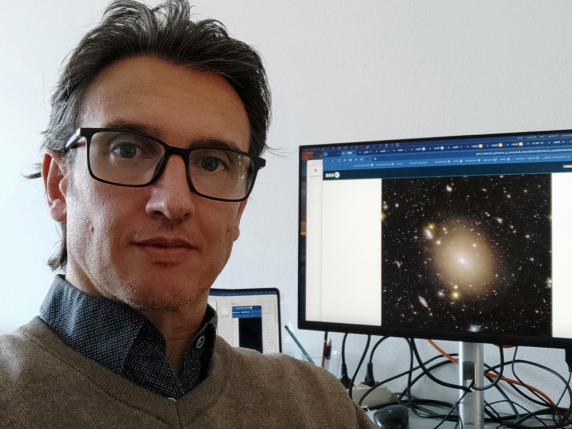
Massimo Meneghetti (National Institute for Astrophysics (INAF))
For more information about this talk click here
-
Discussion Panel: Galaxies: The Dark Side
Chair:
Samantha Brown-Sevilla
Panel: Sara Issaoun
(Center for Astrophysics | Harvard & Smithsonian), Laila Linke
(University of Innsbruck), Massimo Meneghetti
(INAF - Astronomical Observatory of Bologna) -
Universe(s) in a box: simulating galaxies to connect theory and observations
During Galaxy History : UTC: 7 p.m. - 8:30 p.m. America/New_York: 2 p.m.- 3:30 p.m.
Repeated during Galaxy History - repeated : UTC: 10 a.m. - 11:30 a.m. America/New_York: 5 a.m.- 6:30 a.m.
Modern telescopes reveal a stunning variety of galaxies across the cosmos: elegant spirals like our Milky Way, smooth ellipticals, and irregular shapes that defy easy classification. These vast systems of hundreds of billions of stars are not scattered randomly, but form an intricate cosmic web: filaments, clusters, and voids that stretch across billions of light-years. One of the central challenges of cosmology and galaxy evolution is to understand how such structure emerged from the nearly uniform conditions of the early Universe, and how processes driven by both visible and invisible components — such as dark matter, dark energy, and super massive black holes — have shaped the large-scale structure and galaxies therein over 14 billion years of cosmic evolution. In recent decades, cosmological simulations have become indispensable tools for exploring these questions. By combining the laws of gravity, magnetohydrodynamics, and atomic physics with models for star formation, supernova explosions, and feedback from supermassive black holes, these “universes in a box” allow us to test theoretical ideas and directly compare them with astronomical observations. Thanks to advances in supercomputing and algorithmic design, simulations that once tracked only a few thousands of particles can now follow tens of billions, capturing the complex interplay between cosmic structure and the galaxies that inhabit it. I will present results from the IllustrisTNG project, a suite of large-scale simulations that has become a benchmark for modeling the formation and evolution of galaxies, and introduce its successors such as TNG-Cluster, which follows the growth of hundreds of massive galaxy clusters. These simulations reproduce many of the observed properties of real galaxies and have revealed the crucial role of feedback from stars and black holes in regulating their growth and evolution. I will highlight how these processes shape not only the stars and gas within galaxies, and hence how galaxies evolve and interact, but also their extended environments — from the circumgalactic medium to the hot plasma that permeates galaxy clusters.
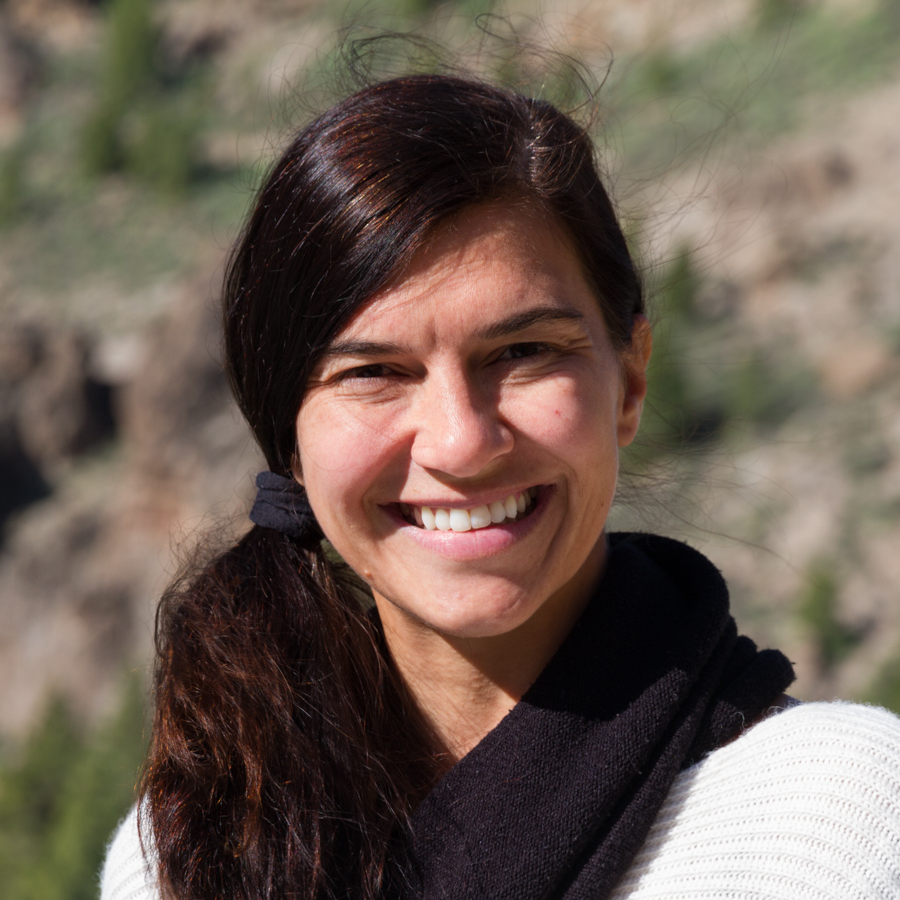
Annalisa Pillepich (Max-Planck-Institute for Astronomy (MPIA))
For more information about this talk click here
-
The Cosmos in its Infancy
During Galaxy History : UTC: 7 p.m. - 8:30 p.m. America/New_York: 2 p.m.- 3:30 p.m.
Repeated during Galaxy History - repeated : UTC: 10 a.m. - 11:30 a.m. America/New_York: 5 a.m.- 6:30 a.m.
Since the launch of JWST, our view of the first stars and galaxies has come into sharp focus. Photometric and spectroscopic observations now reveal their distinct star formation histories, as well as the gas and ionization conditions that shaped galaxies in the first few hundred million years after the Big Bang. In this talk, University of Arizona Associate Research Professor and JADES team member Kevin Hainline will discuss what JWST has taught us about galaxies at z > 10 from ultra-deep observations. He will show how these galaxies are identified, how their properties have defied expectations from the Hubble era, and how our picture of the early Universe, its stars, gas, and galaxies, has evolved as a result. Finally, he’ll outline what new insights we can expect from upcoming JWST surveys in the years ahead.

Kevin Hainline (University of Arizona)
For more information about this talk click here
-
The Latest from Galaxy Zoo
During Galaxy History : UTC: 7 p.m. - 8:30 p.m. America/New_York: 2 p.m.- 3:30 p.m.
Repeated during Galaxy History - repeated : UTC: 10 a.m. - 11:30 a.m. America/New_York: 5 a.m.- 6:30 a.m.
Galaxy Zoo (www.galaxyzoo.org) since 2007 has provided quantitative visual morphologies for millions of galaxies from many different imaging surveys. The latest images on the site have included those from Euclid (Walmsley et al. 2025), JWST and the Vera Rubin Observatory. The morphological information collected by Galaxy Zoo has shown itself to be a powerful database for studying galaxy evolution, with hundreds of papers making use of the data as an important characteristic to understand in the physics of how galaxies assemble, and how they regulate their star formation. On behalf of the science team, and all our hundreds of thousands of volunteer classifiers, I give an update on the latest scientific results and analysis from the project, and reflections on the scientific impact.

Karen Masters (Haverford College)
For more information about this talk click here
-
Workshop: Galaxy History
During Galaxy History : UTC: 7 p.m. - 8:30 p.m. America/New_York: 2 p.m.- 3:30 p.m.
Repeated during Galaxy History - repeated : UTC: 10 a.m. - 11:30 a.m. America/New_York: 5 a.m.- 6:30 a.m.
Karen Masters (Haverford College)
For more information about this talk click here
-
How Gaia is revolutionising the understanding of our Milky Way Galaxy
During Milky Way : UTC: 10:30 a.m. - noon America/New_York: 5:30 a.m.- 7 a.m.
Repeated during Milky Way - repeated : UTC: 6 p.m. - 7:30 p.m. America/New_York: 1 p.m.- 2:30 p.m.
Gaia is a highly advanced and specialised space telescope, developed and operated by the European Space Agency. It was launched in 2013, and was operated for 10 years, until January 2025. It is creating a revolutionary three-dimensional map of our Galaxy by measuring the extremely accurate positions and motions of some three billion stars. While the measurement of star positions has a very long history, stretching back more than 2000 years, accuracies have improved dramatically in the last three decades by exploiting measurements from above the Earth's atmosphere. This is providing a massive advance in mapping the Galaxy, and understanding its composition, structure, and history. Gaia uses the Earth's orbit baseline, of around 300 million kilometres, to measure star distances by triangulation. Measuring the stars repeatedly over several years, and with unprecedented accuracy, also allows us to measure how each star is moving through space. I will use a series of animations to illustrate some of the new insights that Gaia providing about the structure and evolution of stars, and about the structure, dynamics, and origin of our Milky Way Galaxy.

Michael Perryman (European Space Agency (retired); Adjunct Professor, University College Dublin)
For more information about this talk click here
-
The Milky Way as the Cosmic Classroom
During Milky Way : UTC: 10:30 a.m. - noon America/New_York: 5:30 a.m.- 7 a.m.
Repeated during Milky Way - repeated : UTC: 6 p.m. - 7:30 p.m. America/New_York: 1 p.m.- 2:30 p.m.
The Milky Way, our home galaxy, serves as a natural laboratory for understanding galaxy formation and evolution. Its structural and dynamical components, such as the central bar and spiral arms, the thin and thick stellar disks, stellar halo, and dark matter halo, offer crucial insights into the processes that shape disk galaxies across cosmic time. Observations reveal that the Galaxy formed hierarchically, through the merging and accretion of smaller systems and cold gas from the intergalactic medium. Faint stellar streams and satellite interactions preserve fossil records of these events, allowing reconstruction of the Milky Way’s evolutionary history. Modern surveys such as Gaia, JWST, and ground-based facilities like the Rubin Observatory (LSST) are revolutionizing our ability to map the Milky Way in unprecedented detail, bridging its local properties to the broader cosmological context of galaxy formation in the Universe.

Kanak Saha (Inter-University Centre for Astronomy and Astrophysics (IUCAA))
For more information about this talk click here
-
Discovering the Milky Way
During Milky Way : UTC: 10:30 a.m. - noon America/New_York: 5:30 a.m.- 7 a.m.
Repeated during Milky Way - repeated : UTC: 6 p.m. - 7:30 p.m. America/New_York: 1 p.m.- 2:30 p.m.
Our cosmic home is the Milky Way, a galaxy consisting of many billions of stars, countless planetary systems, and gas nebulae. For a long time, researchers have been trying to find out what this conspicuous band in the night sky actually is, how the Milky Way was formed, and how it has evolved. This is their story.

Cecilia Scorza (LMU Faculty of Physics Munich)
For more information about this talk click here
-
Workshop: Milky Way
During Milky Way : UTC: 10:30 a.m. - noon America/New_York: 5:30 a.m.- 7 a.m.
Repeated during Milky Way - repeated : UTC: 6 p.m. - 7:30 p.m. America/New_York: 1 p.m.- 2:30 p.m.
Cecilia Scorza (LMU Faculty of Physics Munich)
For more information about this talk click here
Posters
-
Exploring Galactic Ecosystem -- the Transformative Wellsprings of Stars, Planets, and Life
William H. Waller (Endicott College, The Galactic Inquirer)
It is not hyperbole to state that galactic ecosystems have spawned pretty much everything that we hold dear – including ourselves. These nebular nurseries have incubated all the stars, planetary systems, and many of the complex molecules known to humanity. From there, the myriad of planets in orbit around their hosting stars have further refined the organic matter into even more complex biochemicals. On the surface of one particularly moist planet, life took hold, and evolutionary processes led to you and me collectively pondering the wonders of galactic ecosystems under dark skies and in vivid astronomical images. In this presentation, I will introduce galactic ecosystems of varying size and what they can tell us about our cosmic origins.
-
Exploring galaxy morphology through AI and playful learning
Maura Sandri (National Institute for Astrophysics (INAF))
We present an unplugged educational activity to teach how AI works through galaxy classification. Using a card game, students simulate unsupervised and supervised learning by creating their own classification algorithms. Each card shows one or more galaxies, and students in two groups define parameters based on visual features. After classifying their cards, they exchange and classify a mixed set with the same rules, testing algorithm consistency and generalization. The classification aims to approximate the Hubble sequence, enhancing understanding of galaxy morphology. The activity introduces AI concepts in a playful way. Cards will be freely available on the Play INAF platform.