Glossary term: Angular Diameter
Description: The angular diameter of an object is its visible diameter from a specific location measured as an angle. The angular diameter is used in astronomy as one way to express the size of celestial objects on the sky. The angular diameter increases with increasing physical size of an object and decreases when an object is farther away. For example, the Moon and Sun both have angular diameters of about half a degree when viewed from Earth. The Moon is about 400 times smaller than the Sun but appears the same size (about half a degree across), as the Sun is about 400 times further away.
See this term in other languagesTerm and definition status: This term and its definition have been approved by a research astronomer and a teacher
The OAE Multilingual Glossary is a project of the IAU Office of Astronomy for Education (OAE) in collaboration with the IAU Office of Astronomy Outreach (OAO). The terms and definitions were chosen, written and reviewed by a collective effort from the OAE, the OAE Centers and Nodes, the OAE National Astronomy Education Coordinators (NAECs) and other volunteers. You can find a full list of credits here. All glossary terms and their definitions are released under a Creative Commons CC BY-4.0 license and should be credited to "IAU OAE".
If you notice a factual error in this glossary definition then please get in touch.
In Other Languages
- Arabic: القطر الزاوي
- Bengali: কৌণিক ব্যাস
- German: Winkelausdehnung
- Spanish: Diámetro Angular
- Persian: قطر زاویهای
- French: Diamètre angulaire
- Italian: Diametro angolare
- Japanese: 角直径 (external link)
- Korean: 각지름
- Brazilian Portuguese: Diâmetro angular
- Simplified Chinese: 角直径
- Traditional Chinese: 角直徑
Related Media

Annular Solar Eclipse
Caption: This image captures an annular eclipse, a special type of solar eclipse that occurs when the Moon passes directly in front of the Sun but does not completely cover it. Because the Moon is near the farthest point in its orbit it has a smaller angular size than normal and is thus slightly smaller in the sky than the Sun. If an eclipse occurs in this situation, the Moon only blocks the central portion of the Sun's disk but leaves a bright ring, often called the “ring of fire”, visible around the Moon’s silhouette. An annular eclipse is different from a total solar eclipse in that observers see this luminous ring rather than the Sun being fully obscured.
Credit: Wikipedia user - Dpickd1
credit link
License: CC-BY-4.0 Creative Commons Attribution 4.0 International (CC BY 4.0) icons
Related Diagrams

Annual Parallax
Caption: Distance determination has historically been a challenge for astronomy. One of the primary ways to measure distance is to use annual parallax. The Earth orbits around the Sun over the course of a year meaning that it moves from one side of the Sun (shown here as position A) to the other side of the Sun (position B) over the course of six months. It then moves back to its original position over the remaining six months. This movement subtly changes the perspective an observer on Earth sees the night sky from. This is similar to the change in viewing perspective you may get when viewing a scene from your left eye and then your right eye. The change of viewing perspective causes nearby objects to shift in position in your vision. The annual motion of the Earth around the Sun changes the perspective of the observer enough to shift the observed positions of celestial objects. How big this effect is depends on the distance to the celestial object. Nearby stars will have bigger shifts in observed position than more distant stars.
The positional shift is known as the trigonometric or annual parallax (which we will call α here) and is defined as the shift in position of a star compared to what an observer at the center of the Solar System (the Sun) would see. In this diagram we see the star viewed from perspectives six months apart (positions A and B). When observed from position A the star’s shift in position will be α while when observed at position B it will be –α. Thus the relative difference in the stars position between being observed at position A and position B will be 2α.
The size of the trigonometric or annual parallax in arcseconds is approximately 1 divided by the distance in parsecs. An arcsecond (often represented by a ″ symbol) is the angular diameter a one-metre-long stick would have when viewed from 206 km away. A parsec (often abbreviated to pc) is 3.26 light years or 30.86 trillion kilometres. This is 206,265 astronomical units (the typical distance between the Earth and the Sun). No other star is closer than 1 pc to the Sun so all stars in the sky have trigonometric parallaxes less than one arcsecond.
While trigonometric parallaxes have long been used to measure the distances to objects in our Solar System or nearby stars, recent advances have pushed the boundaries of these distance measures further. The Gaia satellite has pushed the boundaries of parallax measurements to over a thousand parsecs. Arrays of radio telescopes can also very accurately measure the positions of very distant objects and thus their trigonometric parallax.
Note the Earth and Sun are not to scale here and the Earth’s axial tilt is not accurately represented.
Credit: Aneta Margraf/IAU OAE
License: CC-BY-4.0 Creative Commons Attribution 4.0 International (CC BY 4.0) icons
Related Activities
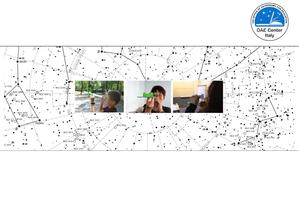
The sky at your fingertips
astroEDU educational activity (links to astroEDU website) Description: Build a simple cross-staff and measure the stars!
License: CC-BY-4.0 Creative Commons Attribution 4.0 International (CC BY 4.0) icons
Age Ranges:
10-12
, 12-14
Education Level:
Middle School
, Primary
Areas of Learning:
Informal/Field Trip Related
, Observation based
, Project-based learning
Costs:
Low Cost
Duration:
2 hours
Skills:
Analysing and interpreting data
, Developing and using models