Glossary term: O-type Star
Description: A star with spectral type "O". Astronomers identify O-type stars by the presence of absorption lines from ionized helium in their spectra. They have typical (effective) temperatures greater than around 30,000 kelvins (K). Compared to other stars, they appear bluish-white to human eyes unless interstellar or atmospheric reddening is important. O-type stars are the hottest and bluest of the main spectral classifications. O-type stars on the main sequence have the highest masses (greater than about 15 solar masses), shortest hydrogen burning lifetimes, and, as a result, are mostly found in and around star-forming regions.
Related Terms:
- Hydrogen Fusion
- Main Sequence
- Spectral Type
- Star Formation
- Reddening
- Effective Temperature
- Absorption Line
See this term in other languages
Term and definition status: This term and its definition have been approved by a research astronomer and a teacher
The OAE Multilingual Glossary is a project of the IAU Office of Astronomy for Education (OAE) in collaboration with the IAU Office of Astronomy Outreach (OAO). The terms and definitions were chosen, written and reviewed by a collective effort from the OAE, the OAE Centers and Nodes, the OAE National Astronomy Education Coordinators (NAECs) and other volunteers. You can find a full list of credits here. All glossary terms and their definitions are released under a Creative Commons CC BY-4.0 license and should be credited to "IAU OAE".
If you notice a factual error in this glossary definition then please get in touch.
In Other Languages
- Arabic: نجمة من النوع أو
- German: O-Stern
- Spanish: Estrella de tipo O
- French: Étoile de type O
- Italian: Stella di tipo O
- Japanese: O型星 (external link)
- Brazilian Portuguese: Estrela tipo O
- Simplified Chinese: O型星
- Traditional Chinese: O型星
Related Diagrams
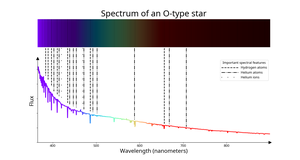
Spectrum of an O-type star
Caption: The spectrum of the O-type star HD 235673 with wavelength in nanometers on the x-axis and flux on the y-axis. The top part of the plot shows the same spectrum but with bright patches for wavelengths with high flux and dark patches for wavelengths with low flux. The colour of the line between 400 nm and 700 nm roughly corresponds to the colour the human eye would see light of that wavelength. Below 400 nm and above 700 nm, where the human eye can see little to no light, the lines are coloured blue and red respectively.
The black lines show spectral absorption lines caused by atoms and ions of different elements in the star’s atmosphere. These atoms and ions absorb at specific wavelengths, causing sharp, dark lines in the spectra. How strong these lines are depends on the temperature of the star’s atmosphere. Two stars made from the same mix of elements could have spectra with vastly different sets of lines in their spectra if they have different temperatures in their atmospheres. For O-type stars the most important features are a small number of lines caused by ionized helium. These lines are stronger in O-type stars than in cooler stars. Lines from helium atoms and hydrogen atoms also appear in the spectrum. The spectrum has more flux at the blue end of the spectrum than at the red end of the spectrum.
Credit: IAU OAE/SDSS/Niall Deacon
License: CC-BY-4.0 Creative Commons Attribution 4.0 International (CC BY 4.0) icons