Glossary term: आकाश
Description: आकाश भनेको हामी बाहिर हुँदा देख्ने कुरा हो, पृथ्वीको कुनै पनि संरचनाले बाधा नपुर्याई, माथि हेर्दा वा कम्तिमा क्षितिजभन्दा माथि हेर्दा जुन हामीले पृथ्वी र पृथ्वीमा रहेका संरचनाहरू देख्न सक्ने सीमा चिन्ह लगाउँछ। रातको स्वच्छ आकाशलाई हेर्दा, हामी टाढाका ग्रहहरू, ताराहरू, र केही आकाशगंगाहरू समेत देख्न सक्छौं (उत्तरी गोलार्धमा एन्ड्रोमेडा आकाशगंगा र दक्षिणी गोलार्धमा म्यागेलानिक बादलहरू)। ताराहरूको झिलमिलाहट हामी अझै पनि पृथ्वीको वायुमण्डलको ग्यासहरूबाट हेरिरहेका छौं भन्ने प्रमाण हो। दिनको समयमा, हावाका अणुहरूद्वारा छरिएको सूर्यको प्रकाशले आकाशलाई नीलो रंगले चम्काउँछ, जसले ब्रह्माण्डमा हाम्रो दृष्टिलाई अवरुद्ध गर्छ। आकाशलाई ढाक्ने बादल वा कुहिरोले पनि हामीलाई कुनै पनि खगोलीय वस्तुहरू अवलोकन गर्नबाट रोक्छ।
Related Terms:
See this term in other languages
Term and definition status: The original definition of this term in English have been approved by a research astronomer and a teacher The translation of this term and its definition is still awaiting approval
The OAE Multilingual Glossary is a project of the IAU Office of Astronomy for Education (OAE) in collaboration with the IAU Office of Astronomy Outreach (OAO). The terms and definitions were chosen, written and reviewed by a collective effort from the OAE, the OAE Centers and Nodes, the OAE National Astronomy Education Coordinators (NAECs) and other volunteers. You can find a full list of credits here. All glossary terms and their definitions are released under a Creative Commons CC BY-4.0 license and should be credited to "IAU OAE".
If you notice a factual or translation error in this glossary term or definition then please get in touch.
Related Media
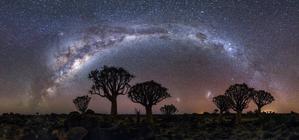
Milky Way Over Quiver Tree
Caption: Winner in the 2023 IAU OAE Astrophotography Contest, category of Still images taken exclusively with smartphones/mobile devices.
This breathtaking photograph was captured on 17 June 2023, near Keetmanshoop, Namibia, with a smartphone. Dominating the night sky, the majestic arc of the Milky Way creates a celestial bridge across the heavens. The image captures a range of notable astronomical objects: the Large and Small Magellanic Clouds, seen towards the bottom of the image and appearing as fuzzy clouds; Antares, seen towards the top left of the image; and the coalsack nebula (referred to by various names by Indigenous cultures around the world), seen vertically above the Large Magellanic Cloud. Silhouetted against this astral backdrop, the trees — which are actually succulent aloe plants native to southern Africa — add a touch of Earth's unique beauty. Historically, these plants were known as ‘quiver trees’ because groups of local Indigenous people would use their hollowed branches to hold darts. The serene Namibian landscape, combined with the brilliance of the southern hemisphere's stars, offers a glimpse into the majesty of our Universe.
Credit: Jianfeng Dai/IAU OAE (CC BY 4.0)
License: CC-BY-4.0 Creative Commons Attribution 4.0 International (CC BY 4.0) icons
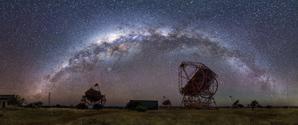
Milky Way Over H.E.S.S Observatory
Caption: Honorable mention in the 2023 IAU OAE Astrophotography Contest, category of Still images taken exclusively with smartphones/mobile devices.
The darkness of the skies at H.E.S.S Observatory reveal the seemingly innumerable stars that make up the Milky Way galaxy, making it challenging to discern the constellations as seen taken with a smartphone from Namibia in June 2023. The stars Alpha and Beta Centauri are visible bottom left of the image just about the tower. The orange-hued star visible just above and to the right of the left H.E.S.S telescope is Antares, a red-giant star that is part of the constellation Scorpius.
Credit: Jianfeng Dai/IAU OAE (CC BY 4.0)
License: CC-BY-4.0 Creative Commons Attribution 4.0 International (CC BY 4.0) icons
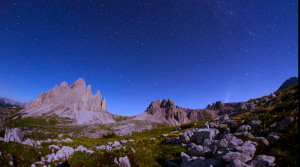
Big Dipper and Comet Neowise C2020 F3
Caption: Honorable mention in the 2023 IAU OAE Astrophotography Contest, category of Time-lapses of rotation of Big Dipper or Southern Cross.
This time-lapse documents the trajectory of the iconic Big Dipper across three frames taken in July 2020. Captured from three locations in Italy, Tre Cime di Lavaredo Auronzo di Cadore, Monte Rite, Cibiana di Cadore, and Casera Razzo, Vigo di Cadore, this visual odyssey showcases the captivating journey of the Big Dipper with the addition of trails of stars painting a celestial canvas. It not only traces the path of this renowned asterism but also features the rare appearance of comet Neowise C/2020 F3, an extraordinary event that graced our skies during July 2020.
Credit: Giorgia Hofer/IAU OAE (CC BY 4.0)
License: CC-BY-4.0 Creative Commons Attribution 4.0 International (CC BY 4.0) icons
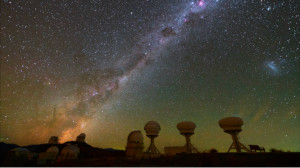
Southern Sky Over La Silla
Caption: First place winner in the 2023 IAU OAE Astrophotography Contest, category of Time-lapses of rotation of Big Dipper or Southern Cross.
This video shows the Milky Way’s sprawling brilliance across the celestial expanse. Among the stars’ grand theatre, the Southern Cross constellation claims its place in the scene, distinguished by its distinctive cross shape as seen in the top of this video and slightly to the right just over the Milky Way, slowly disappearing as the video progresses. This celestial marker, a prominent feature in the southern hemisphere, holds cultural and navigational significance, having served as a navigational guidepost for centuries. Accompanying the Milky Way’s grandeur are the two Magellanic clouds, celestial companions seen dancing in the distant sky. The Carina Nebula adds its ethereal glow to the cosmic panorama, painting a radiant hue against the darkness. In the midst of this celestial ballet, a gentle green hue envelops the atmosphere, a phenomenon known as airglow, adding a touch of subtle luminescence to the night sky. The terrestrial also makes an appearance, with planes flying overhead and vehicles driving between observatory buildings. This time-lapse, taken from the La Silla Observatory in Chile, is a window to the captivating dance of stars, offering a glimpse into the awe-inspiring beauty of our galaxy and the celestial landmarks that grace the southern sky.
Credit: José Rodrigues/IAU OAE (CC BY 4.0)
License: CC-BY-4.0 Creative Commons Attribution 4.0 International (CC BY 4.0) icons