Término del glosario: Cohete
Descripción: Un cohete es un dispositivo que se utiliza habitualmente para lanzar naves espaciales desde la superficie terrestre al espacio exterior. Para ello, un cohete está compuesto por motores de cohete y depósitos de combustible. Los motores de cohete también se utilizan para controlar el movimiento de las naves espaciales en el espacio exterior, modificando la velocidad o realizando correcciones de rumbo. El principio básico de un motor de cohete es producir un chorro de partículas a alta velocidad, normalmente mediante la combustión de combustible para cohetes. Cuando dicho chorro se dirige en una dirección concreta, el motor del cohete se acelera en la dirección opuesta, como consecuencia de una ley fundamental de la física conocida como conservación del momento. Cabe señalar que el chorro de partículas no necesita empujar contra nada para que se produzca este efecto: los cohetes funcionan perfectamente incluso en el casi vacío del espacio exterior.
Términos relacionados:
Ver este término en otros idiomas
Estado del término y la definición: La definición original de este término en inglés ha sido aprobada por unastrónomo o astrónoma investigadora y un docente La traducción de este término y su definición aún están pendientes de aprobación
El Glosario multilingüe de la OAE es un proyecto de la Oficina de Astronomía para la Educación de la UAI (OAE) en colaboración con la Oficina de Divulgación de Astronomía de la UAI (OAO). Los términos y definiciones fueron seleccionados, redactados y revisados gracias al esfuerzo colectivo de la OAE, los Centros y Nodos de la OAE, los Coordinadores Nacionales de Educación Astronómica (NAECs) y otros voluntarios. Puedes encontrar una lista completa de créditos aquí. Todos los términos del glosario y sus definiciones se publican bajo la licencia Creative Commons CC BY-4.0 y deben atribuirse a la "IAU OAE".
Si detectas algún error de contenido o de traducción en este término del glosario o en ladefinición, ponte en contacto con nosotros.
Contenidos relacionados
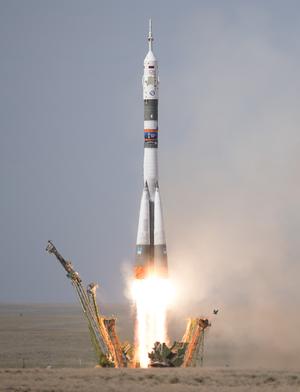
Soyuz Rocket launch
Pie de foto: The Soyuz MS-09 rocket launched from the Baikonur Cosmodrome in Kazakhstan on 6 June 2018, taking the Expedition 56 crew to the International Space Station (ISS). The crew consisted of Soyuz Commander Sergey Prokopyev of Roscosmos, flight engineer Serena Auñón-Chancellor of NASA, and flight engineer Alexander Gerst of ESA (European Space Agency).
Crédito: NASA/Joel Kowsky
enlace de crédito
License: CC-BY-NC-ND-2.0 Creative Commons Atribución-NoComercial-SinDerivadas 2.0 Genérica íconos

The Speed of Spacecraft
Pie de foto: This infographic is part of the "Simplifying Astronomy for Arabic Speakers" project, aiming to present scientific concepts in a simple and accessible way. The design focuses on the speed of spacecraft during the various stages of their launch, illustrating how velocity changes as the spacecraft progresses to reach the desired orbit.
Details of the Stages:
Stage One (Launch):
The spacecraft begins its journey by launching from the launch pad with an increasing speed. The velocity in this stage is influenced by Earth's gravity and atmospheric resistance.
After One Minute:
The spacecraft reaches a speed of approximately 1,600 kilometers per hour (km/h), reflecting a rapid acceleration powered by its engines.
After Two and a Half Minutes:
The rocket boosters are jettisoned, allowing the spacecraft to reach a speed of about 4,800 km/h. At this point, the spacecraft becomes lighter, enabling it to accelerate more efficiently.
Final Stage:
By the end of the ascent phase, the spacecraft achieves its final speed of approximately 28,000 km/h, allowing it to enter the desired orbit around Earth.
Through educational designs like this, the project provides enthusiasts with an opportunity to understand the intricate details of space missions in an engaging and simplified manner.
Crédito: Ali Al-Edhari ; Background image credit - NASA
License: CC-BY-4.0 Creative Commons Reconocimiento 4.0 Internacional (CC BY 4.0) íconos