Glossary term: শিলাময় গ্রহ
Description: একটি শিলাময় গ্রহ হল একটি গ্রহ যা মূলত পাথর ও লোহা জাতীয় পদার্থ দ্বারা গঠিত। শিলাময় গ্রহসমূহে গ্যাসীয়
গ্রহসমুহের ন্যায় হাইড্রজেন ও হিলিয়াম গঠিত বায়ুমণ্ডল দেখা যায় না, পরিবর্তীতে খুবই ছোট বা অনুপস্থিত বায়ুমণ্ডল দেখা যায়।শিলাময় জায় । শিলাময় গ্রহসমূহ সাধারণত গ্যাসীয় গ্রহ সমূহের তুলনায় কম ভরসম্পন্ন ও আকারে ছোট হয়ে থাকে ।
আমাদের সৌরজগতে বুধ , পৃথিবী , শুক্র , পৃথিবী ও মঙ্গল হচ্ছে শিলাময় গ্রহ ।
বহিঃসৌরজাগতিক গ্রহ বা বহির্জাগতিক গ্রহ সম্পর্কিত জ্যোতির্বিজ্ঞানের গবেষণার মূল বিষয়ের একটি হল শিলাময় গ্রহ অনুসন্ধান যা পৃথিবীর ন্যায় ভর ও একই ধরনের বস্ত দ্বারা গঠিত এবং এর কেন্দ্রীয় তারকার কাছাকাছি অবস্থান করে।
Related Terms:
See this term in other languages
Term and definition status: The original definition of this term in English have been approved by a research astronomer and a teacher The translation of this term and its definition is still awaiting approval
The OAE Multilingual Glossary is a project of the IAU Office of Astronomy for Education (OAE) in collaboration with the IAU Office of Astronomy Outreach (OAO). The terms and definitions were chosen, written and reviewed by a collective effort from the OAE, the OAE Centers and Nodes, the OAE National Astronomy Education Coordinators (NAECs) and other volunteers. You can find a full list of credits here. All glossary terms and their definitions are released under a Creative Commons CC BY-4.0 license and should be credited to "IAU OAE".
If you notice a factual or translation error in this glossary term or definition then please get in touch.
In Other Languages
- আরবী: كوكب أرضي
- জার্মান: Gesteinsplanet
- ইংলিশ: Terrestrial Planet
- স্প্যানিশ: Planeta terrestre
- ফ্রেঞ্চ: Planète tellurique
- ইটালিয়ান: Pianeta terrestre
- জাপানিজ: 地球型惑星 (external link)
- ব্রাজিলিয়ান পর্তুগীজ: Planeta terrestre
- সরলীকৃত চাইনীজ: 类地行星
- প্রচলিত চাইনীজ: 類地行星
Related Media
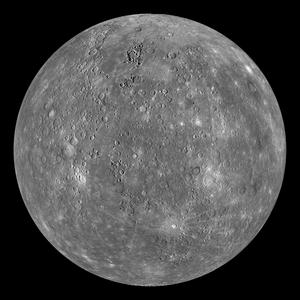
Mercury
Caption: This image is a composite of a picture mosaic of the planet Mercury's surface obtained by the MESSENGER (Mercury Surface, Space Environment, Geochemistry and Ranging) space probe. MESSENGER was launched by NASA in 2004 and explored Mercury from 2011 to 2015.
Credit: NASA/Johns Hopkins University Applied Physics Laboratory/Carnegie Institution of Washington
credit link
License: PD Public Domain icons
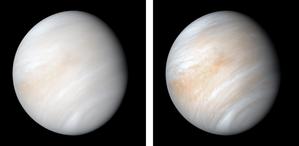
Venus in visible light
Caption: This picture taken by NASA's Mariner 10 probe shows what the planet Venus looks like when looking at it with naked eyes. Venus is enshrouded inside a thick cloudy atmosphere dominated by carbon dioxide, never revealing its hot surface.
Credit: NASA/JPL-Caltech
credit link
License: PD Public Domain icons
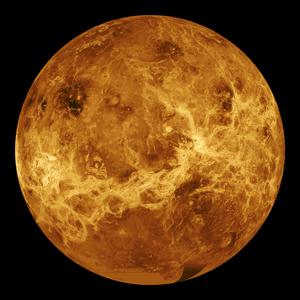
Venus' surface
Caption: This image is a computer-aided rendering of the surface of the planet Venus. Since visual light cannot penetrate the thick clouds in Venus' atmosphere, the image was obtained with radio waves. NASA's space probe Megallan, launched in 1989 mapped Venus' surface between 1990 and 1994.
Credit: NASA/JPL
credit link
License: PD Public Domain icons
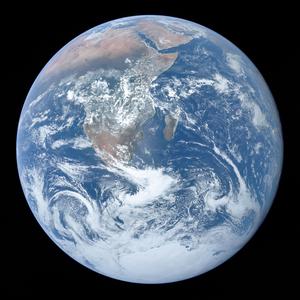
Earth as observed from Apollo 17
Caption: Full disk view of the Earth taken on 7 December 1972, by the crew of the Apollo 17 spacecraft en route to the Moon at a distance of about 29,000 kilometres (18,000 mi). It shows Africa, Antarctica, and the Arabian Peninsula.
Credit: NASA/Apollo 17 crew/Project Apollo Archive
License: PD Public Domain icons
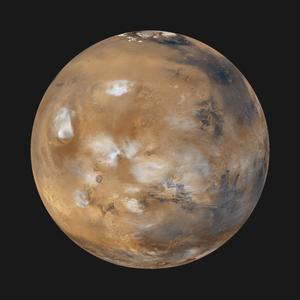
Mars
Caption: This image of the planet Mars taken by NASA's Mars Global Surveyor Orbiter in 1999 shows its dry surface. The picture features the most spectacular geological regions on Mars. Besides the deep Valles Marineris valley we see four volcanoes. While three of them form the Tharsis ridge, the Olympus Mons is largest volcano we have so far discovered in the Solar System. Ice clouds cover parts of the Martian surface.
Credit: NASA/JPL/MSSS
credit link
License: PD Public Domain icons