Astronomy in low tech environments: Ethiopia
PosterAstronomy education in low-tech environments: Challenges and solutions
2nd Shaw-IAU Workshop
Wednesday Oct. 7, 2020
UTC: 5:25 p.m. - 6:55 p.m. America/New_York: 1:25 p.m.- 2:55 p.m.
, Thursday Oct. 8, 2020
UTC: 10:25 a.m. - 11:55 a.m. America/New_York: 6:25 a.m.- 7:55 a.m.
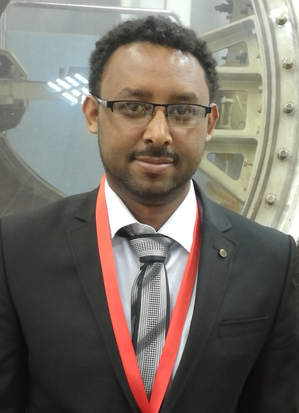
Nebiyu Suleyman Mohammed
(Ethiopian Space Science and Technology Institute)
In many parts of the world, there are no advanced astronomical instruments or tools available to the public mainly because of budget shortage. As a result, people get discouraged and have limitations to make space activities and thus stick to only the theoretical approaches. However, there are many effective low-tech solutions that can be done with simple and cheap materials. Hands-on activities are very important to help students and teachers to understand the significance of Astronomical observations and phenomena. It creates a link between physical principles with everyday observations that leads to many of the more abstract and remote ideas to become more familiar. These activities will teach the students to focus on the experience and skills developed by using critical thinking. They are designed to be worked individually or in a group. These may include activities such as stargazing using free software or mobile apps, laboratory experiments, developing of tools & instruments and watching documentary videos. In most cases, Mathematics plays an important role in modeling these activities, and finally, the analysis is needed to arrive at the conclusions. Specifically, with these methods, there are some suggested traditional activities designed for collaborative learning in class or outreach programs such as constellation studies, lunar phases, modeling scales of distances, and sizes of celestial objects and planetary orbits.
Biography:
My name is Nebiyu Suleyman, a passionate science communicator and public lecturer in astronomy, committed to making space science accessible and inspiring for all. I hold master's degrees in Astronomy & Astrophysics and Communication Engineering—an interdisciplinary background that enables me to contribute to space programs while effectively sharing complex scientific ideas with diverse audiences.
I currently serve on the Scientific Committee of the Ethiopian Space Science Society (ESSS), helping shape national space science strategies and promoting public engagement. From 2015 to 2019, I represented Ethiopia as National Point of Contact for the UN-affiliated Space Generation Advisory Council (SGAC), working to connect young professionals and advocate for youth involvement in global space policy.
My mission is to bring astronomy to underserved communities. I have published internationally on inclusive and accessibility of science education, emphasizing practical, low-cost teaching methods using homemade materials—crucial for resource-limited settings. Over the past decade, I’ve organized and led numerous outreach events across Ethiopia, including stargazing nights, solar observations, space camps, AstroBus tours, and summer schools—all designed to ignite curiosity and foster scientific thinking.
I am also the founder of Venus Tutors, an online platform that provides STEM tutoring to students, especially in under-resourced areas. Through this initiative, I strive to democratize access to quality education and support the next generation of scientists and innovators.My journey reflects a deep commitment to science, education, and community. Through continued outreach and collaboration, I aim to bridge the gap between advanced scientific knowledge and everyday understanding—empowering people to see themselves as part of a vast and fascinating universe.