This page describes an image Lunar Phase Southern Hemisphere
Download File ( image 1.26 MB)
Download PDF File (PDF file 452.81 kB)
Also available in black and white
Download File ( image 602.73 kB)
Download PDF File (PDF file 414.32 kB)
Diagram caption:
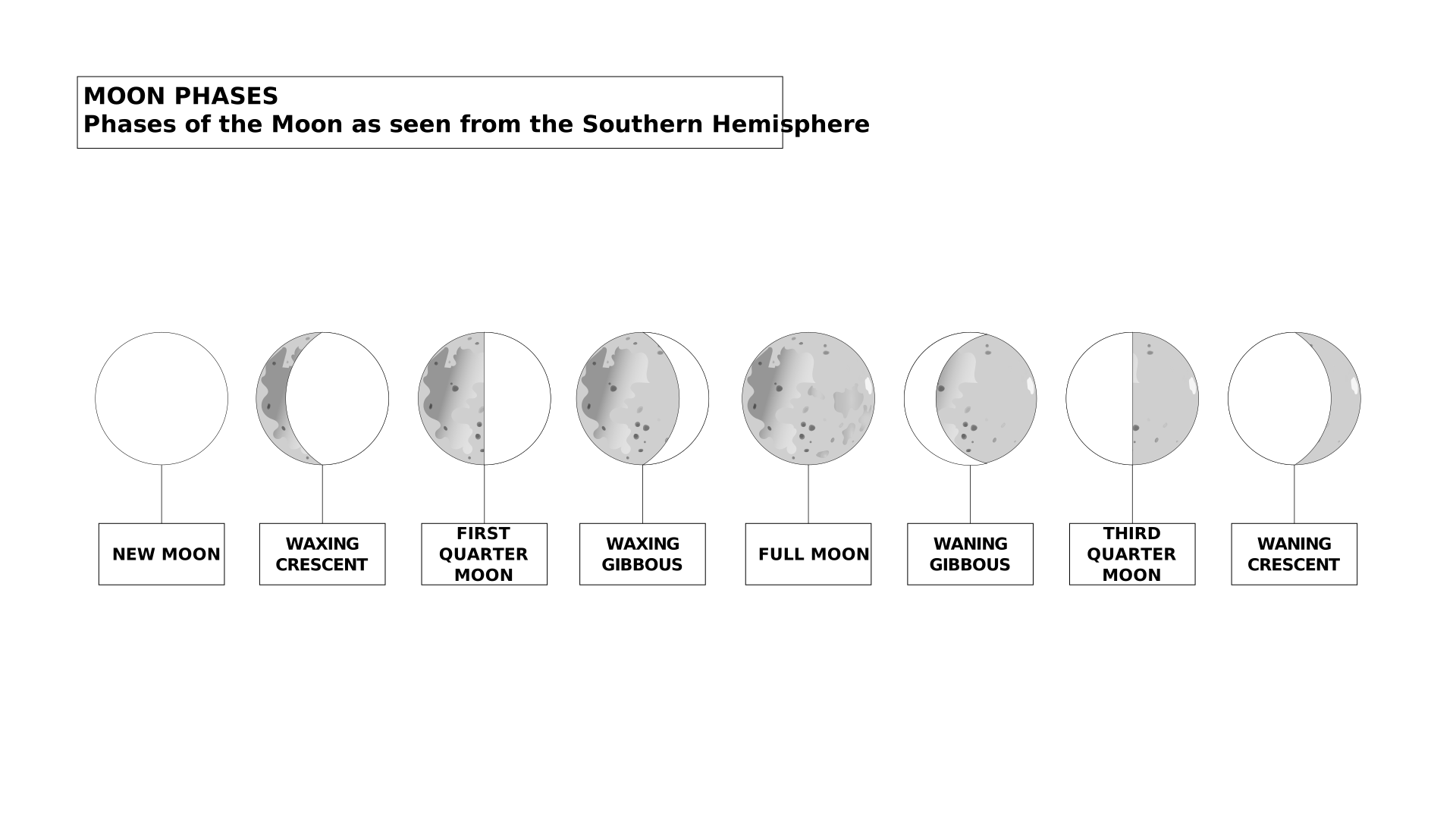
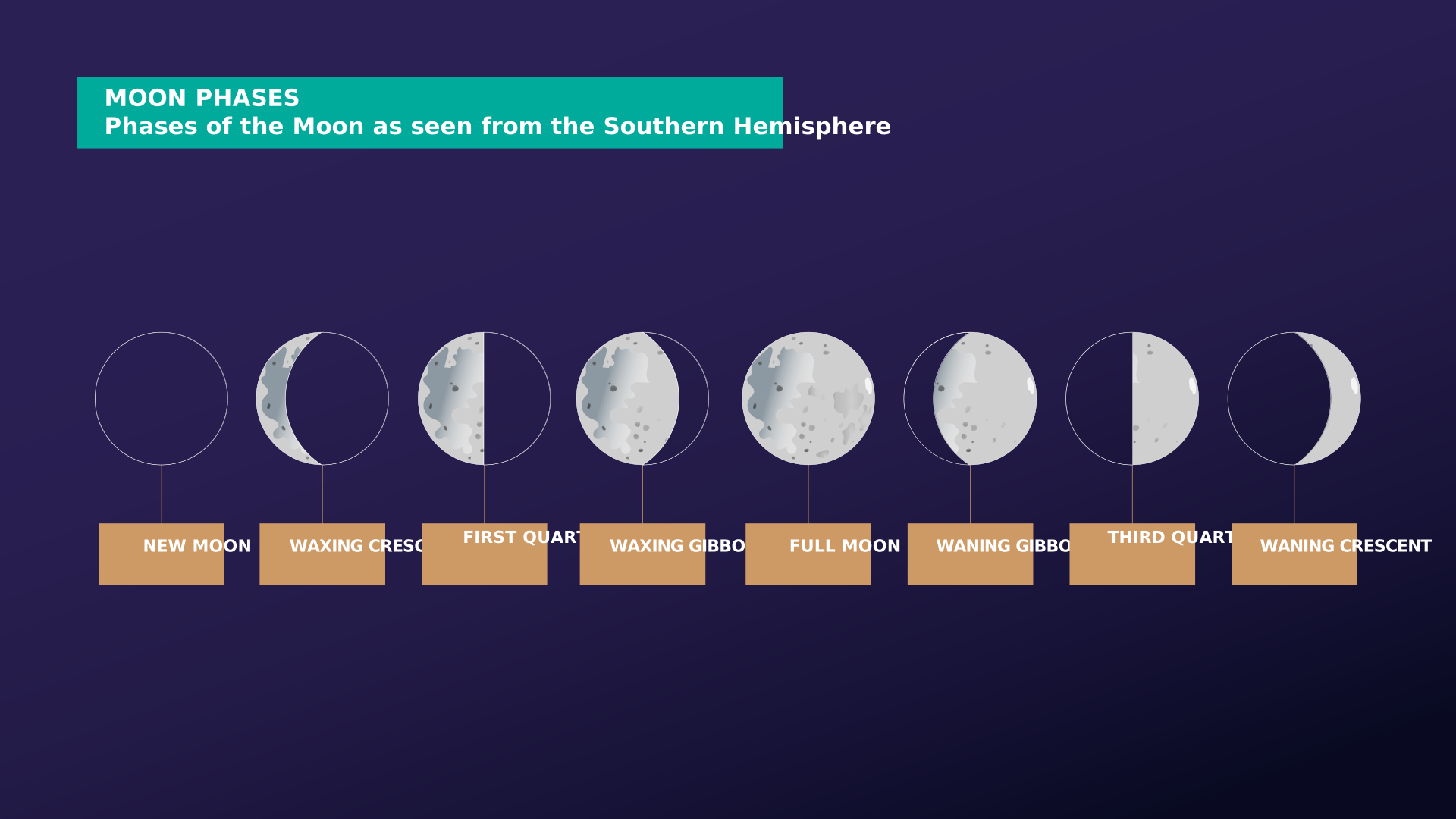
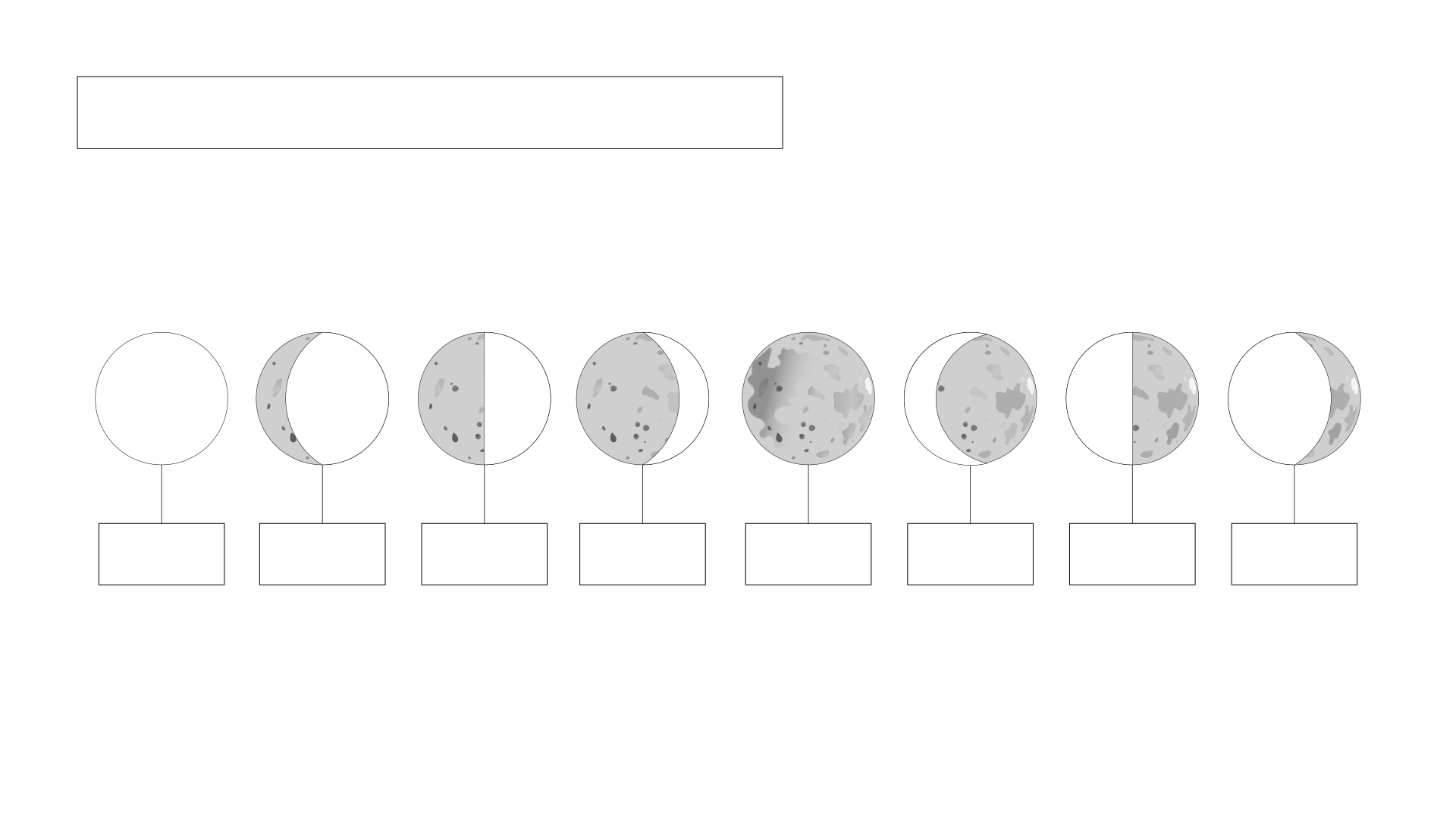
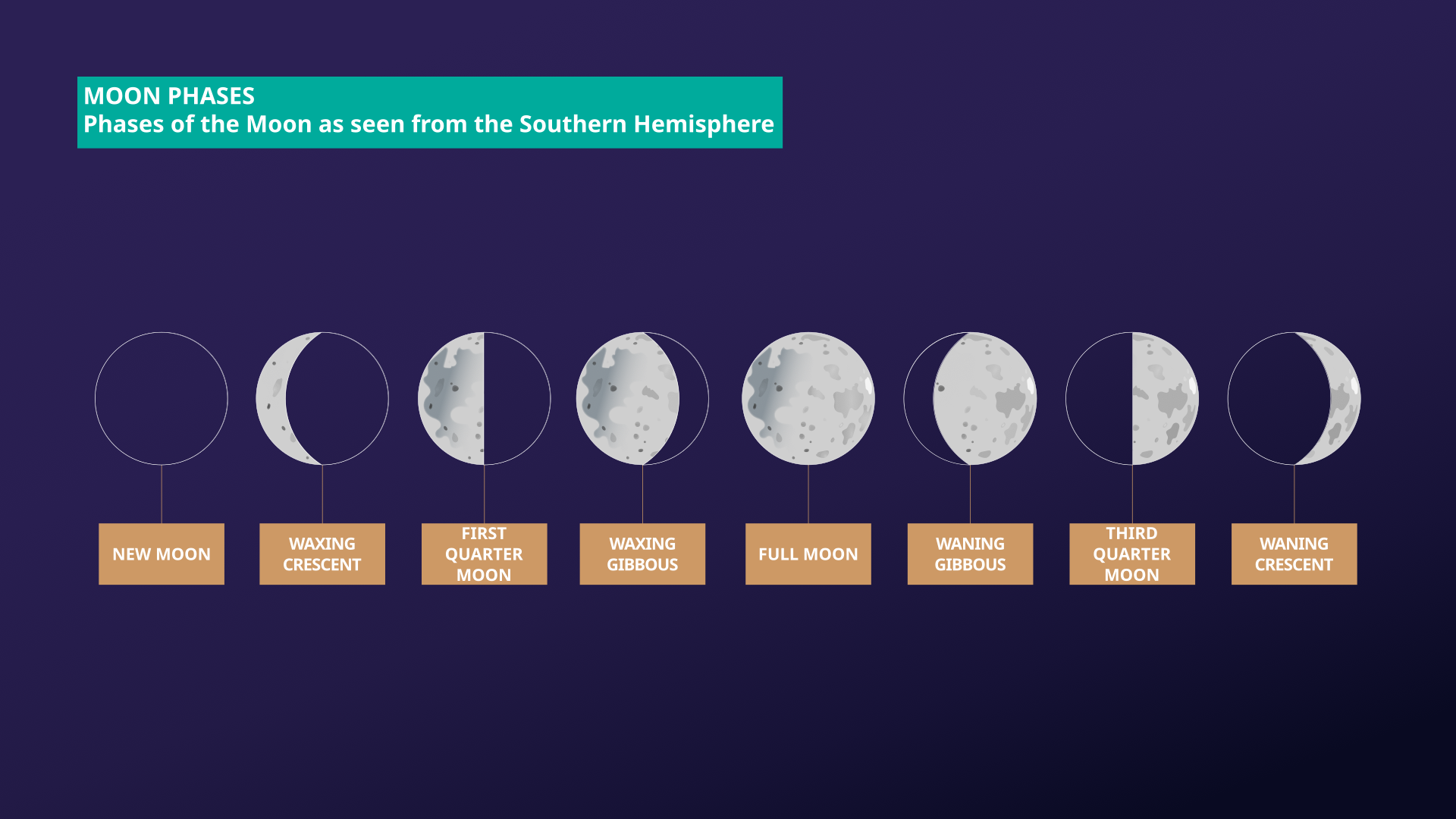
The phases of the Moon when viewed from the Southern Hemisphere. Here north is up and west is left The Moon orbits the Earth every 29.5 days. It is tidally locked to the Earth meaning its rotation period is the same as its orbital period and the same side of the Moon always faces the Earth. At any particular time, half of the Moon is illuminated by the Sun and half is in shadow. Over the course of the Moon’s orbit around the Earth every part of the Moon is illuminated for half of the orbit and is in shadow for the other half of the orbit.
When the Moon sits between the Earth and the Sun its illuminated half faces away from the Earth and we only see the half that is in shadow. This phase of the Moon is known as new moon. As the Moon moves in its orbit, a small but growing sliver of the illuminated half of the Moon begins to be seen from the Earth. This illuminated sliver appears on the western side of the Moon’s face when viewed from Earth. This phase is known as waxing crescent moon. By a quarter of the way through the Moon’s orbit around the Earth the Moon appears 90° away from the Sun and half of the Moon’s illuminated half points toward the Earth. This phase is known as first quarter moon. As the orbit continues more than half of the Moon seen from Earth is now illuminated with a dark crescent. This phase is known as waxing gibbous moon. Once we reach the halfway point in the Moon’s orbit round the Earth the Moon is now on the opposite side of the Earth from the Sun and we see all of the Moon’s illuminated half. As the whole of the side of the Moon that faces the Earth is now illuminated this is referred to as full moon.
For the remaining half of the Moon’s orbit the half of the moon that faces the Earth begins to move into shadow. Hence the illuminated portion of the Moon that we see from Earth begins to shrink or wane. The western edge of the face of the Moon when viewed from Earth begins to appear dark and this grows through subsequent phases. The phases are repeated in reverse order: waning gibbous, third quarter, waning crescent and finally back to new moon.
Note the surface features of the Moon are illustrative and do not accurately represent the Moon’s true surface.
Diagram credit: Aneta Margraf/IAU OAE.
Diagram translation status: Not yet approved by a reviewer
Diagram license: Creative Commons Attribution 4.0 International (CC BY 4.0) Creative Commons Attribution 4.0 International (CC BY 4.0) icons
Related glossary terms:
Crescent Moon
, Full Moon
, Gibbous Moon
, New Moon
, Quarter Moon
, Waning Crescent
, Waning Gibbous
, Waxing Crescent
, Waxing Gibbous
, चंद्राच्या कला
Categories:
Naked Eye Astronomy
Want to make your own translation or version of this diagram? Then
download the SVG
version of this diagram in English (609.64 kB). You can edit this using
software like Inkscape (free) or Adobe Illustrator
(proprietary). Just remember to credit the author of the original appropriately.
Also available in black and white ( image 609.64 kB).
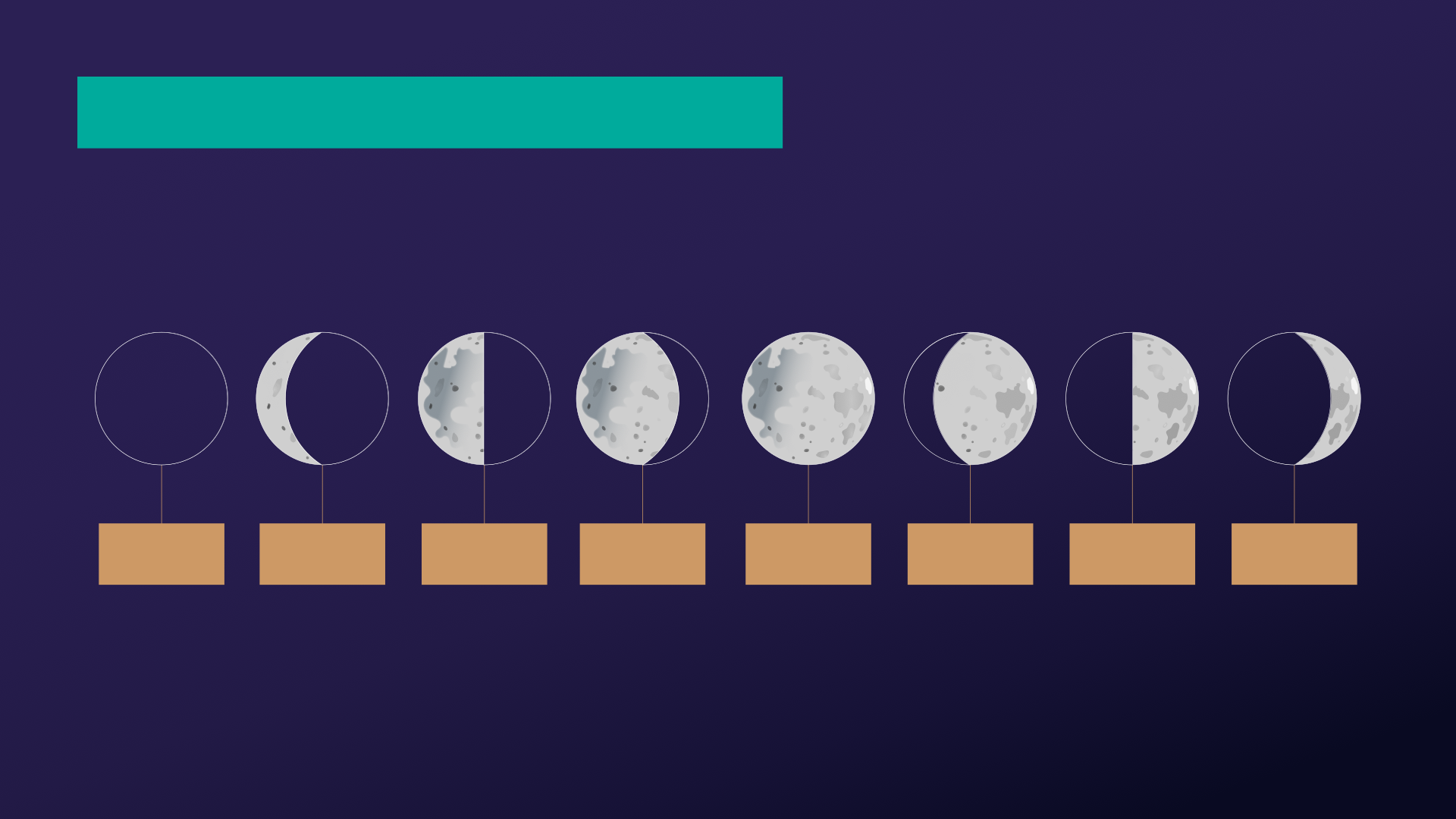
You can also make your own version or translation of this diagram by adding adding text to a version of
this diagram with no text. Just download one of the following files:
Download Text-Free File ( image 1.20 MB)
Download Text-Free PDF File (PDF file 447.17 kB)
Also available in black and white:
Download Text-Free File ( image 105.66 kB)
Download Text-Free PDF File (PDF file 408.71 kB)
In Other Languages
इंग्रजी: Lunar Phase Southern Hemisphereइटालियन: Fasi lunari nell'emisfero australe
जर्मन: Mondphasen auf der südlichen Hemisphäre
The diagram captions presented on the OAE website were written, translated and reviewed by a collective effort from the OAE, the OAE Centers and Nodes, the OAE National Astronomy Education Coordinators (NAECs) and other volunteers. You can find a full list of credits for our translation project here. All media file captions are released under a Creative Commons CC BY-4.0 license and should be credited to "IAU OAE". The media files themselves may have different licenses (see above) and should be credited as listed above under "credit".
If you notice a error in this diagram or its caption then please get in touch.