文档与资源 - 搜索结果
搜索结果
Camelopardalis Constellation Map
图像
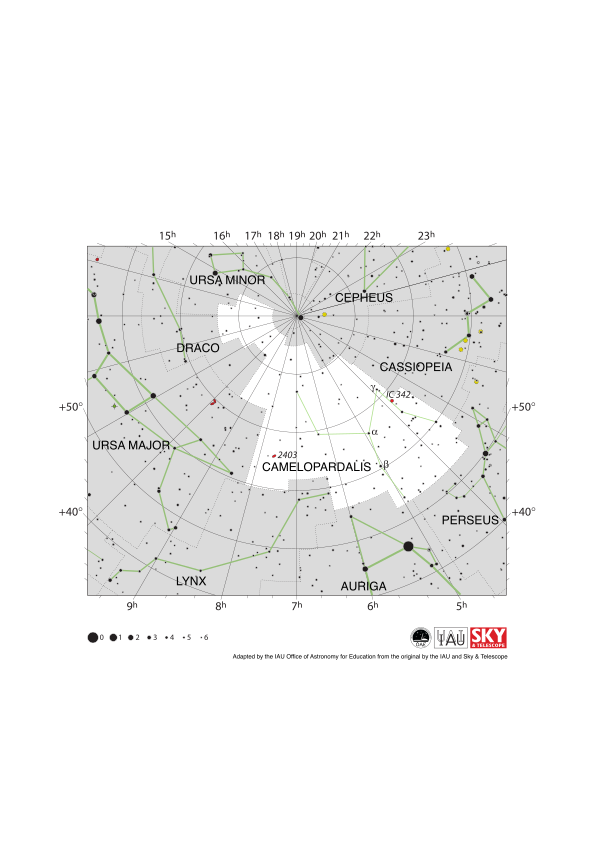
图注: The constellation Camelopardalis with its bright stars and surrounding constellations. Camelopardalis is surrounded by (going clockwise from the top): Cepheus, Cassiopea, Perseus, Auriga, Lynx, Ursa Major, Draco and Ursa Minor. Camelopardalis is a large constellation but contains relatively few bright stars.
Camelopardalis is a northern constellation and as such the whole constellation is visible for the whole northern hemisphere at some point in the year. It is also visible from equatorial parts of the southern hemisphere with some parts visible to temperate southern regions. The whole constellation is circumpolar for all arctic and more northerly temperate regions of the northern hemisphere. Camelopardalis is best viewed in the evening in the late northern hemisphere winter and late southern hemisphere summer.
The spiral galaxies NGC 2403 and IC 342 lie in Camelopardalis and are marked here with red ellipses.
This diagram maps an area around the north celestial pole. Here lines of constant right ascension converge. The right ascension values of these lines are marked on the x-axis above and below the diagram. Some of the lines of constant declination are marked on the y-axis. The sizes of the stars marked here relate to the star's apparent magnitude, a measure of its apparent brightness. The larger dots represent brighter stars. The Greek letters mark the brightest stars in the constellation. These are ranked by brightness with the brightest star being labeled alpha, the second brightest beta, etc., although this ordering is not always followed exactly. The dotted boundary lines mark the IAU's boundaries of the constellations and the solid green lines mark one of the common forms used to represent the figures of the constellations. Neither the constellation boundaries, nor the lines joining the stars appear on the sky.
来源: Adapted by the IAU Office of Astronomy for Education from the original by the IAU and Sky & Telescope
来源链接
词汇表:
视星等 , 天球坐标 , 拱极星 , 星座 , 赤纬 , 北天极(NCP) , 赤经(RA) , 漩涡星系
分类:
肉眼天文学
授权许可: 知识共享许可协议 署名 4.0 国际 (CC BY 4.0) 知识共享许可协议 署名 4.0 国际 (CC BY 4.0) 图标
文件
( 图像
138.40 kB)
PDF 文件
(PDF file
215.25 kB)

Mensa Constellation Map
图像
图注: The constellation Mensa with its brighter stars and surrounding constellations. Mensa is surrounded by (going clockwise from the top): Dorado, Hydrus, Octans, Chamaeleon and Volans. Mensa is a faint constellation with relatively few bright stars.
Mensa lies close to the south celestial pole and thus the whole constellation is visible at some point in the year throughout the southern hemisphere. The whole constellation is visible to a thin strip of the northern hemisphere around the equator with parts of the constellation visible to some other northern equatorial regions. Mensa is circumpolar in temperate, antarctic and some equatorial regions of the southern hemisphere. Mensa is best viewed in the evenings in the northern hemisphere winter and southern hemisphere summer.
The Large Magellanic Cloud (LMC), a satellite galaxy of the Milky Way, lies in Mensa and the neighboring constellation Dorado. The outline of the Large Magellanic Cloud is marked here as a roughly circular loop in green.
This diagram maps an area around the south celestial pole. Here lines of constant right ascension converge. The right ascension values of these lines are marked on the x-axis above and below the diagram. The solid circle around the pole marks a line of -80° declination with the larger, incomplete circle to the right marking -70° declination. The sizes of the stars marked here relate to the star's apparent magnitude, a measure of its apparent brightness. The larger dots represent brighter stars. The Greek letters mark the brightest stars in the constellation. These are ranked by brightness with the brightest star being labeled alpha, the second brightest beta, etc., although this ordering is not always followed exactly. The dotted boundary lines mark the IAU's boundaries of the constellations and the solid green lines mark one of the common forms used to represent the figures of the constellations. Neither the constellation boundaries, nor the lines joining the stars appear on the sky.
来源: Adapted by the IAU Office of Astronomy for Education from the original by the IAU and Sky & Telescope
来源链接
词汇表:
视星等 , 天球坐标 , 星座 , 赤纬 , 赤经(RA)
分类:
肉眼天文学
授权许可: 知识共享许可协议 署名 4.0 国际 (CC BY 4.0) 知识共享许可协议 署名 4.0 国际 (CC BY 4.0) 图标
文件
( 图像
135.16 kB)
PDF 文件
(PDF file
172.00 kB)

Triangulum Australe Constellation Map
图像
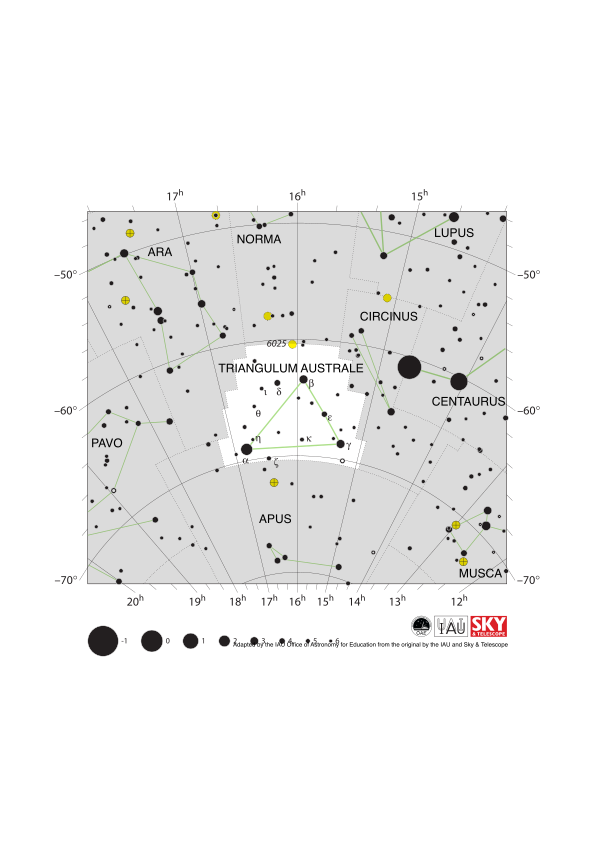
图注: The constellation Triangulum Australe with its bright stars and surrounding constellations. Triangulum Australe is surrounded by (going clockwise from the top): Norma, Circinus, Apus and Ara.
Triangulum Australe is a southern constellation and thus the whole constellation is visible at some point in the year throughout the southern hemisphere. The whole constellation is also visible from some equatorial regions of the northern hemisphere with parts of the constellation visible from the remaining northern equatorial regions. Triangulum Australe is best viewed in the evening in the northern hemisphere summer and southern hemisphere winter.
The open cluster NGC 6025 lies in Triangulum Australe and is marked here with a yellow circle.
The y-axis of this diagram is in degrees of declination with north as up and the x-axis is in hours of right ascension with east to the left. The sizes of the stars marked here relate to the star's apparent magnitude, a measure of its apparent brightness. The larger dots represent brighter stars. The Greek letters mark the brightest stars in the constellation. These are ranked by brightness with the brightest star being labeled alpha, the second brightest beta, etc., although this ordering is not always followed exactly. The dotted boundary lines mark the IAU's boundaries of the constellations and the solid green lines mark one of the common forms used to represent the figures of the constellations. Neither the constellation boundaries, nor the lines joining the stars appear on the sky.
来源: Adapted by the IAU Office of Astronomy for Education from the original by the IAU and Sky & Telescope
来源链接
词汇表:
视星等 , 天球坐标 , 星座 , 赤纬 , 赤经(RA) , 疏散星团
分类:
肉眼天文学
授权许可: 知识共享许可协议 署名 4.0 国际 (CC BY 4.0) 知识共享许可协议 署名 4.0 国际 (CC BY 4.0) 图标
文件
( 图像
112.83 kB)
PDF 文件
(PDF file
166.92 kB)
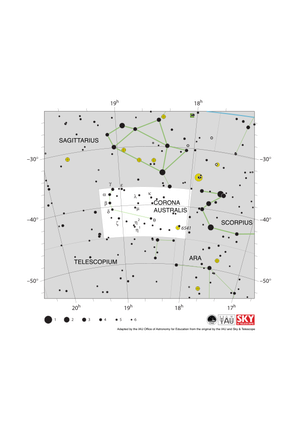
Corona Australis Constellation Map
图像
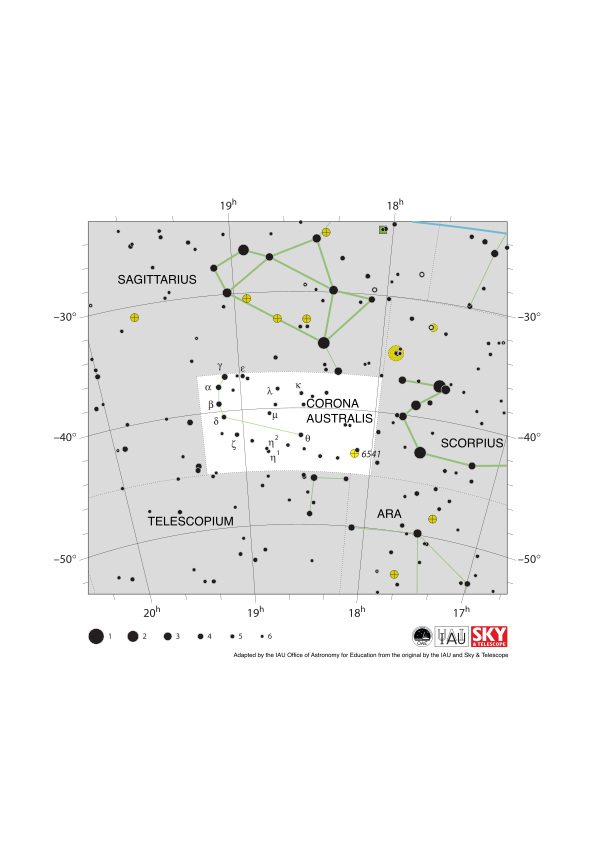
图注: The constellation Corona Australis with its brighter stars and surrounding constellations. Corona Australis is surrounded by (going clockwise from the top): Sagittarius, Scorpius, Ara and Telescopium. This constellation has relatively few bright stars.
Corona Australis is a southern constellation and thus the whole constellation is visible in the southern hemisphere at some point in the year. The constellation can also be viewed from equatorial and some temperate regions of the northern hemisphere. The constellation is best viewed in the evening in the northern hemisphere summer and southern hemisphere winter.
The globular cluster NGC 6541 lies in Corona Australis and is marked here with a yellow circle with a plus sign superimposed on it.
The y-axis of this diagram is in degrees of declination with north as up and the x-axis is in hours of right ascension with east to the left. The sizes of the stars marked here relate to the star's apparent magnitude, a measure of its apparent brightness. The larger dots represent brighter stars. The Greek letters mark the brightest stars in the constellation. These are ranked by brightness with the brightest star being labeled alpha, the second brightest beta, etc., although this ordering is not always followed exactly. The dotted boundary lines mark the IAU's boundaries of the constellations and the solid green lines mark one of the common forms used to represent the figures of the constellations. Neither the constellation boundaries, nor the lines joining the stars appear on the sky. The blue line at the top right of the diagram marks the ecliptic.
来源: Adapted by the IAU Office of Astronomy for Education from the original by the IAU and Sky & Telescope
来源链接
词汇表:
视星等 , 天球坐标 , 星座 , 赤纬 , 黄道 , 球状星团 , 赤经(RA) , 天蝎座 , 人马座
分类:
肉眼天文学
授权许可: 知识共享许可协议 署名 4.0 国际 (CC BY 4.0) 知识共享许可协议 署名 4.0 国际 (CC BY 4.0) 图标
文件
( 图像
88.22 kB)
PDF 文件
(PDF file
158.70 kB)

天琴座地图
图像
图注: 天琴座及其明亮恒星与周边星座示意图。从顶部开始沿顺时针方向,天琴座周边的星座依次为:天龙座、武仙座、狐狸座和天鹅座。该星座最亮的织女星主导着天琴座,其亮度被定义为最常用星等标尺的零点基准。织女星是北半球夏夜显著可见的"夏季大三角" 的一个顶点。
作为北天星座,天琴座在北半球全年皆可观测,赤道地区及南半球部分温带区域也能看到全貌,而南半球其余温带地区仅可见局部。最佳观测时间为北半球夏季与南半球冬季的夜晚。
深空天体:环状星云(M57)在图中以叠加了十字符号的绿色圆圈标注,球状星团M56在图中以黄色圆圈加十字标注。
该图的纵轴为赤纬,横轴为赤经,方向为上北下南左东右西。图中标注的恒星大小对应其视星等——衡量天体视亮度的标准,较大的圆点代表着较亮的恒星。图中的希腊字母标注着星座中最亮的恒星。这些恒星按亮度排序,最亮的一般被标记为α星,第二亮的一般为β星,等等,不过这种字母排序并不总是和实际亮度排序完全一致。图中虚线标注的是国际天文学联合会划定的星座边界,绿色实线则是一种常见的星座形象连线。需要注意的是,在实际观测时,这些边界与连线都不会出现在天空中。
来源: 国际天文学联合会天文教育办公室(IAU OAE)根据国际天文学联合会和《天空与望远镜》的原文改编
来源链接
词汇表:
视星等 , 天球坐标 , 星座 , 赤纬 , 球状星团 , 行星状星云 , 赤经(RA) , 星宿(星群)
分类:
肉眼天文学
授权许可: 知识共享许可协议 署名 4.0 国际 (CC BY 4.0) 知识共享许可协议 署名 4.0 国际 (CC BY 4.0) 图标
文件
( 图像
81.83 kB)
PDF 文件
(PDF file
153.30 kB)