文档与资源 - 搜索结果
搜索结果

Global Temperature Trends: Past 50 Years
图像
图注: This map visualizes the changes in surface air temperature across the globe over the past half-century. Through meticulous analysis of annual averages, the map highlights the most significant trends in temperature change, particularly emphasizing shifts in northern latitudes and over land masses.
来源: NASA’s Scientific Visualization Studio, Key and Title by Eric Fisk
来源链接
词汇表:
全球气候变暖
分类:
地球
授权许可: 知识共享许可协议 署名 4.0 国际 (CC BY 4.0) 知识共享许可协议 署名 4.0 国际 (CC BY 4.0) 图标
文件
( 图像
108.48 kB)
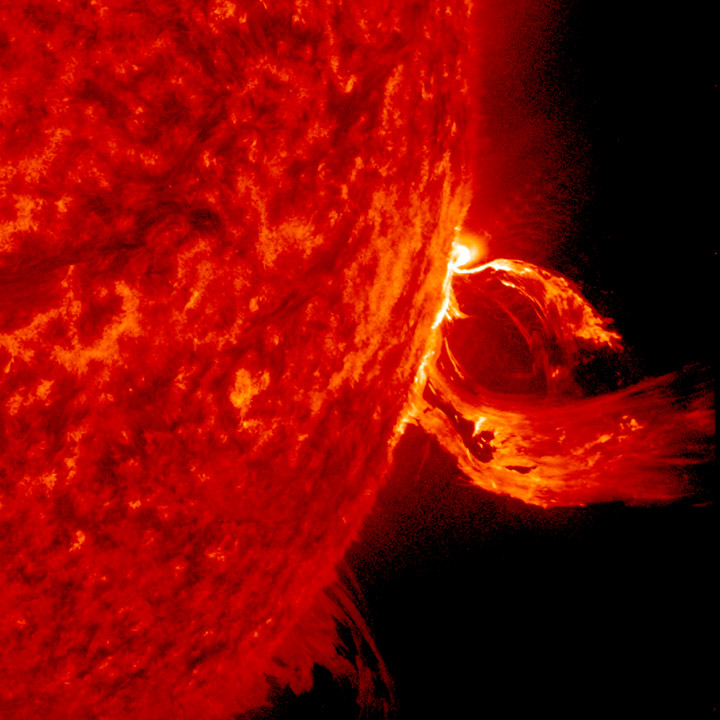
A Coronal Mass Ejection
图像
图注: A burst of solar material can be seen erupting from the Sun in this view, illustrating a coronal mass ejection (CME)—a large eruption of plasma and magnetic field from the Sun’s outer atmosphere, or corona. These CMEs are caused by magnetic explosions in the Sun's corona. During a CME, huge amounts of electrically charged particles are launched into space at great speeds, carrying part of the Sun’s magnetic field with them. These events are driven by changes in the Sun’s magnetic structure and release vast clouds of hot gas that travel outward into the solar system. When a CME moves through space, it can interact with a planet’s magnetic field and atmosphere, sometimes creating spectacular auroras or, in strong cases, interfering with artificial satellites and power systems.
CMEs are often associated with a temporary brightening of the region of the Sun where the CME originated. This is known as a solar flare. Stars other than the Sun can also have CMEs and flares.
This image was taken by NASA's Solar Dynamics Observatory (SDO). This is a space mission to monitor the Sun. The image here is taken at a special wavelength which partially ionised helium emits strongly at.
来源: NASA/Goddard/SDO
来源链接
词汇表:
太阳 , 日冕物质抛射(CME)
授权许可: 公共领域 公共领域 图标
文件
( 图像
596.22 kB)

Venus Transit from Tempe, AZ, USA , June 5, 2012
图像
图注: While the planet Venus regularly passes between the Sun and the Earth, most of the time it passes above or below the Sun when observed from Earth. On rare occasions, the planet Venus passes directly in front of the Sun for observers on Earth. The last such Venus transits were in 2004 and 2012, respectively. The next such transit will be in 2117. The picture was taken at 18:54 PDT on June 5, 2012, from Tempe, Arizona, US. The telescope used was an 8" Schmidt-Cassegrain with ND5 filter; the camera was a Sony NEX5N with the APS sensor placed at prime focus. Clearly visible are the disk of the Sun, Venus as a prominent round spot. Several sun spots also appear on the solar disk.
来源: Stephen Rector
来源链接
词汇表:
凌 , 金星
分类:
太阳系
授权许可: 知识共享许可协议 Attribution-ShareAlike 3.0 Unported 知识共享许可协议 Attribution-ShareAlike 3.0 Unported 图标
文件
( 图像
4.60 MB)

The Crab Nebula
图像
图注: The Crab Nebula is situated 6500 light years away in the constellation Taurus. This is remnant of a supernova explosion caused by a massive star at the end of its life. This happened several thousand years ago but the light from this explosion only reached the Earth in the year 1054. This celestial event was viewed by people across the world with many different societies noting it in their records.
The force of the supernova explosion has pushed pushed the outer layers of the star out into the surrounding gas. Here we see this as the bubbly orange structure as the force of the explosions ploughs into the surrounding gas. At its heart lies the Crab Nebula Pulsar, a neutron star that is the remains of the exploded star. This neutron star has a strong magnetic field. Electrons in nebula dance in this magnetic field, emitting the diffuse blue light we see inside the orange bubble.
来源: NASA, ESA, J. Hester and A. Loll (Arizona State University)
来源链接
词汇表:
超新星遗迹
分类:
银河系与星际介质
, 恒星
授权许可: 公共领域 公共领域 图标
文件
( 图像
24.55 MB)

The giant elliptical galaxy ESO 325-G004
图像
图注: The giant elliptical galaxy ESO 325-G004 sits in the Abell S0740 galaxy cluster. This huge galaxy has a mass of approximately a hundred billion solar masses. ESO 325-G004 is brightest in its core with its brightness decreasing further from its center. This galaxy has no visible spiral structure or dust lanes. ESO 325-G004 and many of the smaller galaxies around it are members of the galaxy cluster Abell S0740.
来源: Cropped from the original by NASA, ESA, and The Hubble Heritage Team (STScI/AURA); J. Blakeslee (Washington State University)
来源链接
词汇表:
椭圆星系 , 星系团
分类:
星系
授权许可: 公共领域 公共领域 图标
文件
( 图像
108.45 kB)