文档与资源 - 搜索结果
搜索结果
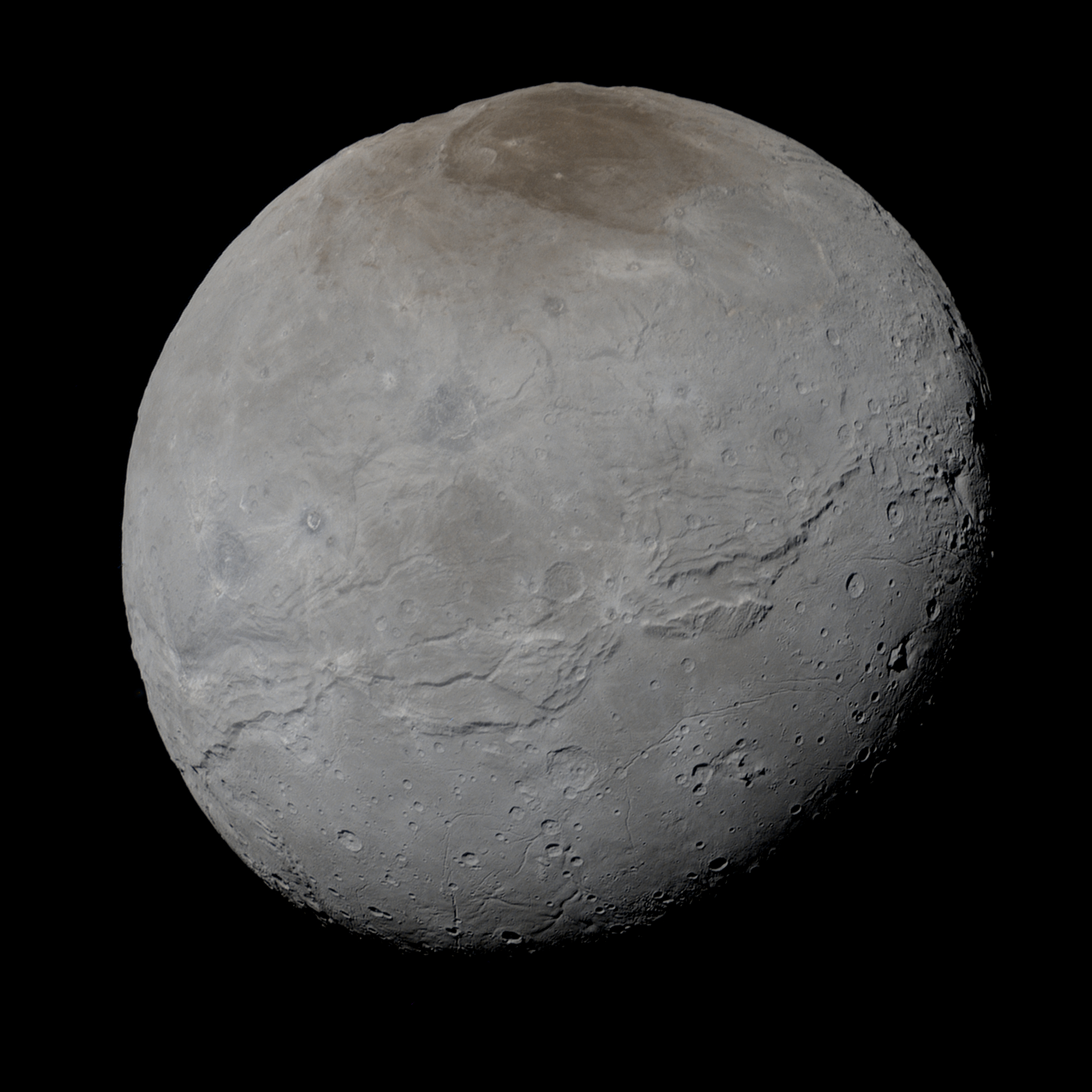
Detailed View of Charon, Moon of Pluto
图像
图注: Charon is the largest natural moon of the dwarf planet Pluto. This detailed image was taken by NASA’s New Horizons spacecraft in 2015 during its historic mission through the outer Solar System. Charon’s surface shows a fascinating mix of light and dark regions, including vast canyons, broad plains, and impact crater. With a diameter of about 1,200 kilometers, Charon is more than half the diameter of Pluto, making it unusually large compared to its parent body. Charon's mass is roughly 12% of that of Pluto.
Because Pluto and Charon are so close in mass, the center of mass of the system (the point both Pluto and Charon orbit) is not within Pluto but between Pluto and Charon. This is in contrast to systems like the Earth and its Moon where the center of mass lies within the larger body, the Earth in this case. Scientists think the Pluto-Charon system may have formed by a collision of two objects that then separated and began to orbit each other. By studying Charon and the smaller moons that circle Pluto, astronomers gain insight into how moons form and how distant icy bodies evolve over billions of years.
来源: NASA/Johns Hopkins University Applied Physics Laboratory/Southwest Research Institute/Alex Parker
来源链接
词汇表:
卫星 , 冥王星
授权许可: 公共领域 公共领域 图标
文件
( 图像
2.88 MB)

Neptune’s Moon Triton Fosters Rare Icy Union
图像
图注: An image of Neptune's moon Triton taken by NASA's Voyager 2 spacecraft. This image covers the south pole region of Triton. Triton's surface is covered by an icy mix of frozen nitrogen, water and carbon dioxide. Below the surface some of these compounds are thought to be in a liquid state. These liquids can burst out of the surface through geysers. These geysers produce the dark streaks seen in this image.
来源: NASA/JPL
来源链接
词汇表:
卫星 , 海神 , 海卫一
分类:
太阳系
授权许可: 知识共享许可协议 署名 4.0 国际 (CC BY 4.0) 知识共享许可协议 署名 4.0 国际 (CC BY 4.0) 图标
文件
( 图像
506.41 kB)
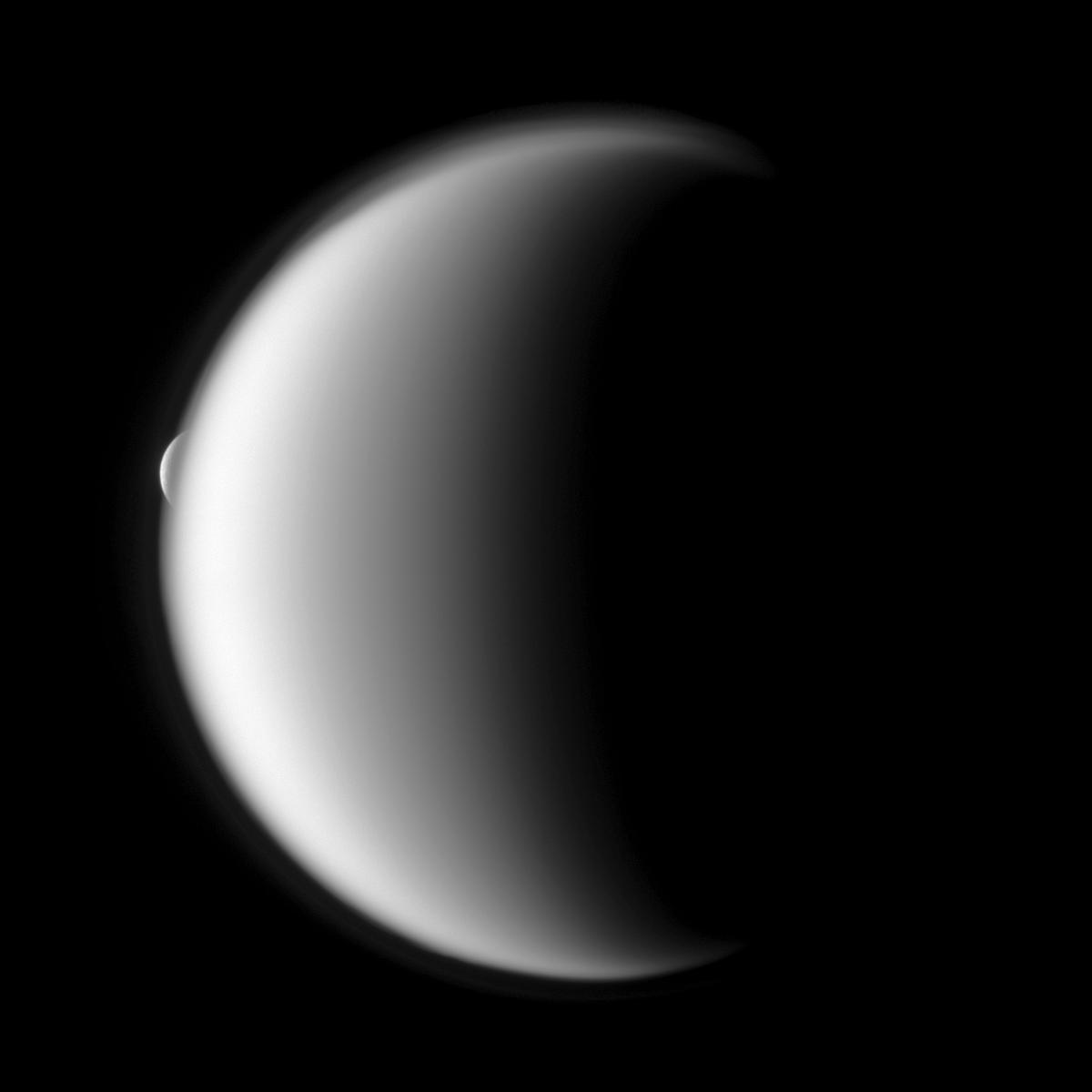
Rhea reappearing after occultation by Titan
图像
图注: On October 27, 2009, NASA’s Cassini spacecraft orbiting around Saturn captured this view of Saturn's moon Rhea as it began to emerge after being hidden by Saturn's largest moon Titan during an occultation. An occultation is a celestial event in which one object moves in front of another and temporarily blocks the first object from view.
In this image, Titan — about 5,150 km across — was closer to the spacecraft at about 1 million km, while Rhea — roughly 1,528 km in diameter — was farther away at about 2.3 million km. Titan’s high-altitude atmospheric haze is visible as a faint glow around its limb, showing the difference in surface and atmospheric properties between these two moons.
Scientists study occultations like this because watching how one moon disappears behind or reappears from another helps refine our understanding of their orbits and physical characteristics.
来源: NASA/JPL/Space Science Institute
来源链接
词汇表:
卫星 , 泰坦 , 掩星
授权许可: 公共领域 公共领域 图标
文件
( 图像
85.73 kB)

Moon map from the NASA Clementine mission
图像
图注: A map of the Moon's surface constructed of images taken by the BMDO/NASA Clementine mission. The center of the image corresponds roughly to the center of the full moon. This map is a projection of the spherical moon onto a flat surface so the regions around the poles appear distorted, just as Antarctica appears distorted on a map of the Earth.
The large, dark patches in the center of the image are maria (singular mare). These are named after the Latin word for sea but they are not oceans like we have on Earth. Instead they are vast plains of basalt formed by lava that flowed out of volcanos on the moon billions of years ago. They appear darker and smoother than the older, lighter lunar highlands.
来源: USGS Astrogeology Science Center;
来源链接
词汇表:
月球 , 月海
分类:
太阳系
授权许可: 公共领域 公共领域 图标
文件
( 图像
302.21 kB)
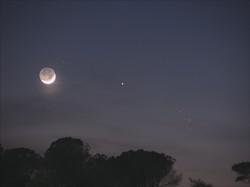
月球-水星-昴星团相合
图像
为 OAE 制作
图注: 2022年国际天文学联合会(IAU)OAE天文摄影比赛静态天体图案类别荣誉奖作品。
这张照片展示了年轻的月牙,其右侧是昴星团中的九颗最亮的恒星(其中一颗被云层遮挡)。照片中央是水星,看上去略带红色。
这幅图片更倾向于表明昴星团可能由七颗星组成。然而,观察者被云层误导了——五颗星组成了一辆小战车,一颗紧挨着车把,另外三颗在四边形的另一端。如果没有云层,八颗星将清晰可见。
蛾眉月与昴星团相伴的这种天象仅在北半球的春天才能看到。因此,古巴比伦人利用它来确定一年中的第二个月,并判断是否需要闰月。至少早在公元前第二个千年,巴比伦人就利用多个星群来确定月份。每隔五天,下一个星群就会在隐没于日光后再次出现。为了确定闰年的必要性,使太阳年和阴历年同步,巴比伦人使用了多个星群,而不仅仅是昴星团。例如,他们还利用了明亮的心宿二和天狼星,并观测到了它们伴月的天象以及偕日升的天象。现代犹太教和现代伊斯兰教仍在遵循传统,使用巴比伦的一些天文规则。然而,鉴于星座由于岁差而发生了移动,而且如今我们也有了计算历法的手段,这种蛾眉月和昴星团相伴的天象就不再那么有用了,尽管它依然如此优美。因此,古巴比伦和中巴比伦的传统仅存留了基本的形式。此外,长期以来一直声称青铜时代欧洲的内布拉星盘上描绘了这种天象,但这种说法不太可能属实。
本照片于2022年5月在意大利厄尔巴岛拍摄。
来源: Giulio Colombo/ IAU OAE
词汇表:
合 , 水星 , 月球 , 蛾眉月 , 新月 , 昴宿星团
分类:
肉眼天文学
授权许可: 知识共享许可协议 署名 4.0 国际 (CC BY 4.0) 知识共享许可协议 署名 4.0 国际 (CC BY 4.0) 图标
此文件在 Zenodo 上 ( 图像 420.90 kB)