文档与资源 - 搜索结果
搜索结果
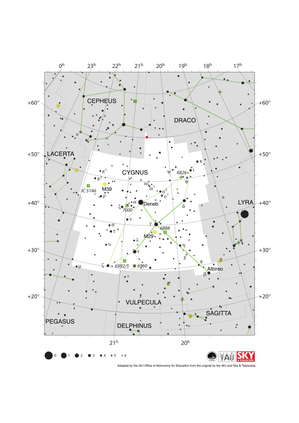
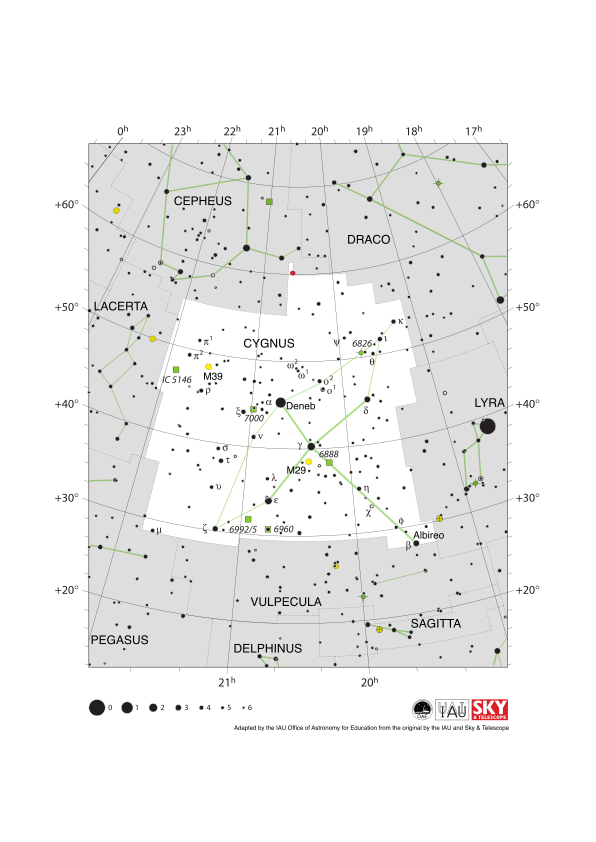
Cygnus Constellation Map
图像
图注: The constellation Cygnus with its bright stars and surrounding constellations. Cygnus is surrounded by (going clockwise from the top): Cepheus, Draco, Lyra, Vulpecula, Pegasus and Lacerta. Cygnus is notable for its brightest star Deneb. This forms one vertex of the prominent Summer Triangle asterism that is visible in northern hemisphere summer evenings.
Cygnus is a northern constellation and thus the whole of the constellation is visible at some point in the year in the whole northern hemisphere. The whole constellation is also visible from equatorial regions of the southern hemisphere with parts of the constellation visible from temperate southern regions.
The plane of the Milky Way runs through Cygnus and thus the constellation is rich in nebulae and star clusters. These include the North America Nebula (NGC 7000) and the Crescent Nebula (NGC 6888). The Veil Nebula is a huge supernova remnant, parts of which are marked here as NGC 6960 and NGC 6992/5. All of the previously-mentioned nebulae are marked with green squares. The planetary nebula NGC 6826 is marked here with a green circle superimposed on a plus sign. The open star clusters M29 and M39 are marked here with yellow circles.
The y-axis of this diagram is in degrees of declination with north as up and the x-axis is in hours of right ascension with east to the left. The sizes of the stars marked here relate to the star's apparent magnitude, a measure of its apparent brightness. The larger dots represent brighter stars. The Greek letters mark the brightest stars in the constellation. These are ranked by brightness with the brightest star being labeled alpha, the second brightest beta, etc., although this ordering is not always followed exactly. The dotted boundary lines mark the IAU's boundaries of the constellations and the solid green lines mark one of the common forms used to represent the figures of the constellations. Neither the constellation boundaries, nor the lines joining the stars appear on the sky.
来源: Adapted by the IAU Office of Astronomy for Education from the original by the IAU and Sky & Telescope
来源链接
词汇表:
视星等 , 天球坐标 , 星座 , 赤纬 , 银河系 , 星云 , 行星状星云 , 赤经(RA) , 星宿(星群) , 疏散星团 , 超新星遗迹
分类:
肉眼天文学
授权许可: 知识共享许可协议 署名 4.0 国际 (CC BY 4.0) 知识共享许可协议 署名 4.0 国际 (CC BY 4.0) 图标
文件
( 图像
150.09 kB)
PDF 文件
(PDF file
216.56 kB)

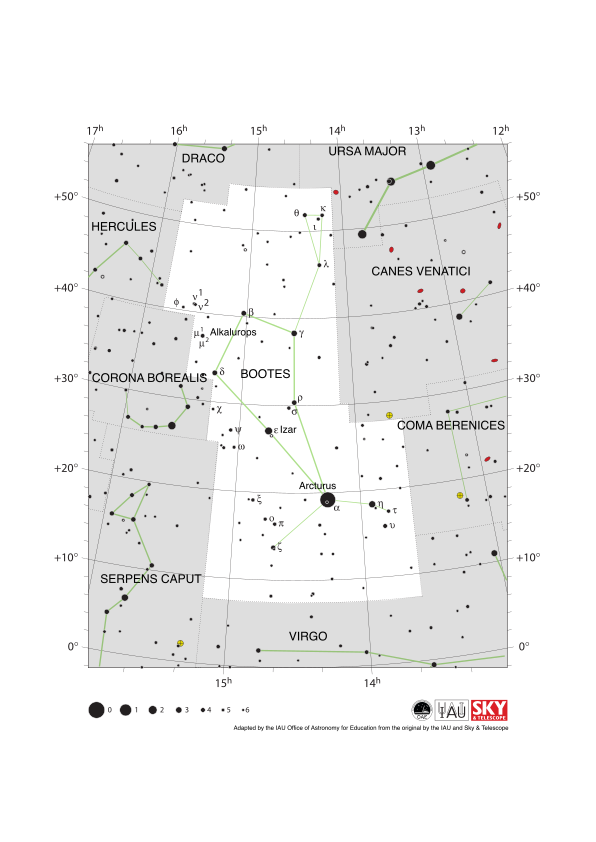
Boötes Constellation Map
图像
图注: The constellation Boötes with its bright stars and surrounding constellations. Boötes is surrounded by (going clockwise from the top): Draco, Ursa Major, Canes Venatici, Coma Berenices, Virgo, Serpens Caput, Corona Borealis and Hercules. It is notable for its brightest star Arcturus which is the fourth brightest star in the night sky.
Boötes is a northern constellation and the whole constellation is visible to the entire northern hemisphere at some point in the year. Parts of the constellation are visible from all but the most antarctic parts of the southern hemisphere but the whole constellation is only visible from equatorial and some temperate parts of that hemisphere. Boötes is most visible in the evenings in the northern hemisphere summer and southern hemisphere winter.
The y-axis of this diagram is in degrees of declination with north as up and the x-axis is in hours of right ascension with east to the left. The sizes of the stars marked here relate to the star's apparent magnitude, a measure of its apparent brightness. The larger dots represent brighter stars. The Greek letters mark the brightest stars in the constellation. These are ranked by brightness with the brightest star being labeled alpha, the second brightest beta, etc., although this ordering is not always followed exactly. The dotted boundary lines mark the IAU's boundaries of the constellations and the solid green lines mark one of the common forms used to represent the figures of the constellations. Neither the constellation boundaries, nor the lines joining the stars appear on the sky.
来源: Adapted by the IAU Office of Astronomy for Education from the original by the IAU and Sky & Telescope
来源链接
词汇表:
视星等 , 天球坐标 , 星座 , 赤纬 , 赤经(RA)
分类:
肉眼天文学
授权许可: 知识共享许可协议 署名 4.0 国际 (CC BY 4.0) 知识共享许可协议 署名 4.0 国际 (CC BY 4.0) 图标
文件
( 图像
123.58 kB)
PDF 文件
(PDF file
185.26 kB)
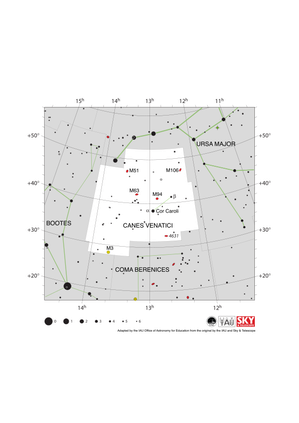
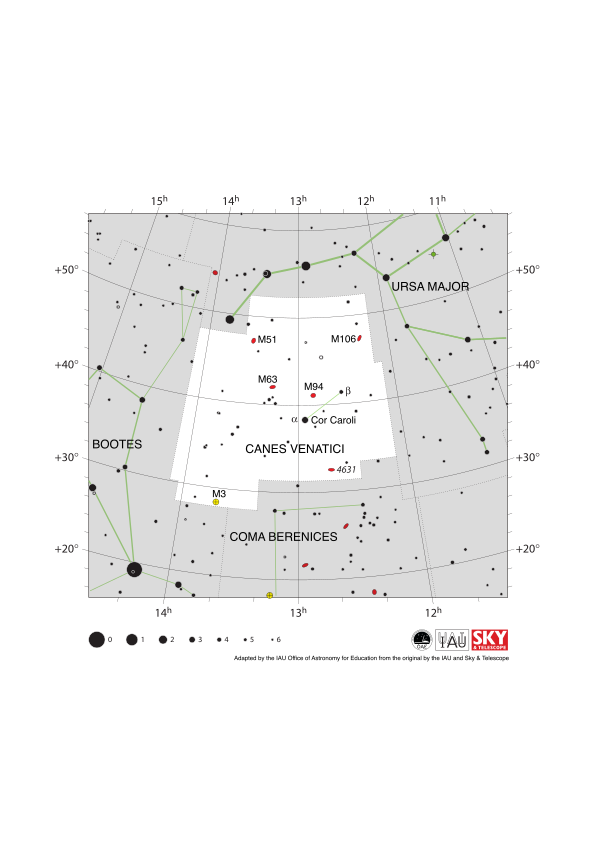
Canes Venatici Constellation Map
图像
图注: The constellation Canes Venatici with its brighter stars and surrounding constellations. Canes Venatici is surrounded by (going clockwise from the top): Ursa Major, Coma Berenices and Boötes.
Canes Venatici is a northern constellation and thus the whole constellation is visible at some point in the year from the whole of the northern hemisphere. The whole of the constellation is also visible from equatorial regions of the southern hemisphere with parts of it visible from temperate southern regions. The constellation is best viewed in the northern hemisphere late spring and southern hemisphere late autumn.
The famous spiral galaxy commonly known as the Whirlpool Galaxy (M51) lies in Canes Venatici and is marked here with a red ellipse. Other notable spiral galaxies in the constellation include M63, M94, M106 and NGC 4631. All are marked here with red ellipses. The globular cluster M3 is marked here with a yellow circle with a plus symbol superimposed on it.
The y-axis of this diagram is in degrees of declination with north as up and the x-axis is in hours of right ascension with east to the left. The sizes of the stars marked here relate to the star's apparent magnitude, a measure of its apparent brightness. The larger dots represent brighter stars. The Greek letters mark the brightest stars in the constellation. These are ranked by brightness with the brightest star being labeled alpha, the second brightest beta, etc., although this ordering is not always followed exactly. The dotted boundary lines mark the IAU's boundaries of the constellations and the solid green lines mark one of the common forms used to represent the figures of the constellations. Neither the constellation boundaries, nor the lines joining the stars appear on the sky.
来源: Adapted by the IAU Office of Astronomy for Education from the original by the IAU and Sky & Telescope
来源链接
词汇表:
视星等 , 天球坐标 , 星座 , 赤纬 , 球状星团 , 赤经(RA) , 漩涡星系
分类:
肉眼天文学
授权许可: 知识共享许可协议 署名 4.0 国际 (CC BY 4.0) 知识共享许可协议 署名 4.0 国际 (CC BY 4.0) 图标
文件
( 图像
93.71 kB)
PDF 文件
(PDF file
165.31 kB)
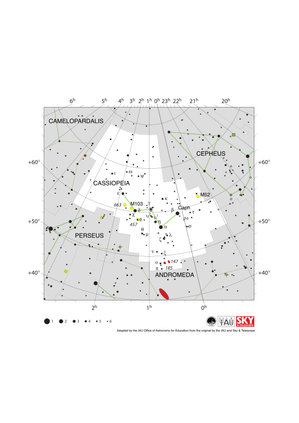
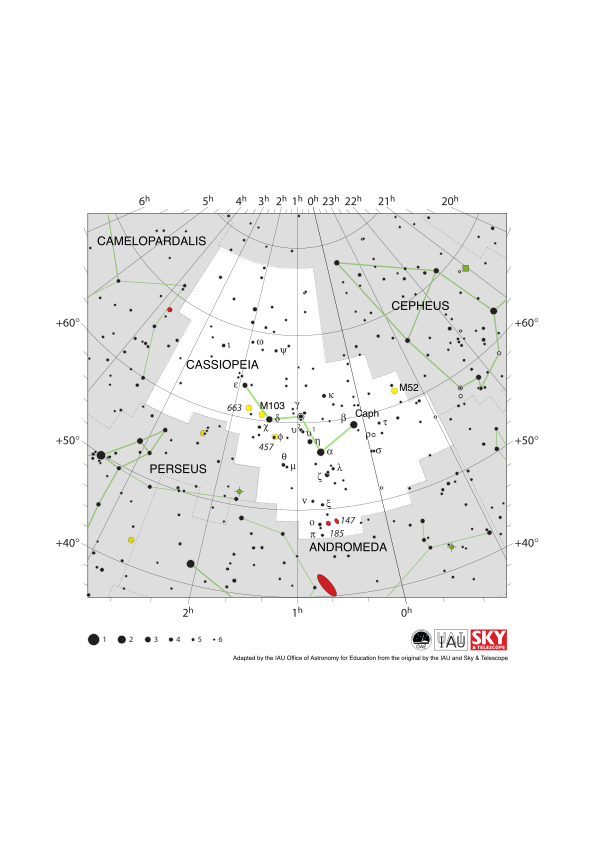
Cassiopeia Constellation Map
图像
图注: The constellation Cassiopeia along with its bright stars and its surrounding constellations. Cassiopeia is surrounded by (going clockwise from the top):Cepheus, Andromeda, Perseus and Camelopardalis.
Cassiopeia is a northern constellation that is visible from all of the northern hemisphere and equatorial regions of the southern hemisphere. It is most visible in the evenings in the northern hemisphere late autumn and southern hemisphere late spring.
The open star clusters M52, M103, NGC 457 and NGC 663 all lie in this constellation. These are marked with yellow circles. Two dwarf elliptical galaxies NGC 147 and NGC 185 lie in the southern part of the constellation. These are marked with red ellipses and are gravitationally bound to the larger Andromeda galaxy which lies to the south in the constellation of Andromeda.
The y-axis of this diagram is in degrees of declination with north as up and the x-axis is in hours of right ascension with east to the left. The sizes of the stars marked here relate to the star's apparent magnitude, a measure of its apparent brightness. The larger dots represent brighter stars. The Greek letters mark the brightest stars in the constellation. These are ranked by brightness with the brightest star being labeled alpha, the second brightest beta, etc., although this ordering is not always followed exactly. The dotted boundary lines mark the IAU's boundaries of the constellations and the solid green lines mark one of the common forms used to represent the figures of the constellations. Neither the constellation boundaries, nor the lines joining the stars appear on the sky.
来源: Adapted by the IAU Office of Astronomy for Education from the original by IAU/Sky & Telescope
来源链接
词汇表:
仙女座 , 仙女座星系 , 视星等 , 天球坐标 , 拱极星 , 星座 , 赤纬 , 矮星系 , 赤经(RA) , 疏散星团
分类:
肉眼天文学
授权许可: 知识共享许可协议 署名 4.0 国际 (CC BY 4.0) 知识共享许可协议 署名 4.0 国际 (CC BY 4.0) 图标
文件
( 图像
125.52 kB)
PDF 文件
(PDF file
193.50 kB)

Corona Borealis Constellation Map
图像
图注: The constellation Corona Borealis with its bright stars and surrounding constellations. Corona Borealis is surrounded by (going clockwise from the top): Boötes, Serpens Caput and Hercules.
Corona Borealis is a northern constellation and thus the constellation is visible from the whole northern hemisphere at some point in the year. It whole constellation is also visible from equatorial and most temperate regions of the southern hemisphere. The constellation is best viewed in the evening in the northern hemisphere summer and southern hemisphere winter.
The y-axis of this diagram is in degrees of declination with north as up and the x-axis is in hours of right ascension with east to the left. The sizes of the stars marked here relate to the star's apparent magnitude, a measure of its apparent brightness. The larger dots represent brighter stars. The Greek letters mark the brightest stars in the constellation. These are ranked by brightness with the brightest star being labeled alpha, the second brightest beta, etc., although this ordering is not always followed exactly. The dotted boundary lines mark the IAU's boundaries of the constellations and the solid green lines mark one of the common forms used to represent the figures of the constellations. Neither the constellation boundaries, nor the lines joining the stars appear on the sky.
来源: Adapted by the IAU Office of Astronomy for Education from the original by the IAU and Sky & Telescope
来源链接
词汇表:
视星等 , 天球坐标 , 星座 , 赤纬 , 赤经(RA)
分类:
肉眼天文学
授权许可: 知识共享许可协议 署名 4.0 国际 (CC BY 4.0) 知识共享许可协议 署名 4.0 国际 (CC BY 4.0) 图标
文件
( 图像
80.08 kB)
PDF 文件
(PDF file
154.15 kB)