Documents & Resources - Search Results
Search results

The Milky Way Across the Zenith
image
Created for the OAE
Caption: Winner in the 2022 IAU OAE Astrophotography Contest, category Still images of celestial patterns.
This all-sky image shows our home galaxy, the Milky Way, crossing the zenith, the point just above the observer as seen from Nagano, Japan, in May 2019. Such images of the whole sky can be taken either with a fish-eye lens or with a convex mirror on the ground, the latter of which would show the photographer as well.
Some of the brightest stars in the night sky can be seen in this image, as well as two of the giant planets of our Solar System: Jupiter, the brightest point in the bottom of this image, and Saturn, another bright point just to the opposite side of the Galaxy, to the bottom and next to the horizon.
Directly right of the Milky Way and below Jupiter, we can spot the bright red star Antares, the primary star of the Japanese asterism of The Heart. Japanese constellations derive from ancient Chinese constellations, which were adopted with only slight or no changes. In this tradition, The Heart is the heart of the “Azure Dragon”, a super-constellation that represents the spring. In the Babylonian and Greco-Roman traditions, this area is considered the heart of the Scorpion. In Babylonian religion, the star is associated with Lisi, the child of the mother goddess, but in Greek mythology it is related to the planet Mars, because of its colour. The reddish colour also led to the star’s Chinese name “The Fire Star”. We know that this colour is caused by its relatively cool temperature.
Going from Antares to the right of the image, we find the more northern parts of the sky. The bright star in the lower-right of the image, close to the horizon, is Arcturus, located in the modern constellation Boötes. While Antares and its surrounding area are considered the heart of the Azure Dragon, Arcturus and Spica (below the horizon) are two single-star asterisms forming its huge horn. Pointing towards it from above, at the right-hand edge of the image’s horizon, we can see the handle of the Big Dipper, or Plough, which is part of the constellation Ursa Major.
The bright point to the right of the galaxy and just above the middle of the image is Vega, located in the modern constellation Lyra. Extending a line to the other side of the Galaxy and a bit lower in the image we can find Altair, in the constellation Aquila. From that point we extend another line to Deneb, the brightest star in the constellation of the Swan, also a bit higher in this image and completely flooded by the Milky Way. These three bright stars comprise the asterism known as the Summer Triangle in the northern hemisphere.
Credit: Ohnishi Kouji/IAU OAE
Glossary Terms:
Jupiter , Milky Way , Saturn , Scorpius
Categories:
Milky Way and Interstellar Medium
, Naked Eye Astronomy
License: Creative Commons Attribution 4.0 International (CC BY 4.0) Creative Commons Attribution 4.0 International (CC BY 4.0) icons
This file on Zenodo ( image 11.13 MB)
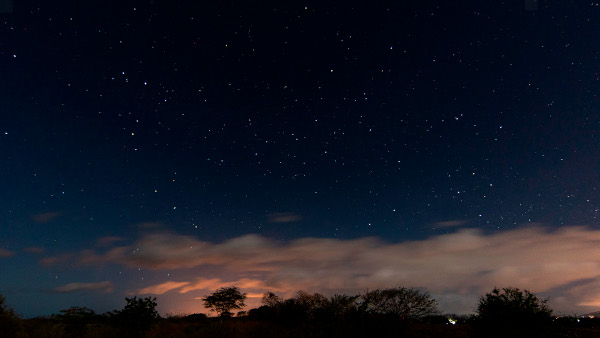
Sky Over the Town of Nindirí, in Masaya, Nicaragua
image
Created for the OAE
Caption: Honourable mention in the 2022 IAU OAE Astrophotography Contest, category Still images of celestial patterns.
This image was taken in Tisma, Nicaragua, in April 2022 during a night illuminated by the Moon. Still, some constellations are visible, but the Milky Way, which runs through the image with some of its brightest regions, hides in the celestial background, partially obscured by terrestrial clouds.
The Scorpion, one of the constellations of the Zodiac, is seen on the left side. We can first spot the brightest star, Antares, in the middle of a group of three in an asterism that looks like the stem of a flower growing from the clouds upwards. Its petals are the head of the scorpion. In the brightness of moonlight, the orange colour of Antares is not clearly visible. The three stars that comprise the head of the scorpion are called Acrab, Dschubba and Fang. They were recently named by the IAU in order to show the global diversity of constellations. Acrab is the Arabic term for the scorpion and Fang (The Room) is the name of the Chinese constellation made out of these stars. The Scorpion’s tail extends to the bottom of the image with the sting just above the horizon in the gap between clouds.
The constellation Centaurus is visible in the middle of this image. We can first recognise Crux and the two pointer stars, Alpha and Beta Centauri right above the clouds. The pointers are the front hooves of the centaur, while the stars of Crux were originally (before Christanity, in antiquity) considered one of the rear legs of the centaur. The stars in the front hooves are Rigil Kentaurus (mixed Arabic and Latin meaning The Foot of the Centaur), to the left, and Hadar, to the right. With Crux at the rear they comprise the legs of the mythological creature’s horse body. The humanoid torso is represented by two bright stars on the shoulders and three fainter stars for the head. The star tale says that this figure represents Chiron, the only decent one among the centaurs who was well educated and the teacher of all great heroes.
The Christian navigators who sailed to the New World around 1500 used these asterisms, although they had never seen them before in Europe. These included explorer Amerigo Vespucci whose name was given to the continent America. His shipmate Andrea Corsali, who came from Florence, where the poet Dante Alighieri was famous for his Divine Comedy written two centuries earlier, was reminded of Dante's poem by the four bright stars of Crux. It was probably in this context that they happened to invent the constellation Crux. Originally, the navigators only used the asterism for practical purposes but some time later, in the period of Christian religious wars between several new churches, celestial cartographers used the cross as a symbol of unity and against war.
Credit: René Antonio Urroz Álvarez/IAU OAE
Glossary Terms:
Scorpius , Alpha Centauri
Categories:
Naked Eye Astronomy
License: Creative Commons Attribution 4.0 International (CC BY 4.0) Creative Commons Attribution 4.0 International (CC BY 4.0) icons
This file on Zenodo ( image 1.72 MB)

The Milky Way Over Anglers Reach
image
Created for the OAE
Caption: Winner in the 2022 IAU OAE Astrophotography Contest, category Still images of celestial patterns.
The Milky Way and several astronomical objects are seen in this image taken from the southern hemisphere, in Anglers Reach, Australia, in April 2022.
On the bottom-left side we can identify the constellation Scorpius with its brightest star, Antares, the reddish spot just above the arc. Some prominent but small southern constellations can also be seen: the dominating bright stars in the middle-left of the image in the Milky Way are the four bright stars of Crux (the Southern Cross) and to its left the two pointer stars, alpha and beta Centauri. Crux points towards the southern celestial pole, which is not marked by a bright star, and The pointer stars point towards Crux, distinguishing it from the asterism of the False Cross in the constellation Argo.
Crux features on the national flags of Australia, Brazil, Papua New Guinea, Samoa and New Zealand. As Crux lies in the brightest parts of the Milky Way, the dark cloud of the famous Coalsack Nebula is prominent next to the bright stars. It forms one of the dark constellations in South American, South African and Australian indigenous cultures. The huge Australian dark constellation of the Emu is almost completely above the horizon in this image, stretching from its head in the Coal Sack to the horizon.
In Greek antiquity, the stars of Crux also belonged to the constellation Centaurus, a hybrid creature with a human torso and head attached to a horse body with four legs. The Greek centaur represents Chiron, the wise teacher of all Greek heroes. Its brightest star is Rigil Kentaurus (Alpha Centauri), the front hoof of the centaur. Just below it, we find the small constellation Triangulum Australe. The triple star system of Alpha Centauri is our Sun’s nearest stellar neighbour.
Along the Milky Way in the middle-right of the picture we find the huge constellation Argo, the Ship. The smaller ancient constellation Argo was extended by Dutch navigators around 1600, and the number of stars in this constellation was then so big that the 18th-century French mathematician Lacaille needed to introduce subtitles for Argo in his star catalogue. In doing so, he invented the constellations Puppis, Carina and Vela. In Carina, the Keel of the ship, this reddish photograph clearly displays the Carina Nebula.
At the right edge of the image we can spot the brightest star in the night sky, Sirius, while the second brightest star, Canopus, the rudder of Argo, the Ship, dominates the area under the arch of the Milky Way.
Also below the Milky Way arc, we can see the Large Magellanic Cloud and the Small Magellanic Cloud, which are small satellite galaxies of our own Galaxy.
Credit: Lucy Yunxi Hu/IAU OAE
Glossary Terms:
Color , Dust , Milky Way , Scorpius , Southern Cross , Dust Cloud , Interstellar Extinction , Large Magellanic Cloud (LMC) , Small Magellanic Cloud (SMC) , Alpha Centauri
Categories:
Galaxies
, Milky Way and Interstellar Medium
, Naked Eye Astronomy
License: Creative Commons Attribution 4.0 International (CC BY 4.0) Creative Commons Attribution 4.0 International (CC BY 4.0) icons
This file on Zenodo ( image 9.39 MB)

Drive
image
Created for the OAE
Caption: Honourable mention in the 2022 IAU OAE Astrophotography Contest, category Still images of celestial patterns.
This image shows the Milky Way crossing the sky above the historical Bixby Bridge in Big Sur, a mountainous region in California, USA, in May 2021.
The star directly above the shore is Antares, a red supergiant in the heart of the Scorpion. To its left, the clouds of the Milky Way seem to emerge from the same point of the horizon as the rocky landmass. Above the land, below the Milky Way in the left quarter of the image, is another bright star, Altair, the bright star in Aquila, the Eagle.
The scorpion is considered a dangerous animal, so scorpion-men (human-scorpion hybrids) guarded the gate to the Netherworld in ancient Babylonian stories, as reported in the Gilgamesh saga. The Eagle, in contrast, appears in the Babylonian saga of King Etana who was taken to the sky by an Eagle and describes the world that he sees below him with increasing distance. Both heroes, Gilgamesh and Etana, are searching for the “herb of life” but one of them by going down, the other by travelling upwards. Gilgamesh aims to get back his dead friend Enkidu and to become immortal himself, while Etana is seeking the herb to help his wife become pregnant. The scorpion and the eagle are the animals supporting these heroes in their search, that ultimately remained unsuccessful. Gilgamesh finally learned that humans can only become immortal by their good deeds for humanity. The Eagle was also recognised in Greek culture, but it was only in Roman times that it became a messenger of a dead soul, carrying it towards the eternal stars. This was when Ptolemy created a constellation to represent the soul of Antinuous below the classical Eagle. This young friend and consultant of the Roman emperor Hadrian drowned in the Nile only seven years before the completion of the Almagest, and the whole Roman empire observed a state of national mourning.
The Milky Way is seen as a “pathway of souls” by many cultures, but in the Babylonian culture, this is not the case. Still, in Greco-Roman philosophy, the bright white parts of it between Antares and Altair, at the intersection of the Milky Way and the Zodiac do have a meaning: Plato, Macrobius and other philosophers refer to it as “the X in the sky”, and the second Celestial Gate was probably considered to be here (the first one being the gate formed by the Hyades and Pleiades).
These celestial pathways and gates, depicted above a gigantic bridge in the landscape and a site where the realms of land and ocean meet, make for an incredibly charged photograph. Additionally, the dark clouds in the Milky Way directly above the land form one of the two large dark constellations of the crocodiles, as interpreted by some people in southern Australia.
Credit: Marcin Zajac/IAU OAE
Glossary Terms:
Dust , Milky Way , Scorpius , Dust Cloud , Interstellar Extinction
Categories:
Milky Way and Interstellar Medium
, Naked Eye Astronomy
License: Creative Commons Attribution 4.0 International (CC BY 4.0) Creative Commons Attribution 4.0 International (CC BY 4.0) icons
This file on Zenodo ( image 8.85 MB)
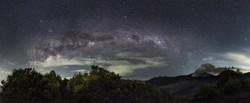
Equatorial Milky Way
image
Created for the OAE
Caption: Honourable mention in the 2022 IAU OAE Astrophotography Contest, category Still images of celestial patterns: Equatorial Milky Way
Taken in Bromo-Tengger-Semeru National Park, Java Island, Indonesia, in March 2016, this image captures regions of the southern Milky Way and, at its left edge, the two planets Mars and Saturn. Mars appears orange and is similar in colour to the star Antares, whose Greek name — anti Ares — references this. Saturn is a little bit fainter than Mars, but clearly visible among the stars of Ophiuchus, above the Pipe Nebula and forming an isosceles triangle with Mars and Antares.
Mars is on the top and Saturn is vertically below. Visible to the naked eye, both planets have significance in many cultures around the world. In Roman mythology Mars is the god of war and fertility, and Saturn the god of sowing and agriculture. Its Greek equivalent, the god Kronos, is also considered the regent of completion. Indigenous Australians, including the Kamilaroi and Wailan people, associate Saturn with “wunygal”, a small bird. Mars is called Iherm-penh (something burnt in flames) by the Anmatyerre people of the Central Desert, while the Kokatha people of the Western Desert associate Mars and the star Anatres with the red-tailed black cockatoo (Kogolongo).
In the middle of this photograph, the most famous southern constellations are clearly recognisable: the Southern Cross (Crux), the pointer stars, Alpha and Beta Centauri, the dark Coalsack Nebula and the red Eta Carina Nebula, which is not visible to the unaided eye but is prominent in modern photographs. In the 19th century, the star eta Carinae had been the second-brightest star in the sky for some time, but since it varies irregularly, it has hardly been recognisable in recent decades, and its future visibility is unpredictable.
Triangulum Australe is visible between the pointer stars and the Scorpion, and in the constellation of Centaurus, the bright globular star cluster Omega Centauri is clearly displayed. It was considered a “nebulous star” since antiquity and, thus, was listed in star catalogues for at least 2000 years. Only within the last century did astronomers discover that globular star clusters are in the halo of our galaxy and that this one consists of roughly 10 million stars.
The dark regions in the Milky Way, which are cool, dense clouds of dust and gas, form the head and body of the Celestial Emu Tchingal. Together with the Southern Cross and the pointer stars, they appear in the Dreamtime stories of many Indigenous Australians. One story associated with the Djab Wurrung and the Jardwadjali people is part of a Dreamtime Story involving Tchingal, the Bram-bram-bult brothers (the pointer stars), their mother Druk (Delta Crux), and Bunya the hunter, who gets transformed into a possum (Gacrux, the red star at the top of the Southern Cross).
Credit: Giorgia Hofer/IAU OAE
Glossary Terms:
Dust , Mars , Milky Way , Saturn , Scorpius , Southern Cross , Dust Cloud , Interstellar Extinction , Alpha Centauri
Categories:
Milky Way and Interstellar Medium
, Naked Eye Astronomy
License: Creative Commons Attribution 4.0 International (CC BY 4.0) Creative Commons Attribution 4.0 International (CC BY 4.0) icons
This file on Zenodo ( image 1.61 MB)