Documents & Resources - Search Results
Search results
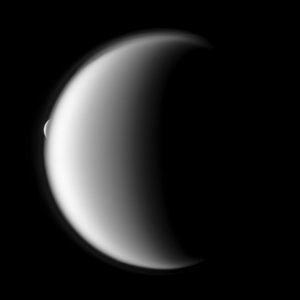
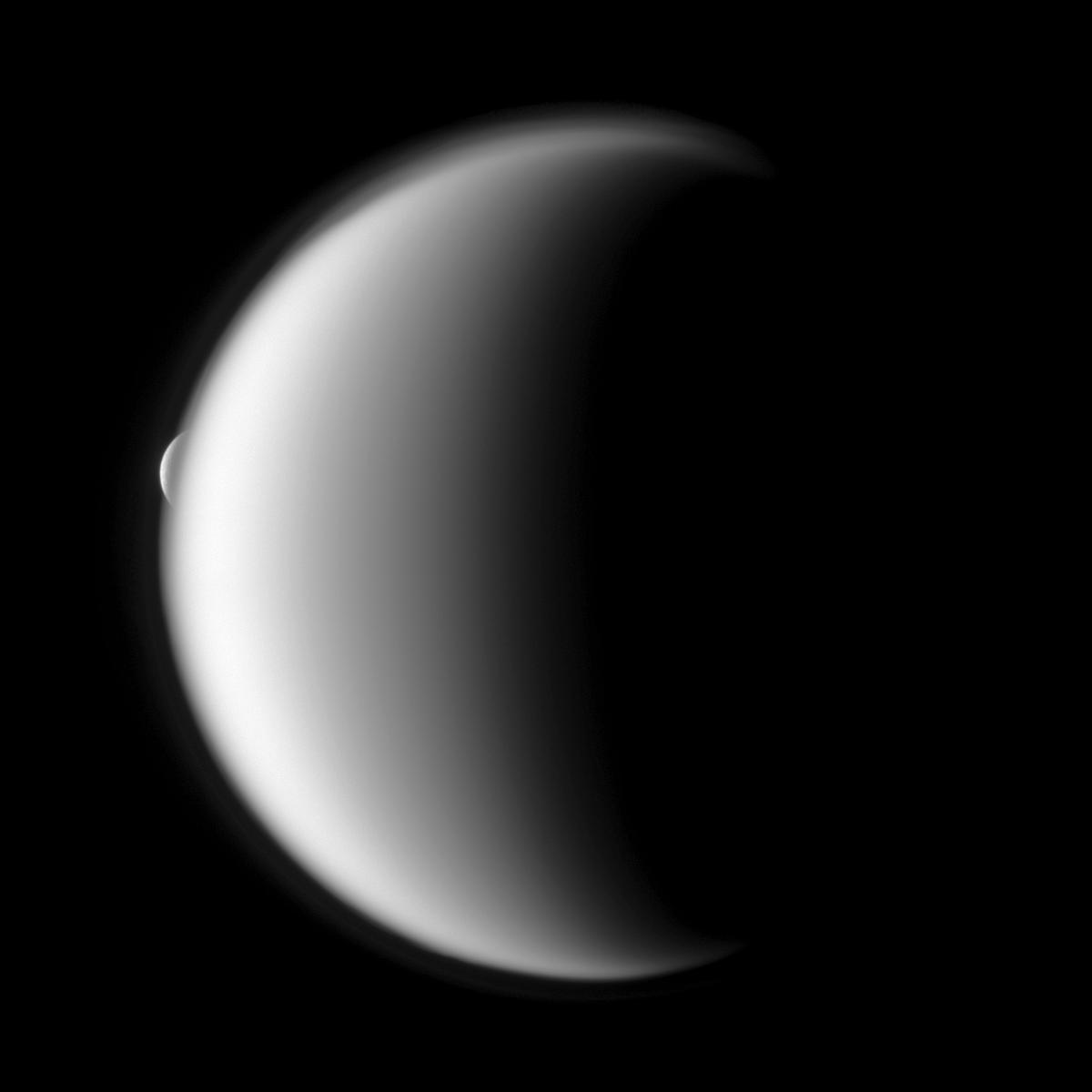
Rhea reappearing after occultation by Titan
image
Caption: On October 27, 2009, NASA’s Cassini spacecraft orbiting around Saturn captured this view of Saturn's moon Rhea as it began to emerge after being hidden by Saturn's largest moon Titan during an occultation. An occultation is a celestial event in which one object moves in front of another and temporarily blocks the first object from view.
In this image, Titan — about 5,150 km across — was closer to the spacecraft at about 1 million km, while Rhea — roughly 1,528 km in diameter — was farther away at about 2.3 million km. Titan’s high-altitude atmospheric haze is visible as a faint glow around its limb, showing the difference in surface and atmospheric properties between these two moons.
Scientists study occultations like this because watching how one moon disappears behind or reappears from another helps refine our understanding of their orbits and physical characteristics.
Credit: NASA/JPL/Space Science Institute
Credit Link
Glossary Terms:
Moons , Titan , Occultation
License: Public Domain Public Domain icons
File
( image
85.73 kB)

Neptune’s Moon Triton Fosters Rare Icy Union
image
Caption: An image of Neptune's moon Triton taken by NASA's Voyager 2 spacecraft. This image covers the south pole region of Triton. Triton's surface is covered by an icy mix of frozen nitrogen, water and carbon dioxide. Below the surface some of these compounds are thought to be in a liquid state. These liquids can burst out of the surface through geysers. These geysers produce the dark streaks seen in this image.
Credit: NASA/JPL
Credit Link
Glossary Terms:
Moons , Neptune , Triton
Categories:
Solar System
License: Creative Commons Attribution 4.0 International (CC BY 4.0) Creative Commons Attribution 4.0 International (CC BY 4.0) icons
File
( image
506.41 kB)
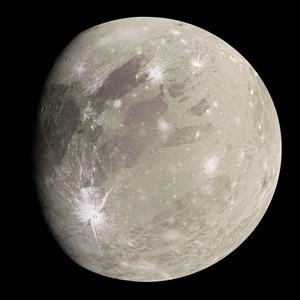
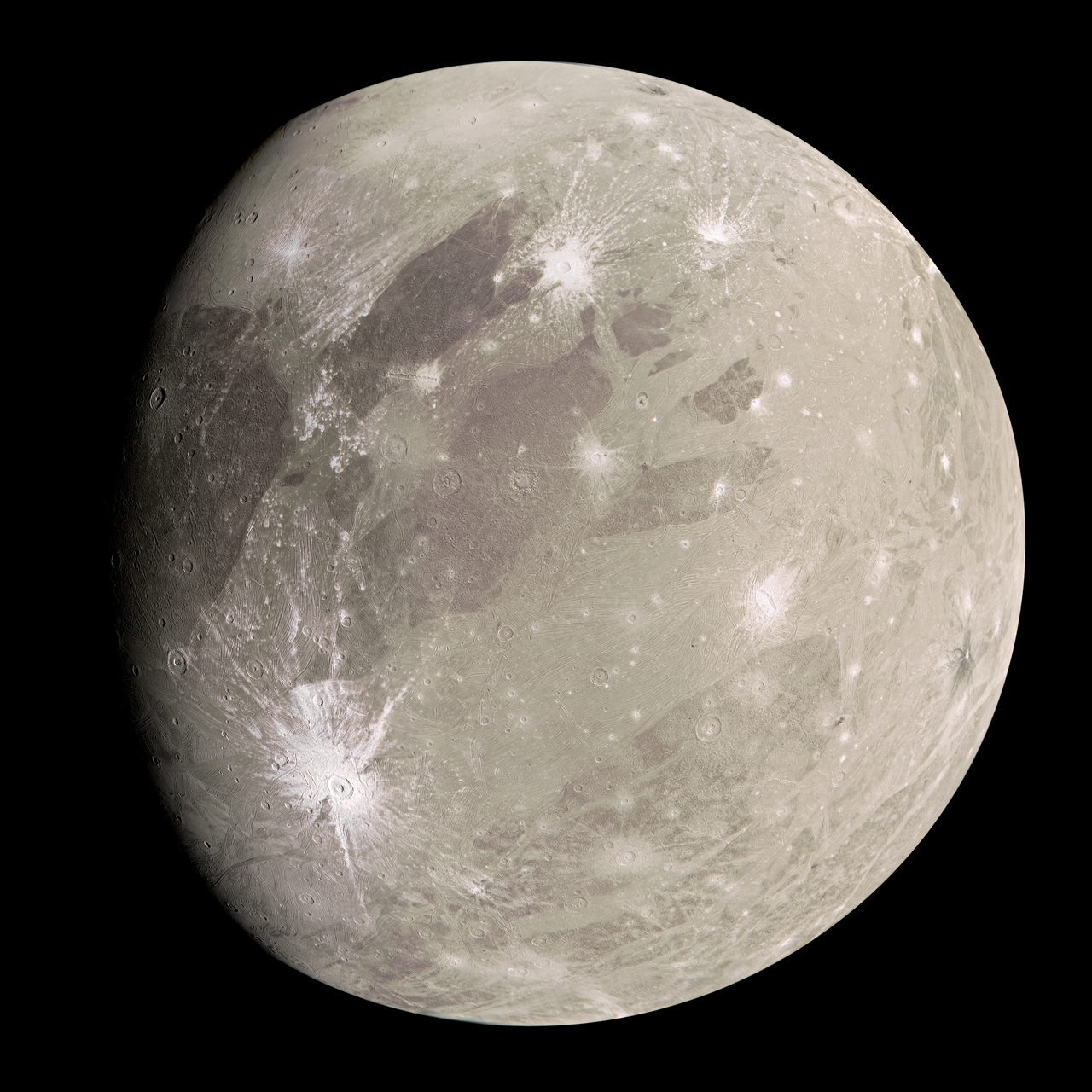
Ganymede seen by Juno spacecraft
image
Caption: Ganymede is the largest and most massive natural moon of Jupiter, and at the same time, the largest moon in the solar system. It also stands out as it is the only moon in the solar system which has an internally generated magnetic field. This is likely created by a liquid iron or iron sulfide core.
With a diameter of over 5,000 kilometers, it exceeds Mercury in size. Although it has more than twice the mass of Earth's Moon, it hosts weaker surface gravity than Mercury, Io, and the Moon due to its lower mean density.
Ganymede's appearance is primarily composed of darker, heavily cratered regions, and brighter, less bombarded ones with deep grooves and ridges indicating geological activity. Whether this might be caused by tidal heating is still subject to further analysis. The brighter regions make up around two-thirds of Ganymede's surface.
The remaining area consists of dark regions, saturated with impact craters, which have been dated back to four billion years. It is assumed that the moon hosts a large saltwater ocean under its icy surface with extreme depths of up to 800 kilometers.
Ganymede likely has a very tenuous oxygen atmosphere, comparable to that found on the Jupiter moon Europa. It cannot be interpreted as a sign of life. Instead, it is thought that hydrogen and oxygen are split up by radiation on the moon's surface.
The first space probe to visit Ganymede was Pioneer 10, performing a high-speed flyby manoeuvre through the Jupiter system. Since then, it has been investigated by several other probes such as Galileo, New Horizons, and Juno. The Jupiter Icy Moons Explorer (JUICE) will be the first to actually enter orbit around Ganymede itself (in around 2034) to further study the moon's magnetic and icy surface. JUICE will impact Ganymede as the last act of its mission.
Credit: NASA/JPL-Caltech/SwRI/MSSS/Kevin M. Gill
Credit Link
Glossary Terms:
Galilean Satellites , Moons
License: Creative Commons Attribution 2.0 Generic Creative Commons Attribution 2.0 Generic icons
File
( image
1.85 MB)
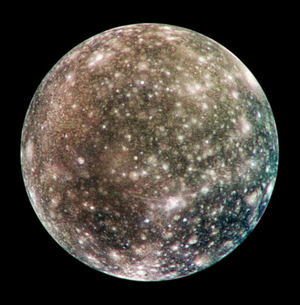
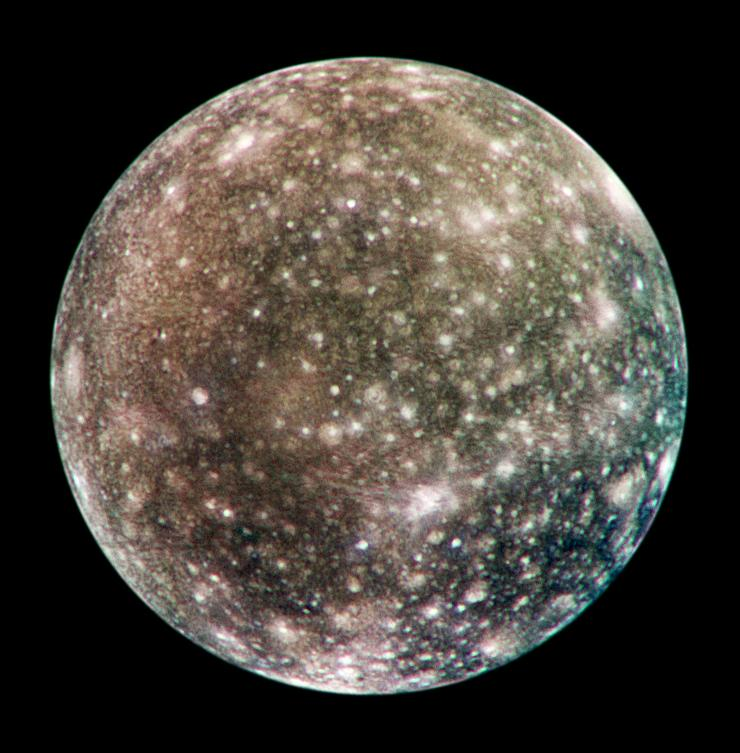
The Callisto satellite
image
Caption: Callisto is the outermost of the four large Galilean moons of Jupiter and the third largest in the whole solar system, falling behind only Ganymede and Saturn's moon Titan. It orbits Jupiter at an average distance of around 1.9 million kilometers, roughly six times the distance between Earth and the Moon.
With a diameter of nearly 5,000 kilometers, it is almost as large as Mercury, the smallest planet in our solar system, but has only a third of its mass as it is composed of approximately equal amounts of rock and ice.
Callisto orbits Jupiter in a tidally locked rotation, always showing the same side to Jupiter. In contrast to the other three Galilean satellites – Io, Europa, and Ganymede – it is not in orbital resonance due to its farther outward location and is thus not appreciably tidally heated. It does not show any signs of plate tectonics or volcanic activity. Its lack of geological processes means that surface features like craters remain unchanged for billions of years. It is thought to have evolved predominantly under the influence of impacts, as its surface is the oldest and most heavily cratered object in the solar system. In fact, it is so covered in craters that any new impact will likely erase a former one.
Callisto's internal structure is still subject to discussion; it may consist of a deep salty ocean. It is thought to be composed mainly of a mix of ice and rock, which are present in various states throughout the inner layers of the moon. Callisto hosts a very thin atmosphere composed mainly of carbon dioxide and some traces of oxygen. The moon has been studied by numerous space probes, such as the Pioneer and Voyager missions and the Galileo orbiter, and will be subject to further explorations by NASA, ESA, and China’s National Space Administration (CNSA).
Credit: NASA/JPL/DLR
Credit Link
Glossary Terms:
Galilean Satellites , Moons
License: Public Domain Public Domain icons
File
( image
610.45 kB)
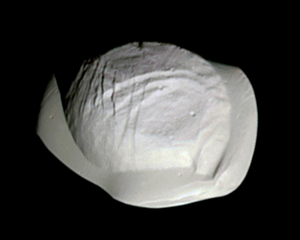
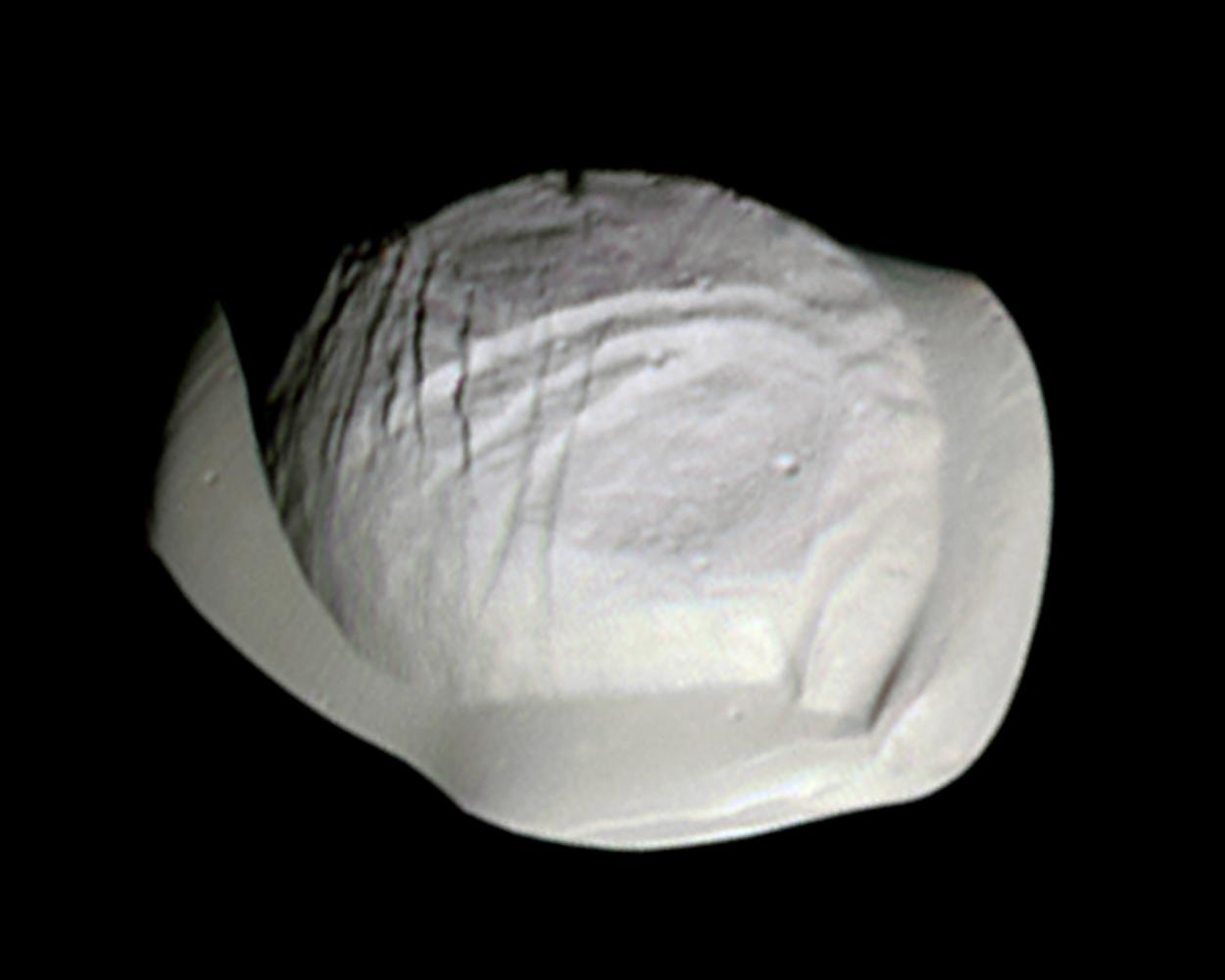
Pan
image
Caption: NASA's Cassini spacecraft captured this image of Saturn's moon Pan in March 2017. Pan is a so-called shepherd moon that orbits Saturn within the Encke gap of Saturn's rings. The striking thin brim stems from material Pan collects during its trajectory through the rings. Pan has a mean diameter of alomst 30 km.
Credit: NASA/JPL-Caltech/Space Science Institute
Credit Link
Glossary Terms:
Moons
Categories:
Solar System
License: Public Domain Public Domain icons
File
( image
469.25 kB)