Documents & Resources - Search Results
Search results

A binary brown dwarf system revealed
image
Caption: This image presents a nearby system of brown dwarfs, objects that fall between planets and stars in mass and do not sustain long-term nuclear fusion in their cores. Located about 6.5 light-years from Earth, this system (known as Luhman 16) is the third closest system to the Solar System after the Alpha Centauri system and Barnard's Star. It was initially observed as what seemed to be a single faint source of infrared light. Brown dwarfs are often difficult to study because of their low brightness, especially in visible light. However they shine brighter in infrared light due to their cooler effective temperatures.
The comparison highlights the importance of observational resolution. The image at the center, taken by NASA’s Wide-field Infrared Survey Explorer (WISE), shows the system as a single blurred object due to its lower resolution (WISE has a resolution of roughly 6 arcseconds). A highlighted zoomed-in view from the Gemini South Observatory in Chile reveals that this “single” source is actually a binary system of two brown dwarfs. The improved angular resolution (roughly 0.6 arcseconds) allows astronomers to separate the two objects clearly, demonstrating how higher-resolution observations uncover hidden structures in the universe. While the Gemini telescope is situated on the Earth and thus is affected by the blurring effects of the Earth's atmosphere, it has a substantially larger mirror than the WISE telescope (8m wide vs. 40cm wide) meaning it can achieve much higher resolutions.
Credit: NASA/JPL/Gemini Observatory/AURA/NSF
Credit Link
Glossary Terms:
Binary Star , Brown Dwarf , Angular Resolution , Resolution
License: Public Domain Public Domain icons
File
( image
1.98 MB)
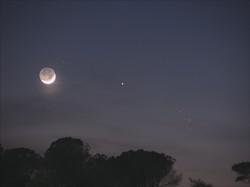
Moon-Mercury-Pleiades Conjunction
image
Created for the OAE
Caption: Honourable mention in the 2022 IAU OAE Astrophotography Contest, category Still images of celestial patterns.
This photograph shows the young lunar crescent, some of the nine brightest stars of the Pleiades (with one behind a cloud) on the right, and the planet Mercury, looking slightly red, in the middle of the image.
This picture is rather suggestive of the idea that the Pleiades might possibly consist of seven stars. However, the viewer is misled by the clouds; five of the stars form a tiny chariot, one is next to the handle, and three are at the other end of the quadrilateral. Eight stars would be clearly visible if there were no clouds.
This configuration of the young Moon next to the Pleiades is visible only in the northern hemisphere spring. Thus it was used by the ancient Babylonians to determine the second month of their year and to judge whether or not an intercalary month was necessary. At least as early as the second millennium before the common era, the Babylonians used several asterisms for each month, with another one of them reappearing every five days after invisibility during daylight. To determine the necessity of intercalation in order to synchronise the solar and the lunar year, the Babylonians used several asterisms, not only the Pleiades. For instance, they also made use of the bright stars Arcturus and Sirius, and they observed a configuration with the Moon as well as heliacal phenomena. The modern Jewish and modern Islamic traditions still make use of some of the Babylonian astronomical rules. However, given that the constellations have shifted as a result of precession, and the fact that nowadays we also have computational means to calculate our calendars, this configuration of the small crescent Moon and the Pleiades is less useful, though it remains exceptionally beautiful. Thus the ancient Babylonian and middle Babylonian tradition survives only rudimentarily. Furthermore, it is unlikely that it is depicted in the Nebra Disc from Bronze Age Europe, as has long been claimed.
This image was taken on Elba Island, Italy, in May 2022.
Credit: Giulio Colombo/ IAU OAE
Glossary Terms:
Conjunction , Mercury , Moon , Waxing Crescent , Crescent Moon , Pleiades
Categories:
Naked Eye Astronomy
License: Creative Commons Attribution 4.0 International (CC BY 4.0) Creative Commons Attribution 4.0 International (CC BY 4.0) icons
This file on Zenodo ( image 420.90 kB)

Milky Way Arch over Lut Desert, Iran, by Amirreza Kamkar, Iran (Islamic Republic of)
image
Created for the OAE
Caption: Second place in the 2021 IAU OAE Astrophotography Contest, category Wide star fields.
This panoramic dawn image shows the majestic band of the Milky Way – our home Galaxy – made up of a few hundred billion stars, among other structures, most of which are not detectable by our eyes, or in some cases even directly with telescopes. The appearance of the band is because the Milky Way is a disc-shaped galaxy, and we (Earth/Solar System) are situated within the disc.
Diverse cultures and traditions around the world each have their own name and cultural stories for the Milky Way. The dark regions visible in the Milky Way are large, dense, cool nebulae (clouds of dust and gas), which obscure the light from stars in the Milky Way. The Indigenous Australians associate stories with the dark patches of the Milky Way, one of the most prominent being the Emu in the Sky (called Tchingal in Wotjobaluk country). In and around the band of the Milky Way there are a vast range of star clusters, two familiar ones are M6 (Butterfly cluster) and M7 (Ptolemy’s cluster).
The bright point just above the horizon is the planet Venus (known to the Boorong people of Indigenous Australia as Chargee Gnowee, elder sister of the Sun). Within the band of the Milky Way the brightest point in the image is the planet Jupiter (called Ginabongbearp, the Sulphur-crested white cockatoo by the Boorong). The planet Saturn is the bright point between Venus and Jupiter (closer to Venus than Jupiter).
There are two constellations and one asterism that can be easily discerned in the image: Aquila, Scorpio (Maui’s Hook), and Teapot (asterism in Sagittarius). In this image, the center of the Milky Way at an approximate distance of 26,000 light years from Earth, is located roughly to the top right of the Teapot spout.
The bright red-orange point to the right of Jupiter is the red supergiant star Antares and is part of the constellation Scorpio (known as Maui’s Hook in Māori and Polynesian cultures). This variation in the colour of stars is the result of temperature of the stars (lower temperature stars are redder, higher temperatures stars are bluer).
Credit: Amirreza Kamkar/IAU OAE
Glossary Terms:
Milky Way , Dust Cloud
Categories:
Milky Way and Interstellar Medium
, Naked Eye Astronomy
License: Creative Commons Attribution 4.0 International (CC BY 4.0) Creative Commons Attribution 4.0 International (CC BY 4.0) icons
This file on Zenodo ( image 2.85 MB)
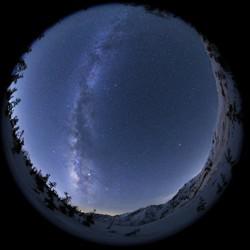
The Milky Way Across the Zenith
image
Created for the OAE
Caption: Winner in the 2022 IAU OAE Astrophotography Contest, category Still images of celestial patterns.
This all-sky image shows our home galaxy, the Milky Way, crossing the zenith, the point just above the observer as seen from Nagano, Japan, in May 2019. Such images of the whole sky can be taken either with a fish-eye lens or with a convex mirror on the ground, the latter of which would show the photographer as well.
Some of the brightest stars in the night sky can be seen in this image, as well as two of the giant planets of our Solar System: Jupiter, the brightest point in the bottom of this image, and Saturn, another bright point just to the opposite side of the Galaxy, to the bottom and next to the horizon.
Directly right of the Milky Way and below Jupiter, we can spot the bright red star Antares, the primary star of the Japanese asterism of The Heart. Japanese constellations derive from ancient Chinese constellations, which were adopted with only slight or no changes. In this tradition, The Heart is the heart of the “Azure Dragon”, a super-constellation that represents the spring. In the Babylonian and Greco-Roman traditions, this area is considered the heart of the Scorpion. In Babylonian religion, the star is associated with Lisi, the child of the mother goddess, but in Greek mythology it is related to the planet Mars, because of its colour. The reddish colour also led to the star’s Chinese name “The Fire Star”. We know that this colour is caused by its relatively cool temperature.
Going from Antares to the right of the image, we find the more northern parts of the sky. The bright star in the lower-right of the image, close to the horizon, is Arcturus, located in the modern constellation Boötes. While Antares and its surrounding area are considered the heart of the Azure Dragon, Arcturus and Spica (below the horizon) are two single-star asterisms forming its huge horn. Pointing towards it from above, at the right-hand edge of the image’s horizon, we can see the handle of the Big Dipper, or Plough, which is part of the constellation Ursa Major.
The bright point to the right of the galaxy and just above the middle of the image is Vega, located in the modern constellation Lyra. Extending a line to the other side of the Galaxy and a bit lower in the image we can find Altair, in the constellation Aquila. From that point we extend another line to Deneb, the brightest star in the constellation of the Swan, also a bit higher in this image and completely flooded by the Milky Way. These three bright stars comprise the asterism known as the Summer Triangle in the northern hemisphere.
Credit: Ohnishi Kouji/IAU OAE
Glossary Terms:
Jupiter , Milky Way , Saturn , Scorpius
Categories:
Milky Way and Interstellar Medium
, Naked Eye Astronomy
License: Creative Commons Attribution 4.0 International (CC BY 4.0) Creative Commons Attribution 4.0 International (CC BY 4.0) icons
This file on Zenodo ( image 11.13 MB)

The Moon and Milky Way arch Above the Golden Hall
image
Created for the OAE
Caption: Winner in the 2022 IAU OAE Astrophotography Contest, category Still images of celestial patterns.
Taken in April 2021 from the top of the Laojun Mountain in China, this image shows a panoramic view of the Milky Way over the Golden Hall called “Yuhuangding” as a symbol of wealth. In China, the Milky Way is considered a huge stream like one of the big rivers. It separates the Cowherd (Altair) and his beloved Weaving Girl (Vega) and it has a Celestial Ford in the northern dark cloud in the modern constellation Cygnus.
The Milky Way appears as a whitish arch as we cannot distinguish all the individual stars, but instead see the accumulation of light from them. It is a disc-shaped galaxy and the Solar System is located within one of its spiral arms, so we see it from inside, which gives it the shape of a band in our sky. It is associated with the religions and mythologies of several cultures. The modern term Milky Way derives from Greek folklore as the milk spread in the sky by the mother goddess Hera, when she unwillingly breastfed young Heracles. This son of Zeus and a mortal woman was put next to her while she was asleep but from his strong sucking she woke up and realised she was feeding an unknown child, and immediately pushed the child away. Greek philosophers like Plato considered the glittering band in the sky to be the traces of a former path of the Sun.
Alternatively, for the Tupi-Guarani indigenous mythology from South America, the Milky Way represents the “path of tapir”. For some Australian native peoples, its dark clouds formed the shape of an emu if high in the sky, and of crocodiles if low on the horizon. For many southern African, South American and Australian cultures, it was considered a pathway to or from heaven. At the right edge of the image, we can recognise the modern constellation Scorpius with its most prominent star, Antares, the reddish star just above the Milky Way.
The brightest point seen in the centre bottom of the image is the rising Moon with Jupiter next to it. A few constellations can be distinguished in this image, including Corona Australis, a faint arc-shaped constellation located to the bottom right. Just above the Southern Crown, we can see the Teapot asterism as part of the Sagittarius constellation. Since Sagittarius lies next to the centre of the Milky Way, many structures such as star-forming regions, globular clusters and planetary nebulae can be found within its boundaries. In Sagittarius, we also find a supermassive black hole four million times as massive as our Sun.
At the left side of the band, we can identify the bright star Deneb in the constellation Cygnus, The Swan, through which the Milky Way runs, meaning that a variety of star clusters are found in this constellation.
Credit: Likai Lin/IAU OAE
Glossary Terms:
Dust , Milky Way , Scorpius , Dust Cloud , Interstellar Extinction , Sagittarius
Categories:
Naked Eye Astronomy
License: Creative Commons Attribution 4.0 International (CC BY 4.0) Creative Commons Attribution 4.0 International (CC BY 4.0) icons
This file on Zenodo ( image 12.44 MB)