Documents & Resources - Search Results
Search results
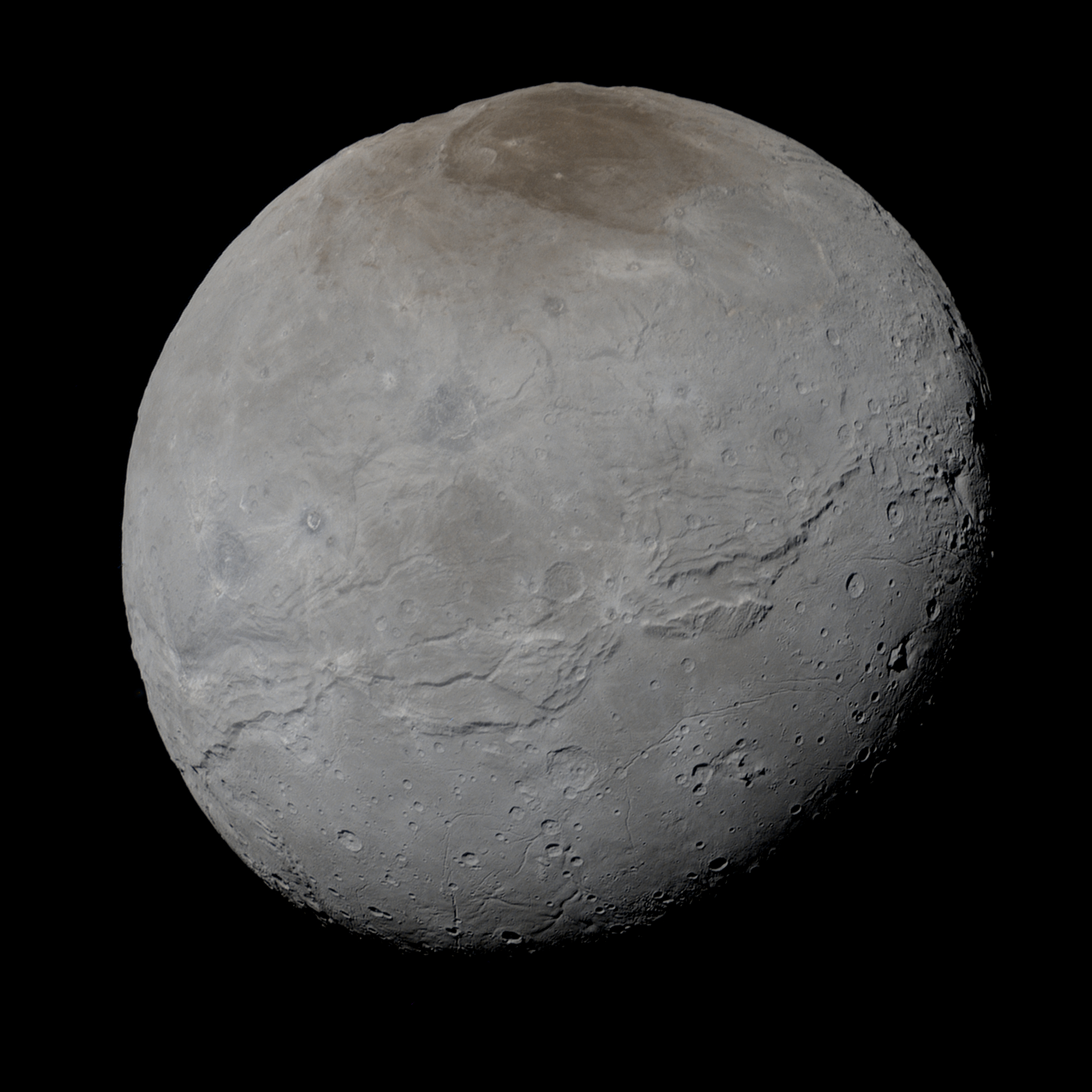
Detailed View of Charon, Moon of Pluto
image
Caption: Charon is the largest natural moon of the dwarf planet Pluto. This detailed image was taken by NASA’s New Horizons spacecraft in 2015 during its historic mission through the outer Solar System. Charon’s surface shows a fascinating mix of light and dark regions, including vast canyons, broad plains, and impact crater. With a diameter of about 1,200 kilometers, Charon is more than half the diameter of Pluto, making it unusually large compared to its parent body. Charon's mass is roughly 12% of that of Pluto.
Because Pluto and Charon are so close in mass, the center of mass of the system (the point both Pluto and Charon orbit) is not within Pluto but between Pluto and Charon. This is in contrast to systems like the Earth and its Moon where the center of mass lies within the larger body, the Earth in this case. Scientists think the Pluto-Charon system may have formed by a collision of two objects that then separated and began to orbit each other. By studying Charon and the smaller moons that circle Pluto, astronomers gain insight into how moons form and how distant icy bodies evolve over billions of years.
Credit: NASA/Johns Hopkins University Applied Physics Laboratory/Southwest Research Institute/Alex Parker
Credit Link
Glossary Terms:
Moons , Pluto
License: Public Domain Public Domain icons
File
( image
2.88 MB)
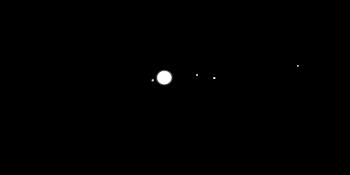
Jupiter Moons Movie2, by Nicolas Hurez, Paul-Antoine Matrangolo, and Carl Pennypacker, United States of America
video
Created for the OAE
Caption: Second place in the 2021 IAU OAE Astrophotography Contest, category Galilean moons.
This sequence shows the orbit of the four Galilean moons around the planet Jupiter. Almost two entire orbits of the innermost moon, Io, can be seen, with the other moons (Europa and Ganymede, but in particular Callisto) being further away, orbiting noticeably slower. The images were obtained in 2018 with the Las Cumbres Global Observatory at different locations on Earth, allowing a continuous sequence of images over approximately half a week without gaps during the day. With clear skies and over the course of several nights, the motion of the Galilean moons can also be observed with binoculars (ideally steady your elbows on a surface).
Credit: Nicolas Hurez, Paul-Antoine Matrangolo and Carl Pennypacker/IAU OAE
Glossary Terms:
Galilean Satellites , Gas Giant , Io , Jupiter , Moons , Orbit , Outer Planets , Planet
Categories:
Solar System
License: Creative Commons Attribution 4.0 International (CC BY 4.0) Creative Commons Attribution 4.0 International (CC BY 4.0) icons
This file on Zenodo ( video 890.47 kB)
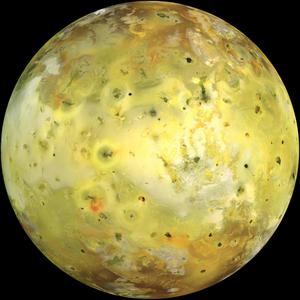
Io
image
Caption: NASA's Galileo spacecraft acquired its highest resolution images of Jupiter's moon Io on 3 July 1999. Io is one of the four Jovian moons discovered by Galileo Galilei in 1610. Io's colours are witness to its extensive volcanic activity as they stem from sulphuric compounds. Tidal forces from Jupiter and the neighbouring moons are the cause for Io's volcanism.
Credit: NASA/JPL/University of Arizona
Credit Link
Glossary Terms:
Galilean Satellites , Io , Moons
Categories:
Solar System
License: Public Domain Public Domain icons
File
( image
789.81 kB)
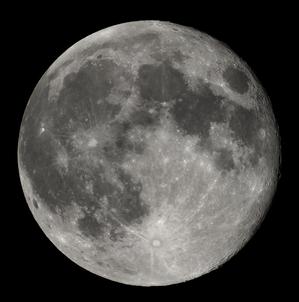
Full moon
image
Caption: The image shows the nearly full Moon observed with a small telescope and a DSLR camera.
Credit: Luc Viatour
Credit Link
Glossary Terms:
Full Moon , Lunar Phase , Moon , Moons
Categories:
Solar System
License: Creative Commons Attribution-ShareAlike 3.0 Unported Creative Commons Attribution-ShareAlike 3.0 Unported icons
File
( image
924.21 kB)
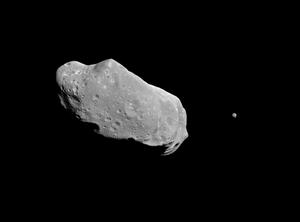
Ida and Dactyl
image
Caption: This picture of the asteroid Ida with its satellite Dactyl was taken by the Galileo space probe in August 1993 from a range of 10,870 kilometers (6,755 miles). Ida is a heavily cratered, irregularly shaped asteroid in the main asteroid belt between Mars and Jupiter. This image is proof that asteroids like the 56 km large Ida can possess their own moons.
Credit: NASA/JPL
Credit Link
Glossary Terms:
Asteroid , Asteroid Belt , Moons
Categories:
Solar System
License: Public Domain Public Domain icons
File
( image
56.80 kB)