Documents & Resources - Search Results
Search results
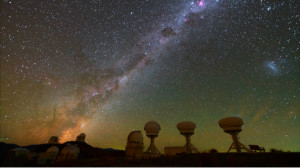
Southern Sky Over La Silla
video
Created for the OAE
Caption: First place winner in the 2023 IAU OAE Astrophotography Contest, category of Time-lapses of rotation of Big Dipper or Southern Cross.
This video shows the Milky Way’s sprawling brilliance across the celestial expanse. Among the stars’ grand theatre, the Southern Cross constellation claims its place in the scene, distinguished by its distinctive cross shape as seen in the top of this video and slightly to the right just over the Milky Way, slowly disappearing as the video progresses. This celestial marker, a prominent feature in the southern hemisphere, holds cultural and navigational significance, having served as a navigational guidepost for centuries. Accompanying the Milky Way’s grandeur are the two Magellanic clouds, celestial companions seen dancing in the distant sky. The Carina Nebula adds its ethereal glow to the cosmic panorama, painting a radiant hue against the darkness. In the midst of this celestial ballet, a gentle green hue envelops the atmosphere, a phenomenon known as airglow, adding a touch of subtle luminescence to the night sky. The terrestrial also makes an appearance, with planes flying overhead and vehicles driving between observatory buildings. This time-lapse, taken from the La Silla Observatory in Chile, is a window to the captivating dance of stars, offering a glimpse into the awe-inspiring beauty of our galaxy and the celestial landmarks that grace the southern sky.
Credit: José Rodrigues/IAU OAE (CC BY 4.0)
Glossary Terms:
Celestial Pole , Celestial Sphere , Earth's Rotation , Observation , Sky , Southern Cross
Categories:
Naked Eye Astronomy
Tags:
astrophotography
License: Creative Commons Attribution 4.0 International (CC BY 4.0) Creative Commons Attribution 4.0 International (CC BY 4.0) icons
This file on Zenodo ( video 1.07 GB)
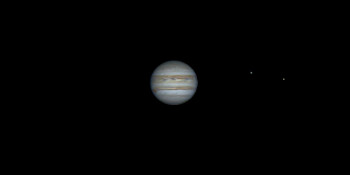
Jupiter's Rotation, by Vishal Sharma, India
video
Created for the OAE
Caption: Third place in the 2021 IAU OAE Astrophotography Contest, category Galilean moons: Jupiter’s Rotation, by Vishal Sharma, India.
This time-lapse beautifully shows the rotation of Jupiter and the passage of two Galilean moons on the right side of the frame. Jupiter completes one rotation in just under 10 hours and we see as the Great Red Spot makes its way from left to right. The two moons travel a noticeable fraction of their orbit in this short time. This image was taken in 2020 in the North of India.
Credit: Vishal Sharma/IAU OAE
Glossary Terms:
Galilean Satellites , Gas Giant , Jupiter , Moons , Orbit , Outer Planets , Planet
Categories:
Solar System
License: Creative Commons Attribution 4.0 International (CC BY 4.0) Creative Commons Attribution 4.0 International (CC BY 4.0) icons
This file on Zenodo ( video 1.54 MB)
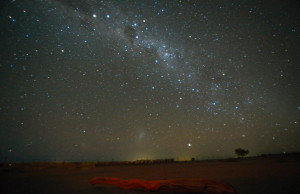
Beautiful Night in the Atacama Desert
video
Created for the OAE
Caption: Honorable mention in the 2023 IAU OAE Astrophotography Contest, category of Time-lapses of rotation of Big Dipper or Southern Cross.
Taken from San Pedro de Atacama, Chile, in June 2023, this time-lapse reveals the celestial ballet that unfolds as the Southern Cross takes its majestic journey across the sky, pointing the way to the South Celestial Pole around which the sky rotates, until it gracefully sets. The star-studded canvas showcases the grandeur of the Milky Way, adorned by the rotating Large and Small Magellanic Clouds swirling around the Southern Celestial Pole. The prominent constellations of Crux, Centaurus, Scorpius, and the former Argo Navis (Carina, Puppis, Vela) are also visible. The spectacle begins just after nightfall, capturing the radiant descent of Canopus, a beacon about to dip below the horizon. Throughout the sequence, there is a subtle presence of passing aeroplanes, fleeting headlights of cars, drifting clouds, and the ethereal airglow. At a stunning moment, a vivid meteor streaked across the sky, a breathtaking fireball briefly igniting the right lower corner around the 41st second mark. As the sequence progresses, the rising moon elegantly illuminates the landscape, casting its glow upon an ancient tree trunk resting on the dry, dusty grounds of the Salar de Atacama. This captivating journey through the night skies concludes before the break of dawn, offering a glimpse into the celestial marvels that are woven into the nocturnal tapestry of San Pedro de Atacama.
Credit: Uwe Reichert/IAU OAE (CC BY 4.0)
Glossary Terms:
Celestial Pole , Celestial Sphere , Earth's Rotation , Southern Cross
Categories:
Naked Eye Astronomy
Tags:
astrophotography
License: Creative Commons Attribution 4.0 International (CC BY 4.0) Creative Commons Attribution 4.0 International (CC BY 4.0) icons
This file on Zenodo ( video 221.01 MB)
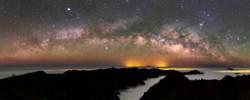
Milky Way Arch over La Palma
image
Created for the OAE
Caption: Winner in the 2022 IAU OAE Astrophotography Contest, category Still images of celestial patterns.
This image, which shows the majestic band of the Milky Way and a range of culturally significant patterns, was taken in May 2022 at a very high altitude from the Roque de los Muchachos Observatory in La Palma, from which one can see the clouds below. Some prominent star patterns include Scorpius, Sagittarius, Lyra, Cygnus, Aquila, the Summer Triangle asterism, and the Teapot asterism.
As the Canary Islands used to be a starting point for European sailors to explore the world, we use this place to point to the many indigenous cultures they encountered. Most notably it is the dark patterns within the band of the Milky Way that hold significance for many Indigenous cultures around the world. The dark patterns are in fact dense, cool clouds of gas and dust that block the light from stars. Indigenous people see caves, waterways and various patterns associated with the dark regions of the Milky Way.
The constellations and patterns hold different cultural significance and interpretations for different people. For example, the constellation Scorpius is referred to by Polynesian people as the demigod Maui’s Fishhook. The Yolnu people of Arnhem Land associate Scorpius with a crocodile called Ingalpir. Some Indigenous Australian groups associate stories with individual stars within Scorpius, most notably Antares, the orange-red star in the top right of the image above the band of the Milky Way. Next to the Scorpion and above the bright centre of the Milky Way, there is a prominent dark cloud that is called the Pipe Nebula by modern astrophotographers. The smoke of this pipe goes up to rho Ophiuchi. This and all the other dark clouds in the Milky Way together form the backbone of heaven for some tribes, and an animal with black-and-white skin for South African Zulu people.
The nomenclature of bright stars also has cross-cultural roots. For example, Vega (the bright blue star towards the top of the image) comes from the Arabic waqi, from al-nasr al-waqi, the Eagle who throws himself down (in order to hunt). This contrasts with the Flying Eagle, Altair, also derived from Arabic. Antares is a Greek word meaning “the one similar to Mars”, referring to its colour. The star name Shaula in the stinger of the Scorpion is a modern version of the Babylonian or even Sumerian star name.
Credit: Amirreza Kamkar/IAU OAE
Glossary Terms:
Constellation , Dust , Milky Way , Scorpius , Asterism , Dust Cloud , Interstellar Extinction , Sagittarius
Categories:
Milky Way and Interstellar Medium
, Naked Eye Astronomy
, Telescopes, Instruments and Observatories
License: Creative Commons Attribution 4.0 International (CC BY 4.0) Creative Commons Attribution 4.0 International (CC BY 4.0) icons
This file on Zenodo ( image 3.31 MB)

A total solar eclipse over the La Silla Observatory, Chile
video
Caption: A real-time video showing the total solar eclipse on the 2nd of July 2019 over the La Silla Observatory in Chile. This video covers the moments before totality, the just under two minutes of totality, and the moments after totality. Note that at the start of the video the Sun was already almost completely obscured by the Moon, it is just hard to see due to the brightness of the Sun and the exposure of the camera. Indeed the Moon started partially eclipsing the Sun roughly an hour before the start of this recording and would continue to partially obscure the Sun for roughly the same time afterwards.
At the point of totality one can see the faint glow of the Sun’s diffuse outer regions and on the horizon one can also see the glow from the parts of the surrounding areas on Earth that are not experiencing totality.
Credit: ESO/A. Santerne
Credit Link
Glossary Terms:
Solar Eclipse , Total Solar Eclipse
Categories:
Planet Earth
, Solar System
License: Creative Commons Attribution 4.0 International (CC BY 4.0) Creative Commons Attribution 4.0 International (CC BY 4.0) icons
File
( video
255.13 MB)