Documents & Resources - Search Results
Search results
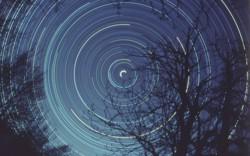
Half day exposure to the north star, by Fabrizio Melandri, Italy
image
Created for the OAE
Caption: First place in the IAU OAE Astrophotography Contest, category Star trails.
This star trail image shows the apparent movement of the stars in the night sky, which results from the Earth’s rotation around its polar axis. The trees in the foreground serve as an anchor as we turn with the Earth. The bright white semi-circle in the center of the image is the North (Pole) star – Polaris, which is located very close to the North Celestial Pole. One way to imagine that the Earth is at center of hollow crystal sphere, and the stars are embedded on this sphere, as the Earth spins on its axis, an observer on Earth sees the stars rising and setting, following an arc, because the horizon prevents the observer from the full arc for stars that are further away from the Celestial Pole. The North Celestial Pole (and its opposite the South Celestial Pole) is essentially formed by extending the line of the Earth’s axis. Capturing this image requires the photographer to take a long exposure with the camera on a tripod and pointing towards the Pole Star (North Hemisphere). In the Southern Hemisphere there is no star as close as Polaris is to the Celestial Pole, so the position of the South Celestial Pole is found using the South Cross and Pointer Stars (Alpha and Beta Centauri). Although overall the image has a slight blue tint, it does capture the varying colours of stars, it is easy to distinguish between the higher temperature blue stars and the lower temperature of the whitish stars, and even lower temperature reddish stars. The reason for this variation in colour is because higher temperature stars emit more in shorter wavelengths (bluer), compared to lower temperature stars which emit in longer wavelengths (redder).
Credit: Fabrizio Melandri/IAU OAE
Glossary Terms:
Circumpolar Stars , Star Trail
Categories:
Naked Eye Astronomy
License: Creative Commons Attribution 4.0 International (CC BY 4.0) Creative Commons Attribution 4.0 International (CC BY 4.0) icons
This file on Zenodo ( image 6.11 MB)
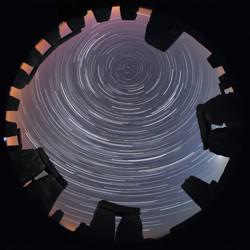
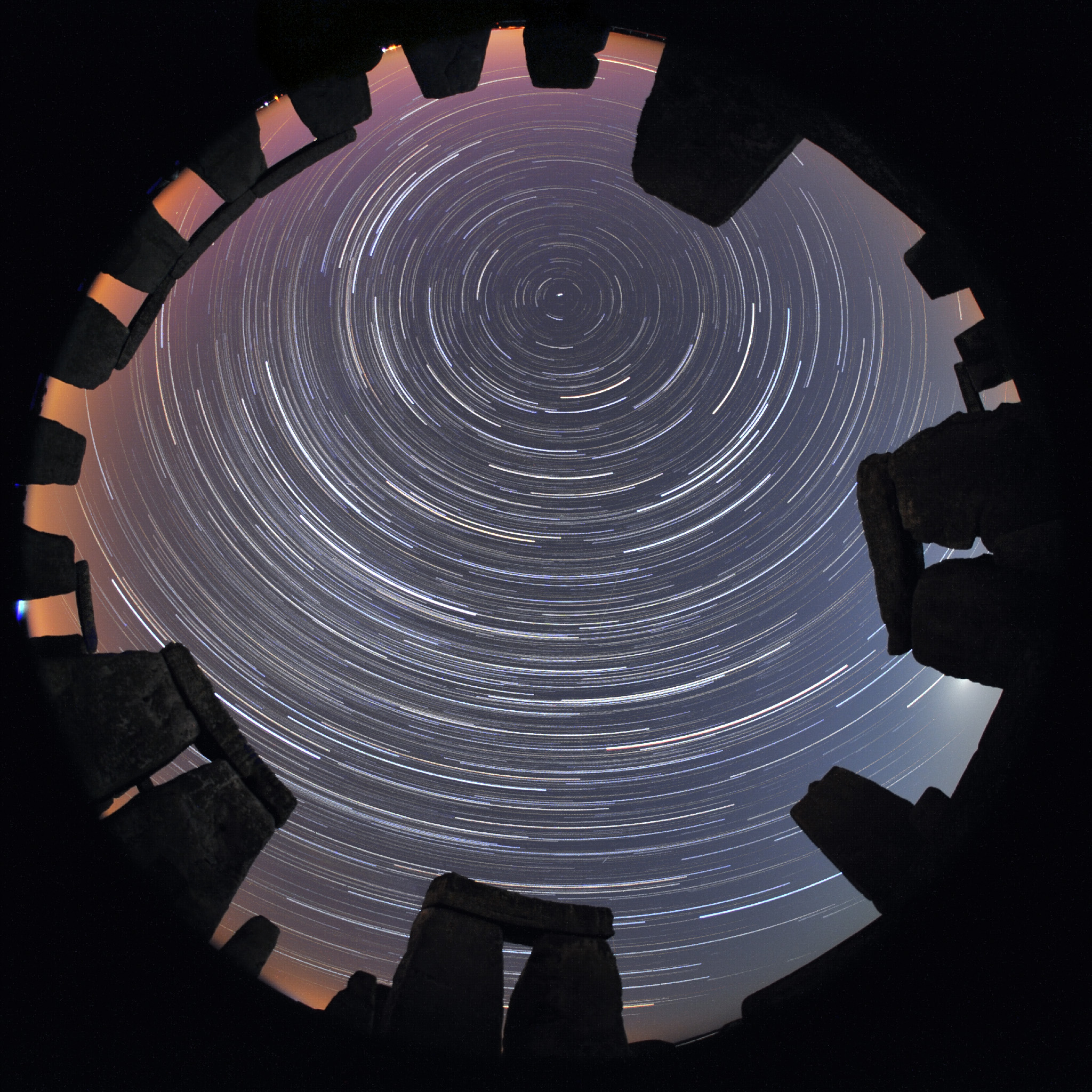
Stone Star Circles, Startrails above Stonehenge, by Till Credner, Germany
image
Created for the OAE
Caption: Second place in the IAU OAE Astrophotography Contest, category Star trails.
Astronomy is one of the oldest (if not the oldest) of the sciences, and as such has connection to various cultures over millennia. This image in a way conveys this relationship by being contextualised in Stonehenge. There is much research into what astronomers call archeoastronomy sites, and how they connect to the sky (for example, seasons, phases of the moon and much more). Civilizations across time and from all over the world have their own views and interpretations of what they see in the sky, and this has been tied not only to culture but also to the people’s day-to-day and seasonal activities. The “concentric circles” which are often referred to as “star trails”, are the result of the apparent motion of the sky, which is in reality due to the rotation of the Earth on its axis. The small dot appearing towards the top center of the image is Polaris – The North or Pole Star. Polaris is only visible to observers in the Northern latitudes. The height of the Pole Star can be used to infer the observer’s actual latitude. Stonehenge is located at around 51° North. This image is taken from one of the most notable ancient sites in the world, brings us back in time, and makes us wonder about the stories told by the people that lived in that place many millennia ago.
Credit: Till Credner/IAU OAE
Glossary Terms:
Circumpolar Stars , Star Trail
Categories:
Naked Eye Astronomy
License: Creative Commons Attribution 4.0 International (CC BY 4.0) Creative Commons Attribution 4.0 International (CC BY 4.0) icons
This file on Zenodo ( image 1.26 MB)
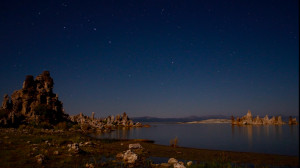
Big Dipper Over the Mono Lake
video
Created for the OAE
Caption: Honorable mention in the 2023 IAU OAE Astrophotography Contest, category of Time-lapses of rotation of Big Dipper or Southern Cross.
The Big Dipper asterism gracefully moves above the otherworldly tufa formations of Mono Lake, California. The time-lapse captures the Big Dipper’s movement across the northern horizon until its inferior conjunction. At Mono Lake’s latitude (+38°), the stars of the Big Dipper remain circumpolar, except for Alkaid. The North Star sits 38° above the horizon, just outside the field of view in the top right. The lunar illumination bathes the landscape in a soft glow, gradually fading as the Moon sets, cloaking the scene in darkness.
Credit: Fabrizio Melandri/IAU OAE (CC BY 4.0)
Glossary Terms:
Big Dipper , Celestial Pole , Celestial Sphere , Circumpolar Stars , Earth's Rotation , Polaris
Categories:
Naked Eye Astronomy
Tags:
astrophotography
License: Creative Commons Attribution 4.0 International (CC BY 4.0) Creative Commons Attribution 4.0 International (CC BY 4.0) icons
This file on Zenodo ( video 65.30 MB)
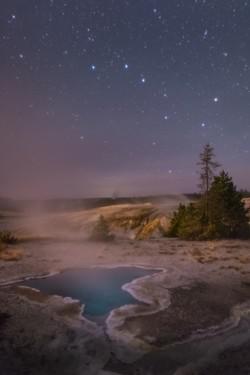
The Big Dipper in Yellowstone, by Alex Conu, Norway
image
Created for the OAE
Caption: First place in the 2021 IAU OAE Astrophotography Contest, category Wide star fields.
This image shows one of the most prominent and well-known asterisms of the Northern Hemisphere – the Big Dipper or the Plough. This asterism is part of the constellation from Greek mythology – Ursa Major (the Great Bear).
The Big Dipper comprises seven (eight) stars extending from the center to the right of the image. The four stars that form the “cup” of the dipper are in the shape of a trapezium just above the tallest tree towards the right of the image. These stars are Dubhe (top right), Merak (bottom right), Megrez (top left) and Phecda (bottom right). The three (four) stars that form the handle are to the left to trapezium (from right to left: Alioth, Mizar and Alkaid). Looking closely at Mizar, it is possible to see a smaller star to the top left and “touching” Mizar. This is Alcor, and with Mizar they make up the unaided-eye double-star system. However, very careful measurements have provided evidence that Mizar is in fact a quadruple system, and Alcor is a binary system. Although the names of the stars are derived from the Arabic names for the stars, different cultures have their own names for the stars.
In various cultures around the world, this asterism is associated with different objects, and furthermore, some indigenous cultures associate stories with individual stars. Constellations in addition to encompassing stories and myths of various cultures, are important navigation “tools”. The stars Dubhe and Merak, can be used to find the Pole (North) Star – Polaris (not seen in this image). Given its relationship to the Northern Hemisphere and being a circumpolar constellation (never setting below the horizon), the Big Dipper and Polaris are used on the flag of Alaska.
It is important to note that although the stars (except for the multiple star systems of Mizar and Alcor) in constellations appear to be “next” to each other, in reality the stars are at various distances from Earth and from each other.
Credit: Alex Conu/IAU OAE
Glossary Terms:
Asterism
Categories:
Naked Eye Astronomy
, Stars
License: Creative Commons Attribution 4.0 International (CC BY 4.0) Creative Commons Attribution 4.0 International (CC BY 4.0) icons
This file on Zenodo ( image 11.24 MB)