Documentos e recursos — Resultados da busca
Resultados da busca
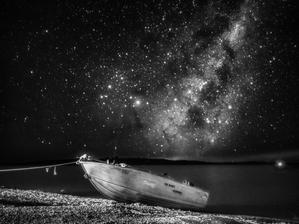
Sailing the Celestial Seas
imagem
Criado para o OAE
Legenda: Honorable mention in the 2023 IAU OAE Astrophotography Contest, category of Still images taken exclusively with smartphones/mobile devices.
In this black and white snapshot taken in April 2022 with a smartphone, a solitary boat rests on the shores of Lake Eucumbene, Australia, framed by the brilliant display of stars comprising the Milky Way. The prominent glow of the galactic centre stands out against the night sky, its intricate patterns of stars and nebulae casting a striking contrast. Each shimmering dot represents a distant sun, possibly orbited by uncharted planets, underscoring the vastness and complexity of our sprawling home galaxy.
Crédito: Lucy Yunxi Hu/IAU OAE (CC BY 4.0)
Termos do Glossário:
Via Láctea , Navegação
Categorias
Astronomia a Olho Nu
Tags:
astrophotography
Licença: Creative Commons Attribution 4.0 International (CC BY 4.0) Creative Commons Attribution 4.0 International (CC BY 4.0) ícones
Este arquivo no Zenodo ( imagem 7.11 MB)
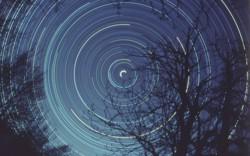
Half day exposure to the north star, by Fabrizio Melandri, Italy
imagem
Criado para o OAE
Legenda: First place in the IAU OAE Astrophotography Contest, category Star trails.
This star trail image shows the apparent movement of the stars in the night sky, which results from the Earth’s rotation around its polar axis. The trees in the foreground serve as an anchor as we turn with the Earth. The bright white semi-circle in the center of the image is the North (Pole) star – Polaris, which is located very close to the North Celestial Pole. One way to imagine that the Earth is at center of hollow crystal sphere, and the stars are embedded on this sphere, as the Earth spins on its axis, an observer on Earth sees the stars rising and setting, following an arc, because the horizon prevents the observer from the full arc for stars that are further away from the Celestial Pole. The North Celestial Pole (and its opposite the South Celestial Pole) is essentially formed by extending the line of the Earth’s axis. Capturing this image requires the photographer to take a long exposure with the camera on a tripod and pointing towards the Pole Star (North Hemisphere). In the Southern Hemisphere there is no star as close as Polaris is to the Celestial Pole, so the position of the South Celestial Pole is found using the South Cross and Pointer Stars (Alpha and Beta Centauri). Although overall the image has a slight blue tint, it does capture the varying colours of stars, it is easy to distinguish between the higher temperature blue stars and the lower temperature of the whitish stars, and even lower temperature reddish stars. The reason for this variation in colour is because higher temperature stars emit more in shorter wavelengths (bluer), compared to lower temperature stars which emit in longer wavelengths (redder).
Crédito: Fabrizio Melandri/IAU OAE
Termos do Glossário:
Estrelas circumpolares , Trilha das estrelas
Categorias
Astronomia a Olho Nu
Licença: Creative Commons Attribution 4.0 International (CC BY 4.0) Creative Commons Attribution 4.0 International (CC BY 4.0) ícones
Este arquivo no Zenodo ( imagem 6.11 MB)
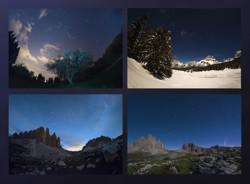
Big Dipper in Four Seasons
imagem
Criado para o OAE
Legenda: Winner in the 2022 IAU OAE Astrophotography Contest, category Still images of celestial patterns.
As Earth moves around the Sun, the positions of the stars in the night sky appear to change over the course of the year. This is well exemplified in this mosaic, with images taken in all four seasons throughout 2020 in the region of Veneto, Italy, showing the apparent motion of the Ursa Minor and Ursa Major constellations.
Ursa Minor, the Little Bear, is a constellation of the northern hemisphere, and it contains the northern celestial pole, in our current epoch marked by a bright star called Polaris or the Pole Star. For centuries Polaris has been used for navigation in the northern hemisphere, as it has been almost at the exact pole position for roughly 200 years. In the Middle Ages and antiquity, there was no pole star; the celestial north pole lay in a dark region and the Greeks considered the “Little She-Bear” as a companion of the “Great She-Bear”, which is more easily recognizable. The brightest stars of these constellations were alternatively also considered as chariots by the Greeks, as written in Aratus’s famous didactic poem from the 3rd century before the common era. The most famous asterism in Ursa Major, composed of seven stars, has different names across the (northern) world. While considered as a chariot by the Greeks, it is “The Northern Dipper” in China, and “The Seven Oxen” for the ancient Romans.
It was also the navigational purpose that led to the name The Great She-Bear, Ursa Major; for the Greeks, travelling towards the direction of the horizon above which Ursa Major appears meant moving towards the land of the bears (northern Europe). An animal is clearly recognizable when taking into account all the fainter stars in the vicinity of the seven bright ones. They considered it a female bear because Greek mythology connects this animal with the nymph Callisto, whose story describes the initiation rituals for women.
In the top left, we see an image taken on a spring evening, while the image below shows the same portion of the sky on a summer evening. Going counterclockwise, we see the sky during autumn in the bottom right image, while the top right finally shows this portion of the sky in the winter. Note that the relative positions of Ursa Minor and the Big Dipper don’t change, but all stars appear to be moved in a circle around Polaris. This star pointing due north lies at the point where Earth’s rotational axis intersects the celestial sphere.
The shift of constellations throughout the year is therefore a globe-clock or a globe-calendar, used by ancient civilizations to measure the year, and to predict the changes of seasons. It helps to establish, for instance, the best time for sowing and sailing as winds change with the seasons.
Crédito: Giorgia Hofer/IAU OAE
Termos do Glossário:
A Grande Concha (Big Dipper, em inglês) , Estrelas circumpolares , Rotação da Terra , Polo Celeste Norte (PCN) , Polaris , Asterismo
Categorias
Astronomia a Olho Nu
Licença: Creative Commons Attribution 4.0 International (CC BY 4.0) Creative Commons Attribution 4.0 International (CC BY 4.0) ícones
Este arquivo no Zenodo ( imagem 2.39 MB)
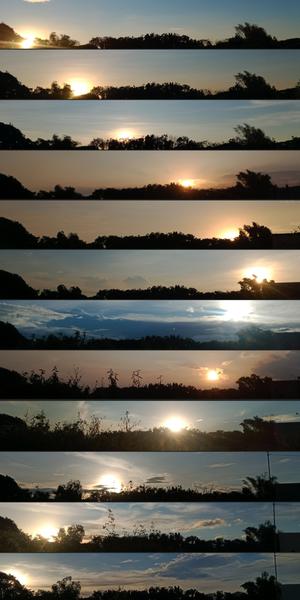
Where the Sun Sets Every Month
imagem
Criado para o OAE
Legenda: Third place winner in the 2023 IAU OAE Astrophotography Contest, category of Still images of sunrise and sunset location over the year.
Taken with a smartphone from San Rafael, Bulacan, Philippines, this series of images capture the changing position of sunset over the year owing to Earth’s axial tilt and orbit around the Sun. From January to December 2022, each image reflects the changing backdrop and position of the Sun at dusk. Observe the changing foliage and the appearance of an electricity pole in October. This collection serves as a visual testament to the celestial dance between Earth and the Sun, and the natural transformations on the ground.
Crédito: John Paul Pile/IAU OAE (CC BY 4.0)
Termos do Glossário:
Equinócio , Solstício , Solstício de verão , Trajetória do Sol (Arco Diurno) , Solstício de Inverno
Categorias
Astronomia a Olho Nu
Tags:
astrophotography
Licença: Creative Commons Attribution 4.0 International (CC BY 4.0) Creative Commons Attribution 4.0 International (CC BY 4.0) ícones
Este arquivo no Zenodo ( imagem 11.82 MB)
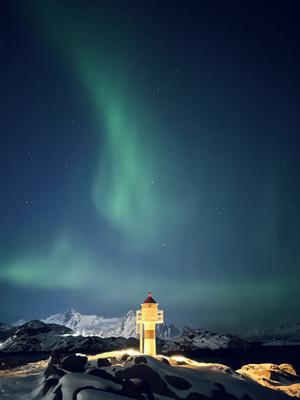
Fire of the Sky
imagem
Criado para o OAE
Legenda: Winner in the 2023 IAU OAE Astrophotography Contest, category of Still images taken exclusively with smartphones/mobile devices.
In the serene landscapes of Lofoten, Norway on 28 March 2023, the sky was set ablaze by the aurora. The Northern (Southern) Lights, also known as aurorae, are natural light displays resulting from interactions between solar winds and Earth’s magnetic fields, as charged particles are redirected towards the north and south pole regions. In Norse legends, they are often depicted as a heavenly fire. In this scene, the celestial show is beautifully complemented by the silhouette of a lighthouse, as if the lighthouse ignited the mesmerising display overhead. Caught off-guard by this dazzling spectacle, the photographer swiftly captured the moment with a smartphone. This is a testament to the breathtaking surprises nature offers and the impressive capabilities of modern devices.
Crédito: Stephanie Ziyi Ye/IAU OAE (CC BY 4.0)
Termos do Glossário:
Aurora , Tempestade geomagnética , Aurora Boreal
Categorias
Astronomia a Olho Nu
Tags:
astrophotography
Licença: Creative Commons Attribution 4.0 International (CC BY 4.0) Creative Commons Attribution 4.0 International (CC BY 4.0) ícones
Este arquivo no Zenodo ( imagem 1.67 MB)