Documentos e recursos — Resultados da busca
Resultados da busca
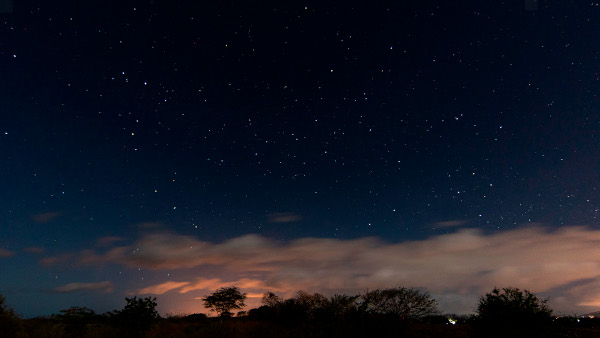
Sky Over the Town of Nindirí, in Masaya, Nicaragua
imagem
Criado para o OAE
Legenda: Honourable mention in the 2022 IAU OAE Astrophotography Contest, category Still images of celestial patterns.
This image was taken in Tisma, Nicaragua, in April 2022 during a night illuminated by the Moon. Still, some constellations are visible, but the Milky Way, which runs through the image with some of its brightest regions, hides in the celestial background, partially obscured by terrestrial clouds.
The Scorpion, one of the constellations of the Zodiac, is seen on the left side. We can first spot the brightest star, Antares, in the middle of a group of three in an asterism that looks like the stem of a flower growing from the clouds upwards. Its petals are the head of the scorpion. In the brightness of moonlight, the orange colour of Antares is not clearly visible. The three stars that comprise the head of the scorpion are called Acrab, Dschubba and Fang. They were recently named by the IAU in order to show the global diversity of constellations. Acrab is the Arabic term for the scorpion and Fang (The Room) is the name of the Chinese constellation made out of these stars. The Scorpion’s tail extends to the bottom of the image with the sting just above the horizon in the gap between clouds.
The constellation Centaurus is visible in the middle of this image. We can first recognise Crux and the two pointer stars, Alpha and Beta Centauri right above the clouds. The pointers are the front hooves of the centaur, while the stars of Crux were originally (before Christanity, in antiquity) considered one of the rear legs of the centaur. The stars in the front hooves are Rigil Kentaurus (mixed Arabic and Latin meaning The Foot of the Centaur), to the left, and Hadar, to the right. With Crux at the rear they comprise the legs of the mythological creature’s horse body. The humanoid torso is represented by two bright stars on the shoulders and three fainter stars for the head. The star tale says that this figure represents Chiron, the only decent one among the centaurs who was well educated and the teacher of all great heroes.
The Christian navigators who sailed to the New World around 1500 used these asterisms, although they had never seen them before in Europe. These included explorer Amerigo Vespucci whose name was given to the continent America. His shipmate Andrea Corsali, who came from Florence, where the poet Dante Alighieri was famous for his Divine Comedy written two centuries earlier, was reminded of Dante's poem by the four bright stars of Crux. It was probably in this context that they happened to invent the constellation Crux. Originally, the navigators only used the asterism for practical purposes but some time later, in the period of Christian religious wars between several new churches, celestial cartographers used the cross as a symbol of unity and against war.
Crédito: René Antonio Urroz Álvarez/IAU OAE
Termos do Glossário:
Escorpião , Alpha Centauri
Categorias
Astronomia a Olho Nu
Licença: Creative Commons Attribution 4.0 International (CC BY 4.0) Creative Commons Attribution 4.0 International (CC BY 4.0) ícones
Este arquivo no Zenodo ( imagem 1.72 MB)

Milky Way Arch over La Palma
imagem
Criado para o OAE
Legenda: Winner in the 2022 IAU OAE Astrophotography Contest, category Still images of celestial patterns.
This image, which shows the majestic band of the Milky Way and a range of culturally significant patterns, was taken in May 2022 at a very high altitude from the Roque de los Muchachos Observatory in La Palma, from which one can see the clouds below. Some prominent star patterns include Scorpius, Sagittarius, Lyra, Cygnus, Aquila, the Summer Triangle asterism, and the Teapot asterism.
As the Canary Islands used to be a starting point for European sailors to explore the world, we use this place to point to the many indigenous cultures they encountered. Most notably it is the dark patterns within the band of the Milky Way that hold significance for many Indigenous cultures around the world. The dark patterns are in fact dense, cool clouds of gas and dust that block the light from stars. Indigenous people see caves, waterways and various patterns associated with the dark regions of the Milky Way.
The constellations and patterns hold different cultural significance and interpretations for different people. For example, the constellation Scorpius is referred to by Polynesian people as the demigod Maui’s Fishhook. The Yolnu people of Arnhem Land associate Scorpius with a crocodile called Ingalpir. Some Indigenous Australian groups associate stories with individual stars within Scorpius, most notably Antares, the orange-red star in the top right of the image above the band of the Milky Way. Next to the Scorpion and above the bright centre of the Milky Way, there is a prominent dark cloud that is called the Pipe Nebula by modern astrophotographers. The smoke of this pipe goes up to rho Ophiuchi. This and all the other dark clouds in the Milky Way together form the backbone of heaven for some tribes, and an animal with black-and-white skin for South African Zulu people.
The nomenclature of bright stars also has cross-cultural roots. For example, Vega (the bright blue star towards the top of the image) comes from the Arabic waqi, from al-nasr al-waqi, the Eagle who throws himself down (in order to hunt). This contrasts with the Flying Eagle, Altair, also derived from Arabic. Antares is a Greek word meaning “the one similar to Mars”, referring to its colour. The star name Shaula in the stinger of the Scorpion is a modern version of the Babylonian or even Sumerian star name.
Crédito: Amirreza Kamkar/IAU OAE
Termos do Glossário:
Constelação , Poeira , Via Láctea , Escorpião , Asterismo , Nuvem de poeira , Extinção interestelar , Sagitário
Categorias
Via Láctea e Meio Interestelar
, Astronomia a Olho Nu
, Telescópios, Instrumentos e Observatórios
Licença: Creative Commons Attribution 4.0 International (CC BY 4.0) Creative Commons Attribution 4.0 International (CC BY 4.0) ícones
Este arquivo no Zenodo ( imagem 3.31 MB)
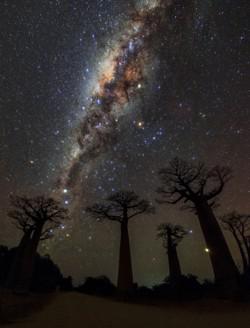
Milky Way over Avenue of Baobabs
imagem
Criado para o OAE
Legenda: Winner in the 2022 IAU OAE Astrophotography Contest, category Still images of celestial patterns.
This image, taken from the Avenue of Baobabs, Morondava, Madagascar, in July 2017, shows the majestic band of the Milky Way, our home galaxy, together with a rich collection of constellations and asterisms: Crux, Centaurus, Scorpius, Sagittarius and the Teapot asterism. Towards the bottom left of the image we can see the Southern Cross and the pointer stars Alpha (the brighter of the two) and Beta Centauri, which help to distinguish it from similar-looking configurations. Some cultures in Africa associate the Southern Cross with a giraffe, while others associate the constellations with a pride of lions or even with the Tree of Life.
Antares, the brightest star in the constellation Scorpius, is the orange-red star straight up from the middle baobab tree.
To the Pokomo people from southwestern Kenya, Africa, the Milky Way is associated with the smoke emanating from a campfire lit by ancient people. The various people in South Africa, in contrast, have different star tales; the Khoikhoi from the region around Cape Town explained the colours of the red and white stars as red and white roots that were roasted on a fire and thrown towards the sky together with the ashes of the fire. The Xhosa from further east consider the Milky Way the raised bristle of a huge angry dog, while the Zulu from near Johannesburg interpret it as a stream of spears of their strongest warriors.
Polynesian people, who were adept seafarers and navigators, see the constellation Scorpius as a fish hook, and refer to it as the demigod Maui’s Fish Hook. For the Djab Wurrung and the Jardwadjali people, the Southern Cross is part of a Dreamtime Story involving Tchingal, the Bram-bram-bult brothers (the pointer stars), their mother Druk (Delta Crux), and Bunya, the hunter who gets changed into a possum (Gacrux, red star at the top of the Southern Cross).
In this image, the planets Saturn (the bright point above Antares) and Jupiter (the bright point at the bottom-right of the image close to the trunk of the baobab tree) are visible. Indigenous cultures have various stories associated with the planets, for example Kamilaroi and Wailan people associate Saturn with wunygal, a small bird. The Boorong people of Western Victoria associate Jupiter with Ginabongbearp, the chief of the old spirits (Nurrumbunguttias), who takes the totemic form of the sulphur-crested white cockatoo.
Crédito: Amirreza Kamkar/IAU OAE
Termos do Glossário:
Cor , Poeira , Júpiter , Via Láctea , Saturno , Escorpião , Cruzeiro do Sul , Nuvem de poeira , Extinção interestelar , Alpha Centauri
Categorias
Via Láctea e Meio Interestelar
, Astronomia a Olho Nu
Licença: Creative Commons Attribution 4.0 International (CC BY 4.0) Creative Commons Attribution 4.0 International (CC BY 4.0) ícones
Este arquivo no Zenodo ( imagem 3.20 MB)

Lyrid of the Lake
imagem
Criado para o OAE
Legenda: Winner in the 2022 IAU OAE Astrophotography Contest, category Still images of celestial patterns.
Taken in the early hours of 24 April 2022, this image captures the sky of Yunnan Province, China, with a reflection on Lake Nian. The Milky Way is visible on the left side, while whitish Earth clouds are visible on the right. A Lyrid meteor crosses the sky along the Milky Way, its tail pointing back toward the shower's radiant in the constellation Lyra, which lies outside the image above the upper edge. The natural colours of the meteor are impressively clear.
A few constellations are also visible. In the top left corner we can recognise the small constellation of the Dolphin, in which five brightest stars comprise the asterism. This asterism forms the head-part of the larger Greek constellation of the Dolphin and was considered the Dolphin since Roman times, when Ptolemy formed the new constellation of Equuleus in the southern part of the original figure. In mediaeval China, this asterism was considered the Good and the Rotten Gourd, the good one being formed by the brighter rhombus on the top and the rotten one made of faint stars in the tail of the Roman dolphin.
The bright star to the right of the Dolphin and at the top of the image is Altair, the brightest star in the constellation Aquila. In Chinese uranology, Altair, together with some adjacent areas, forms the constellation of the Drum at the River. However, in Chinese folklore, the bright star stands for a boy in love with a girl, who is represented by the bright star Vega (in Lyra) on the other side of a huge celestial stream, the Milky Way. Vega is not visible in this image but the Lyrid meteor is like a teardrop of the unlucky girl who cannot reach her lover.
In the upper right of the image, the constellation Scorpius shines with its bright reddish star Antares. With some of its neighbouring stars, it was regarded in China as the asterism of The Heart, which was also one of the Lunar Mansions. It was considered the heart of the Azure Dragon, the super-constellation of spring, in ancient China.
Scorpius and Sagittarius, in the middle of the image, contain the brightest clouds of the Milky Way, the Galactic Centre, which also has clearly visible dark clouds in front of the bright ones.
There is no classical Greco-Roman constellation between Aquila and Scorpius, but in the 17th century, two Polish astronomers, the couple Jan and Elizabeta Hevelius, named this area of bright clouds in the Milky Way Scutum, the Shield, in memory of a Polish king. In China, however, this area directly outside the super-constellation (or heavenly enclosure) of the Celestial Market Place was seen as depicting Market Officers.
Crédito: Jianfeng Dai/IAU OAE
Termos do Glossário:
Via Láctea , Escorpião , Estrela cadente , Sagitário
Categorias
Via Láctea e Meio Interestelar
, Astronomia a Olho Nu
Licença: Creative Commons Attribution 4.0 International (CC BY 4.0) Creative Commons Attribution 4.0 International (CC BY 4.0) ícones
Este arquivo no Zenodo ( imagem 7.19 MB)

To guard the Stars and the Sea Together
imagem
Criado para o OAE
Legenda: Winner in the 2022 IAU OAE Astrophotography Contest, category Still images of celestial patterns.
This image composition is amazing. In the far background of the landscape we see a chain of mountains that seems to mirror the structure of the Milky Way in the sky above. The strong daylight-like colours of the landscape are caused by the Moon, the bright light at the top of the image.
Taken in Kinabalu, Malaysia, in February 2019, this image shows the alignment of planets and the Moon, conveying the idea of the ecliptic as the central line of the Zodiac, the plane within which all planets orbit the Sun. The ecliptic is the central line of the Zodiac, so the region of about five to 10 degrees either side of the ecliptic is where the constellations of the Zodiac are located. Starting from the horizon towards the bottom left of the image we can see the planets Venus, Saturn and Jupiter. The planets have different cultural significance for people around the world, and are deeply embedded in social, religious and practical aspects of life. For example, Wardaman traditions of Indigenous Australians associate the planets with ancestor spirits who traverse the Celestial Road (ecliptic). The appearance and disappearance of planets in the sky are associated with various ceremonies. For example, when Venus starts being the “Morning star” after having been the “Evening star”, this marks the Banumbirr ceremony for the Yolnu people of Arnhem Land, in Australia.
The image also shows the constellations Scorpius, Aquila, Lupus and Triangulum Australe, the asterism of the Teapot, and the two pointer stars Alpha and Beta Centauri. The constellations, asterisms and individual stars within them have significance in many different cultures.
Malaysia, being close to the equator, has had connections to the north as well as to the south and almost the whole sky is visible over the course of the year. The star Antares is seen by the Kokatha people of the Western Desert as Kogolongo, the red tailed black cockatoo, while the Boorong refer to it as Djuit, the red-rumped parrot. The two stars which form the stinger of Scorpius (Shaula and Lesath), are called Karik Karik, the Australian Kestrel.
Crédito: Likai Lin/IAU OAE
Termos do Glossário:
Constelação , Júpiter , Lua , Saturno , Escorpião , Vênus , Zodíaco , Asterismo , Alpha Centauri
Categorias
Astronomia a Olho Nu
Licença: Creative Commons Attribution 4.0 International (CC BY 4.0) Creative Commons Attribution 4.0 International (CC BY 4.0) ícones
Este arquivo no Zenodo ( imagem 3.77 MB)