Documentos e recursos — Resultados da busca
Resultados da busca
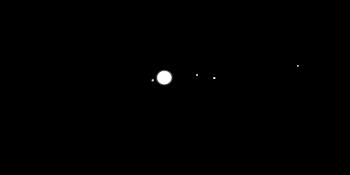
Jupiter Moons Movie2, by Nicolas Hurez, Paul-Antoine Matrangolo, and Carl Pennypacker, United States of America
vídeo
Criado para o OAE
Legenda: Second place in the 2021 IAU OAE Astrophotography Contest, category Galilean moons.
This sequence shows the orbit of the four Galilean moons around the planet Jupiter. Almost two entire orbits of the innermost moon, Io, can be seen, with the other moons (Europa and Ganymede, but in particular Callisto) being further away, orbiting noticeably slower. The images were obtained in 2018 with the Las Cumbres Global Observatory at different locations on Earth, allowing a continuous sequence of images over approximately half a week without gaps during the day. With clear skies and over the course of several nights, the motion of the Galilean moons can also be observed with binoculars (ideally steady your elbows on a surface).
Crédito: Nicolas Hurez, Paul-Antoine Matrangolo and Carl Pennypacker/IAU OAE
Termos do Glossário:
Satélites Galileanos , Gigante gasoso , Io , Júpiter , Luas , Órbita , Planetas Externos , Planeta
Categorias
Sistema Solar
Licença: Creative Commons Attribution 4.0 International (CC BY 4.0) Creative Commons Attribution 4.0 International (CC BY 4.0) ícones
Este arquivo no Zenodo ( vídeo 890.47 kB)
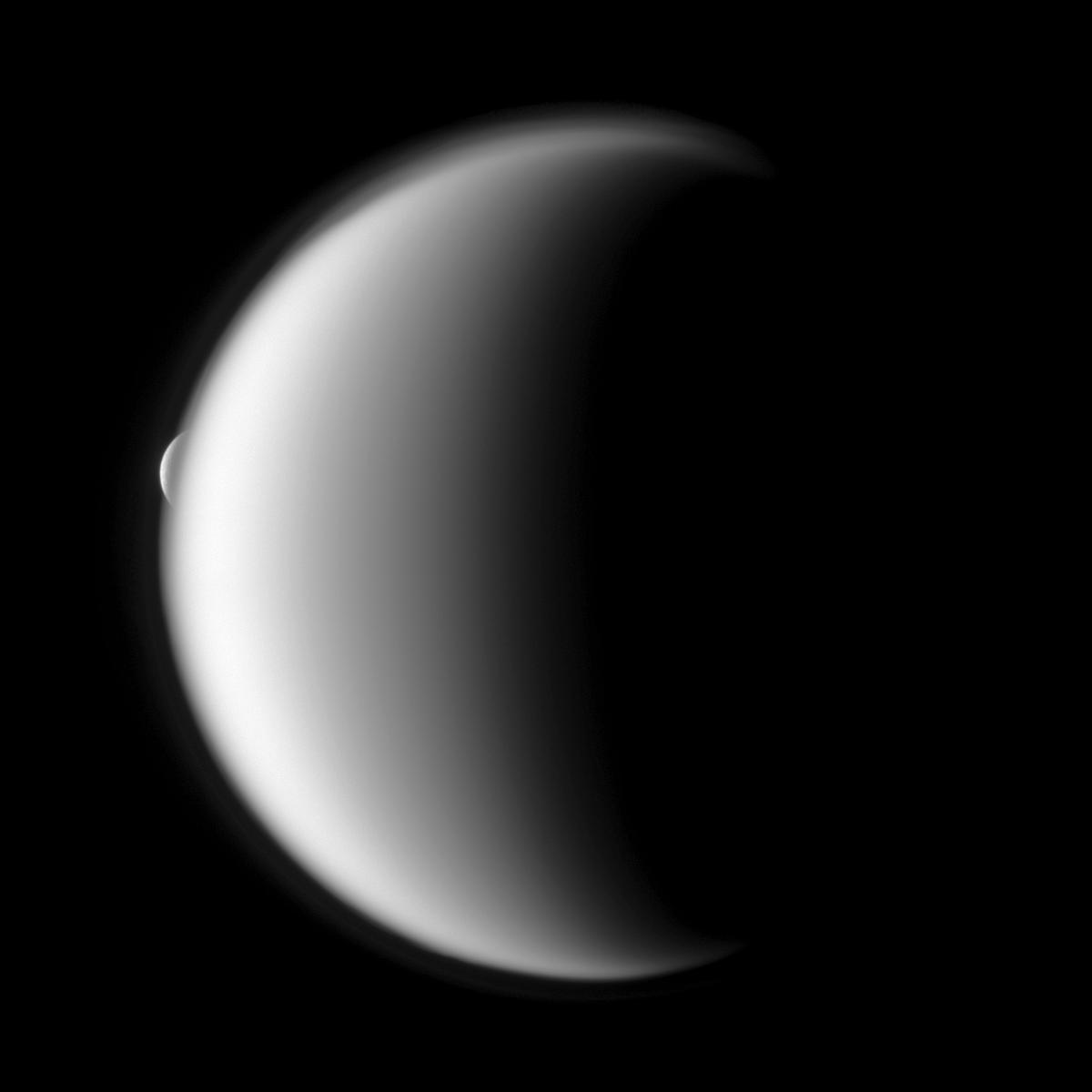
Rhea reappearing after occultation by Titan
imagem
Legenda: On October 27, 2009, NASA’s Cassini spacecraft orbiting around Saturn captured this view of Saturn's moon Rhea as it began to emerge after being hidden by Saturn's largest moon Titan during an occultation. An occultation is a celestial event in which one object moves in front of another and temporarily blocks the first object from view.
In this image, Titan — about 5,150 km across — was closer to the spacecraft at about 1 million km, while Rhea — roughly 1,528 km in diameter — was farther away at about 2.3 million km. Titan’s high-altitude atmospheric haze is visible as a faint glow around its limb, showing the difference in surface and atmospheric properties between these two moons.
Scientists study occultations like this because watching how one moon disappears behind or reappears from another helps refine our understanding of their orbits and physical characteristics.
Crédito: NASA/JPL/Space Science Institute
Link do crédito
Termos do Glossário:
Luas , Titã , Ocultação
Licença: Domínio Público Domínio Público ícones
Arquivo
( imagem
85.73 kB)
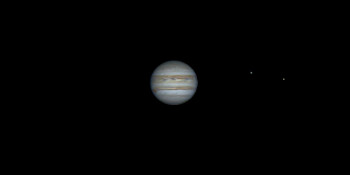
Jupiter's Rotation, by Vishal Sharma, India
vídeo
Criado para o OAE
Legenda: Third place in the 2021 IAU OAE Astrophotography Contest, category Galilean moons: Jupiter’s Rotation, by Vishal Sharma, India.
This time-lapse beautifully shows the rotation of Jupiter and the passage of two Galilean moons on the right side of the frame. Jupiter completes one rotation in just under 10 hours and we see as the Great Red Spot makes its way from left to right. The two moons travel a noticeable fraction of their orbit in this short time. This image was taken in 2020 in the North of India.
Crédito: Vishal Sharma/IAU OAE
Termos do Glossário:
Satélites Galileanos , Gigante gasoso , Júpiter , Luas , Órbita , Planetas Externos , Planeta
Categorias
Sistema Solar
Licença: Creative Commons Attribution 4.0 International (CC BY 4.0) Creative Commons Attribution 4.0 International (CC BY 4.0) ícones
Este arquivo no Zenodo ( vídeo 1.54 MB)
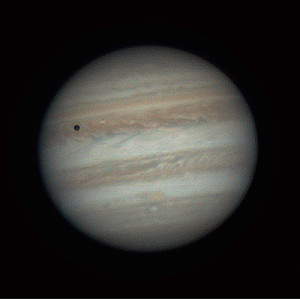
Jupiter, Io and its shadow, by Ralf Burkart, Germany
vídeo
Criado para o OAE
Legenda: First place in the 2021 IAU OAE Astrophotography Contest, category Galilean moons.
This time-lapse of Jupiter taken in 2017 from Germany beautifully illustrates the transit of one of the Galilean moons, Io, in front of Jupiter. As this is simply a moon casting a shadow on a planet it is equivalent to a lunar eclipse on Earth observed from further away. While the shadow of the moon is clearly visible from the beginning, it might be difficult to spot the moon itself against the background of the beautiful atmospheric bands of Jupiter the first time the video is seen. Watching it repeatedly allows appreciating the rapid motion and rotation in this fantastic observation.
Crédito: Ralf Burkart/IAU OAE
Termos do Glossário:
Satélites Galileanos , Gigante gasoso , Io , Júpiter , Luas , Órbita , Planetas Externos , Planeta , Trânsito
Categorias
Sistema Solar
Licença: Creative Commons Attribution 4.0 International (CC BY 4.0) Creative Commons Attribution 4.0 International (CC BY 4.0) ícones
Este arquivo no Zenodo ( vídeo 12.64 MB)
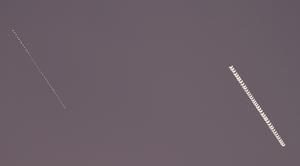
Venus and Mercury Trails
imagem
Criado para o OAE
Legenda: Honorable mention in the 2023 IAU OAE Astrophotography Contest, category of Still images of phases of Venus.
In this composite image, both Mercury (left) and Venus (right) can be seen heading into the sunset. The phases of each are beautifully captured as they descend. Not all planets or moons in the Solar System show phases as viewed from Earth. This phenomenon occurs because the orbits of Venus and Mercury are positioned between Earth’s orbit and the Sun, sometimes allowing us to see only part of the illuminated portion of each planet. These phases are similar to the phases we see of our own Moon.
Crédito: Marcella Giulia Pace (CC BY 4.0)
Termos do Glossário:
Mercúrio , Fase , Vênus
Categorias
Sistema Solar
Tags:
astrophotography
Licença: Creative Commons Attribution 4.0 International (CC BY 4.0) Creative Commons Attribution 4.0 International (CC BY 4.0) ícones
Este arquivo no Zenodo ( imagem 4.86 MB)