Documentos e recursos — Resultados da busca
Resultados da busca
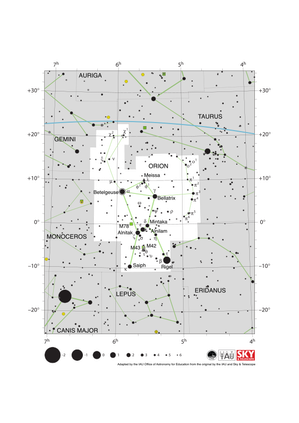
Orion Constellation Map
imagem
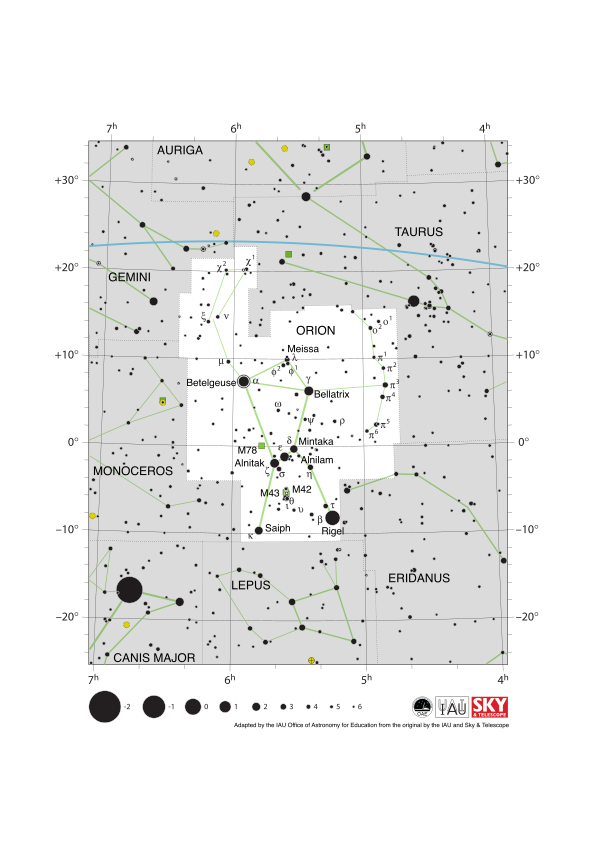
Legenda: The constellation Orion along with its bright stars and surrounding constellations. Orion is surrounded by (going clockwise from the top) Taurus, Eridanus, Lepus, Monoceros and Gemini. Orion’s brightest stars Betelgeuse and Rigel appear at the northern (upper on this diagram) and southern (lower) end of the constellation respectively with the famous three star “belt” in the middle.
Orion spans the celestial equator and is thus visible at some time in the year from all of planet Earth. In the most arctic or antarctic regions of the world, some parts of the constellation may not be visible. Orion is most visible in the evenings in the northern hemisphere winter and southern hemisphere summer. The blue line above Orion marks the ecliptic, the path the Sun appears to travel across the sky over the course of a year. The Sun never passes through Orion, but one can occasionally find the other planets of the Solar System and the Moon in Orion.
Just south of Orion’s belt lie two Messier objects M42 (the Orion nebula) and M43, marked by green squares. These nebulae along with M78 (here the green square to the left of the belt) are part of the huge Orion Molecular Cloud Complex. This covers most of the constellation and includes regions where these molecular clouds are collapsing to form young starts.
The y-axis of this diagram is in degrees of declination with north as up and the x-axis is in hours of right ascension with east to the left. The sizes of the stars marked here relate to the star's apparent magnitude, a measure of its apparent brightness. The larger dots represent brighter stars. The Greek letters mark the brightest stars in the constellation. These are ranked by brightness with the brightest star being labeled alpha, the second brightest beta, etc., although this ordering is not always followed exactly. The circle around Betelgeuse indicates that it is a variable star. The dotted boundary lines mark the IAU's boundaries of the constellations and the solid green lines mark one of the common forms used to represent the figures of the constellations. Neither the constellation boundaries, nor the line marking the ecliptic, nor the lines joining the stars appear on the sky.
Crédito: Adapted by the IAU Office of Astronomy for Education from the original by IAU/Sky & Telescope
Link do crédito
Termos do Glossário:
Magnitude aparente , Coordenadas celestes , Constelação , Declinação , Eclíptica , Gêmeos , Ascensão Reta (AR) , Touro , Órion , Estrela variável
Categorias
Astronomia a Olho Nu
Licença: Creative Commons Attribution 4.0 International (CC BY 4.0) Creative Commons Attribution 4.0 International (CC BY 4.0) ícones
Arquivo
( imagem
147.68 kB)
Arquivo PDF
(PDF file
220.54 kB)
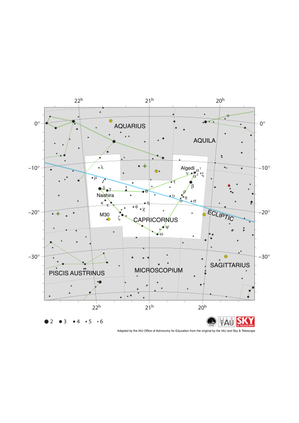
Capricornus Constellation Map
imagem
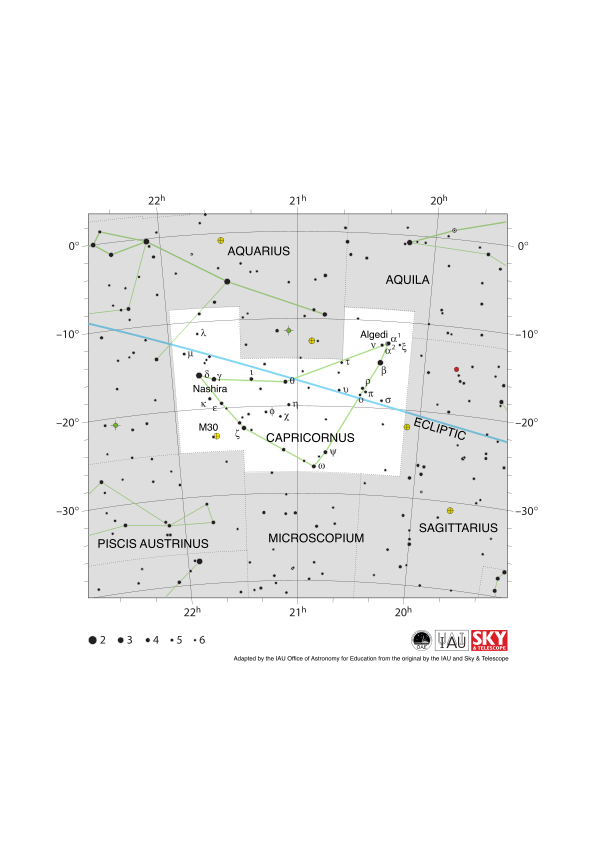
Legenda: The constellation Capricornus (commonly called Capricorn) including its bright stars and surrounding constellations. Capricornus is surrounded by (going clockwise from the top) Aquarius, Aquila, Sagittarius, Microscopium and Piscis Austrinus. Capricornus lies on the ecliptic (shown here as a blue line), this is the path the Sun appears to take across the sky over the course of a year. The Sun is in Capricornus from mid January to mid February. The other planets of the Solar System can often be found in Capricornus.
Capricornus lies just south of the celestial equator and is visible to all observers south of the Arctic Circle. Capricornus is most visible in the evenings in the northern hemisphere autumn and southern hemisphere spring.
In the south east (lower left on this diagram) of the constellation one can find the globular cluster M30 (shown here as a yellow circle with a plus sign superimposed on it).
The y-axis of this diagram is in degrees of declination with north as up and the x-axis is in hours of right ascension with east to the left. The sizes of the stars marked here relate to the star's apparent magnitude, a measure of its apparent brightness. The larger dots represent brighter stars. The Greek letters mark the brightest stars in the constellation. These are ranked by brightness with the brightest star being labeled alpha, the second brightest beta, etc., although this ordering is not always followed exactly. The dotted boundary lines mark the IAU's boundaries of the constellations and the solid green lines mark one of the common forms used to represent the figures of the constellations. Neither the constellation boundaries, nor the line marking the ecliptic, nor the lines joining the stars appear on the sky.
Crédito: Adapted by the IAU Office of Astronomy for Education from the original by IAU/Sky & Telescope
Link do crédito
Termos do Glossário:
Magnitude aparente , Capricórnio , Coordenadas celestes , Constelação , Declinação , Eclíptica , Aglomerado Globular , Ascensão Reta (AR) , Zodíaco , Aquário , Sagitário , Trópico de Capricórnio
Categorias
Astronomia a Olho Nu
Licença: Creative Commons Attribution 4.0 International (CC BY 4.0) Creative Commons Attribution 4.0 International (CC BY 4.0) ícones
Arquivo
( imagem
97.98 kB)
Arquivo PDF
(PDF file
180.85 kB)
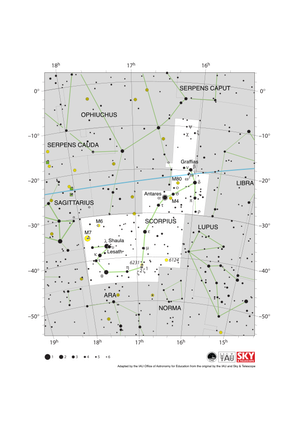
Scorpius Constellation Map
imagem
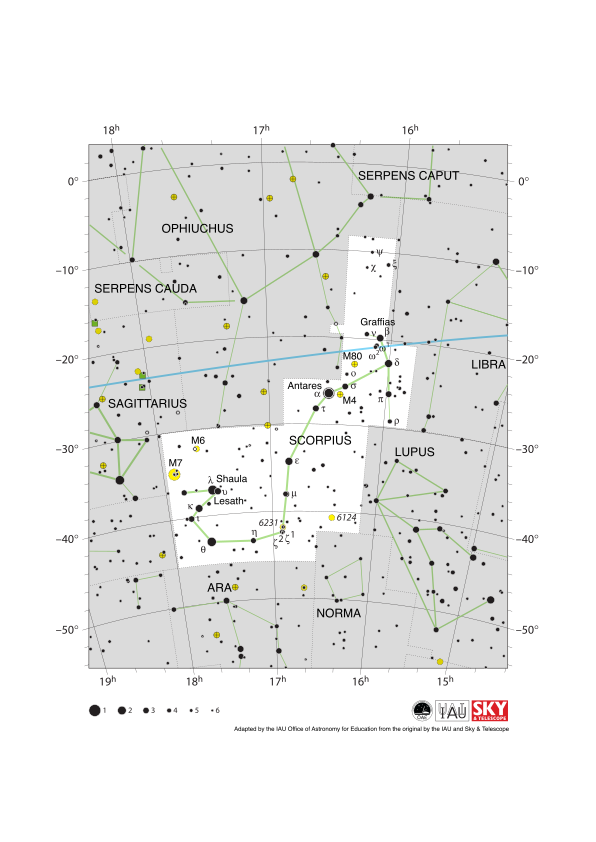
Legenda: The constellation Scorpius (often commonly called Scorpio) along with its bright stars and surrounding constellations. Scorpius is surrounded by (going clockwise from the top) Ophiuchus, Serpens Caput, Libra, Lupus, Norma, Ara, Corona Australis and Sagittarius. Scorpius’s brightest star Antares appears in the heart of the constellation with the famous tail of Scoprius in the south-east (lower left). Scorpius lies on the ecliptic (shown here as a blue line), this is the path the Sun appears to take across the sky over the course of a year. The Sun only spends a short amount of time in late November in Scorpius. The other planets of the Solar System can often be found in Scorpius.
Scorpius lies south of the celestial equator. The whole constellation is not visible from the most arctic regions of the world with parts of Scorpius obscured for observers in northern parts of Asia, Europe and North America. Scorpius is most visible in the evenings in the northern hemisphere summer and southern hemisphere winter.
The yellow circles mark the positions of the open clusters M6, M7 & NGC 6231 while the yellow circles with plus signs superimposed on them mark the globular clusters M4 and M80.
The y-axis of this diagram is in degrees of declination with north as up and the x-axis is in hours of right ascension with east to the left. The sizes of the stars marked here relate to the star's apparent magnitude, a measure of its apparent brightness. The larger dots represent brighter stars. The Greek letters mark the brightest stars in the constellation. These are ranked by brightness with the brightest star being labeled alpha, the second brightest beta, etc., although this ordering is not always followed exactly. The circle around Antares indicates that it is a variable star. The dotted boundary lines mark the IAU's boundaries of the constellations and the solid green lines mark one of the common forms used to represent the figures of the constellations. The blue line marks the ecliptic, the path the Sun appears to travel across the sky over the course of one year. Neither the constellation boundaries, nor the line marking the ecliptic, nor the lines joining the stars appear on the sky.
Crédito: Adapted by the IAU Office of Astronomy for Education from the original by IAU/Sky & Telescope
Link do crédito
Termos do Glossário:
Magnitude aparente , Coordenadas celestes , Constelação , Declinação , Eclíptica , Aglomerado Globular , Libra , Ascensão Reta (AR) , Escorpião , Zodíaco , Aglomerado aberto , Sagitário , Estrela variável
Categorias
Astronomia a Olho Nu
Licença: Creative Commons Attribution 4.0 International (CC BY 4.0) Creative Commons Attribution 4.0 International (CC BY 4.0) ícones
Arquivo
( imagem
152.59 kB)
Arquivo PDF
(PDF file
217.25 kB)
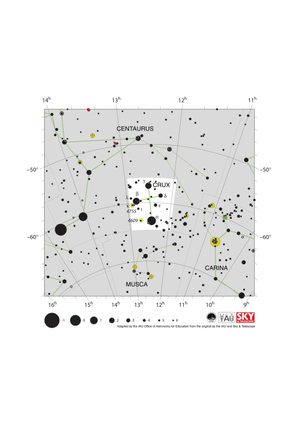
Crux Constellation Map
imagem
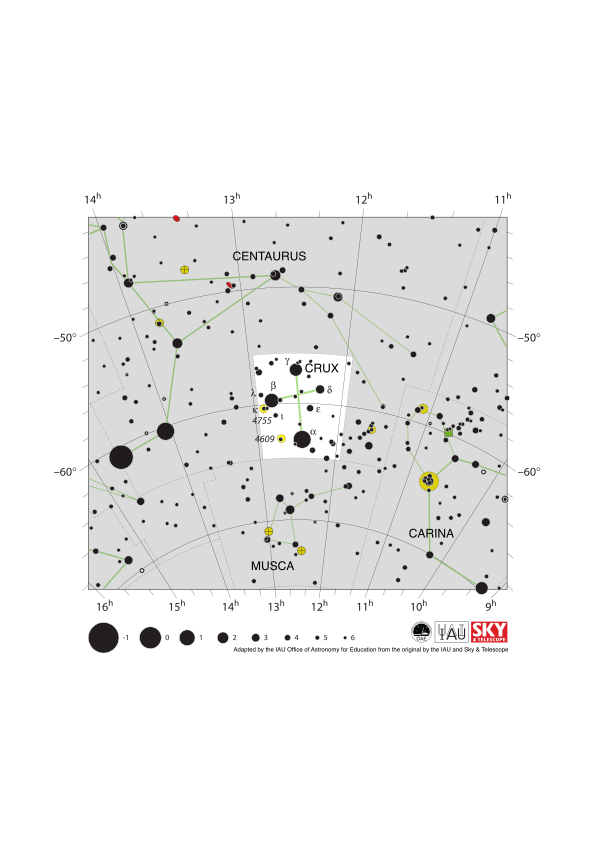
Legenda: The constellation Crux (commonly known as the Southern Cross or Crux Australis) showing its bright stars and surrounding constellations. The Southern Cross is surrounding by (going clockwise from the top) Centaurus, Carina and Musca. The brightest star is alpha Crucis which appears at the bottom of the constellation's famous kite shape. The Southern Cross is visible from southern and equatorial regions of the world. In more southerly parts of the world it is circumpolar so is always above the horizon. In other parts of the southern hemisphere and in equatorial regions it is most visible in the evenings in the southern hemisphere autumn.
The yellow circles show the locations of two open clusters, NGC 4755 (known as the Jewel Box) and NGC 4609.
The line joining gamma and alpha Crucis (the third and first brightest stars in the Southern Cross) points in the approximate direction of the South Celestial Pole. This has led to the Southern Cross playing an important role in celestial navigation, allowing navigators from different astronomical traditions to find their bearings.
The y-axis of this diagram is in degrees of declination with north as up and the x-axis is in hours of right ascension with east to the left. The sizes of the stars marked here relate to the star's apparent magnitude, a measure of its apparent brightness. The larger dots represent brighter stars. The Greek letters mark the brightest stars in the constellation. These are ranked by brightness with the brightest star being labeled alpha, the second brightest beta, etc., although this ordering is not always followed exactly. The dotted boundary lines mark the IAU's boundaries of the constellations and the solid green lines mark one of the common forms used to represent the figures of the constellations. Neither the constellation boundaries, nor the lines joining the stars appear on the sky.
Crédito: Adapted by the IAU Office of Astronomy for Education from the original by IAU/Sky & Telescope.
Link do crédito
Termos do Glossário:
Magnitude aparente , Coordenadas celestes , Constelação , Declinação , Ascensão Reta (AR) , Cruzeiro do Sul , Aglomerado aberto , Polo Celeste Sul (PCS)
Categorias
Astronomia a Olho Nu
Licença: Creative Commons Attribution 4.0 International (CC BY 4.0) Creative Commons Attribution 4.0 International (CC BY 4.0) ícones
Arquivo
( imagem
110.07 kB)
Arquivo PDF
(PDF file
170.97 kB)

Caelum Constellation Map
imagem
Legenda: The constellation Caelum with its bright stars and surrounding constellations. Caelum is surrounded by (going clockwise from the top): Eridanus, Horologium, Dorado, Pictor, Columba and Lepus. Caelum is a relatively small and faint constellation.
Caelum is a southern constellation and the whole constellation is visible at some point in the year from the whole southern hemisphere and from equatorial parts of the northern hemisphere. Parts of the constellation are visible from temperate regions of the northern hemisphere. The constellation is most visible in the evenings in the northern hemisphere winter and southern hemisphere summer.
The y-axis of this diagram is in degrees of declination with north as up and the x-axis is in hours of right ascension with east to the left. The sizes of the stars marked here relate to the star's apparent magnitude, a measure of its apparent brightness. The larger dots represent brighter stars. The Greek letters mark the brightest stars in the constellation. These are ranked by brightness with the brightest star being labeled alpha, the second brightest beta, etc., although this ordering is not always followed exactly. The dotted boundary lines mark the IAU's boundaries of the constellations and the solid green lines mark one of the common forms used to represent the figures of the constellations. Neither the constellation boundaries, nor the lines joining the stars appear on the sky.
Crédito: Adapted by the IAU Office of Astronomy for Education from the original by the IAU and Sky & Telescope
Link do crédito
Termos do Glossário:
Magnitude aparente , Coordenadas celestes , Constelação , Declinação , Ascensão Reta (AR)
Categorias
Astronomia a Olho Nu
Licença: Creative Commons Attribution 4.0 International (CC BY 4.0) Creative Commons Attribution 4.0 International (CC BY 4.0) ícones
Arquivo
( imagem
96.56 kB)
Arquivo PDF
(PDF file
183.95 kB)