Documents & Ressources - Résultat de la recherche
Résultats de la recherche

Milky Way Arch over La Palma
image
Créé pour l'OAE
Légende : Winner in the 2022 IAU OAE Astrophotography Contest, category Still images of celestial patterns.
This image, which shows the majestic band of the Milky Way and a range of culturally significant patterns, was taken in May 2022 at a very high altitude from the Roque de los Muchachos Observatory in La Palma, from which one can see the clouds below. Some prominent star patterns include Scorpius, Sagittarius, Lyra, Cygnus, Aquila, the Summer Triangle asterism, and the Teapot asterism.
As the Canary Islands used to be a starting point for European sailors to explore the world, we use this place to point to the many indigenous cultures they encountered. Most notably it is the dark patterns within the band of the Milky Way that hold significance for many Indigenous cultures around the world. The dark patterns are in fact dense, cool clouds of gas and dust that block the light from stars. Indigenous people see caves, waterways and various patterns associated with the dark regions of the Milky Way.
The constellations and patterns hold different cultural significance and interpretations for different people. For example, the constellation Scorpius is referred to by Polynesian people as the demigod Maui’s Fishhook. The Yolnu people of Arnhem Land associate Scorpius with a crocodile called Ingalpir. Some Indigenous Australian groups associate stories with individual stars within Scorpius, most notably Antares, the orange-red star in the top right of the image above the band of the Milky Way. Next to the Scorpion and above the bright centre of the Milky Way, there is a prominent dark cloud that is called the Pipe Nebula by modern astrophotographers. The smoke of this pipe goes up to rho Ophiuchi. This and all the other dark clouds in the Milky Way together form the backbone of heaven for some tribes, and an animal with black-and-white skin for South African Zulu people.
The nomenclature of bright stars also has cross-cultural roots. For example, Vega (the bright blue star towards the top of the image) comes from the Arabic waqi, from al-nasr al-waqi, the Eagle who throws himself down (in order to hunt). This contrasts with the Flying Eagle, Altair, also derived from Arabic. Antares is a Greek word meaning “the one similar to Mars”, referring to its colour. The star name Shaula in the stinger of the Scorpion is a modern version of the Babylonian or even Sumerian star name.
Crédit : Amirreza Kamkar/IAU OAE
Termes du glossaire:
Constellation , Poussière , Voie lactée , Scorpius , Astérisme , Nuage de poussière , L'extinction interstellaire , Sagittaire
Catégories :
Voie lactée et milieu interstellaire
, Astronomie à l'œil nu
, Télescopes, instruments et observatoires
Licence : Creative Commons (CC) Attribution 4.0 International (CC BY 4.0) Creative Commons (CC) Attribution 4.0 International (CC BY 4.0) Icônes
Ce fichier est sur Zenodo ( image 3.31 MB)

To guard the Stars and the Sea Together
image
Créé pour l'OAE
Légende : Winner in the 2022 IAU OAE Astrophotography Contest, category Still images of celestial patterns.
This image composition is amazing. In the far background of the landscape we see a chain of mountains that seems to mirror the structure of the Milky Way in the sky above. The strong daylight-like colours of the landscape are caused by the Moon, the bright light at the top of the image.
Taken in Kinabalu, Malaysia, in February 2019, this image shows the alignment of planets and the Moon, conveying the idea of the ecliptic as the central line of the Zodiac, the plane within which all planets orbit the Sun. The ecliptic is the central line of the Zodiac, so the region of about five to 10 degrees either side of the ecliptic is where the constellations of the Zodiac are located. Starting from the horizon towards the bottom left of the image we can see the planets Venus, Saturn and Jupiter. The planets have different cultural significance for people around the world, and are deeply embedded in social, religious and practical aspects of life. For example, Wardaman traditions of Indigenous Australians associate the planets with ancestor spirits who traverse the Celestial Road (ecliptic). The appearance and disappearance of planets in the sky are associated with various ceremonies. For example, when Venus starts being the “Morning star” after having been the “Evening star”, this marks the Banumbirr ceremony for the Yolnu people of Arnhem Land, in Australia.
The image also shows the constellations Scorpius, Aquila, Lupus and Triangulum Australe, the asterism of the Teapot, and the two pointer stars Alpha and Beta Centauri. The constellations, asterisms and individual stars within them have significance in many different cultures.
Malaysia, being close to the equator, has had connections to the north as well as to the south and almost the whole sky is visible over the course of the year. The star Antares is seen by the Kokatha people of the Western Desert as Kogolongo, the red tailed black cockatoo, while the Boorong refer to it as Djuit, the red-rumped parrot. The two stars which form the stinger of Scorpius (Shaula and Lesath), are called Karik Karik, the Australian Kestrel.
Crédit : Likai Lin/IAU OAE
Termes du glossaire:
Constellation , Jupiter , Lune , Saturne , Scorpius , Vénus , Zodiaque , Astérisme , Alpha du Centaure
Catégories :
Astronomie à l'œil nu
Licence : Creative Commons (CC) Attribution 4.0 International (CC BY 4.0) Creative Commons (CC) Attribution 4.0 International (CC BY 4.0) Icônes
Ce fichier est sur Zenodo ( image 3.77 MB)
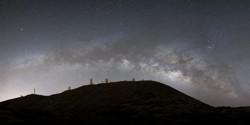
Teide Observatory
image
Créé pour l'OAE
Légende : Honourable mention in the 2022 IAU OAE Astrophotography Contest, category Still images of celestial patterns.
Taken in May 2022 in Teide National Park in Tenerife, Spain, this image shows the arc of the Milky Way galaxy crossing the sky, accompanied by prominent constellations over the professional telescopes located on the mountains of that island. While the telescopes and the people working with them may ignore the constellations, the photographer managed to catch the Milky Way in such a way that it almost matches the shape of the mountain.
The bright star in the top-left side of the image is Vega, one of the brightest stars in the night sky and located in the small constellation Lyra. Being a white star, it is the standard star astrophysicists use to define the colour scale. As it is also a relatively close star, only about 25 light-years away, with a relatively simple name, it frequently appears in modern science fiction, for example in Carl Sagan’s famous novel “Contact”, which was filmed in 1997 with Jodie Foster starring as a radio astronomer.
The bright star seen below the galaxy and on the left half of the image is Altair, also one of the brightest stars in the night sky and located in the constellation Aquila. Together with Deneb — a star in the constellation Cygnus (the Swan) that is not visible in this image — Altair and Vega form the Summer Triangle, a characteristic asterism of popular astronomy in the northern hemisphere, where these telescopes are located.
On the right side of the image we can see the constellation Scorpius. This is easily identified by its brightest star, Antares, the reddish star in the Scorpion’s heart. Below it, the whole body and tail of the Scorpion can be found and above it the celestial Scorpion's head is represented by three bright bluish stars. Below the tail and above the horizon, the constellation of Ara, the Altar, is half-visible, but like all the stars of Sagittarius in the Milky Way and the much fainter ones in Hercules and Ophiuchus above it, these constellations are more difficult to pinpoint in this photograph full of stars. The head of Ophiuchus is the relatively bright star in the middle between Vega and Antares. In addition to the huge size of this constellation, it is also important because it is the thirteenth one of the Zodiac, and the Sun spends roughly three weeks in Ophiuchus, after only five days in Scorpius. Furthermore, Ophiuchus represents the model for the mythological best doctor in the world, called Asklepios in Greek mythology, and Aesculab in Latin. His constellation praises all people working in medical professions, including nurses, pharmacists and doctors.
Crédit : Curd-Christian Tengeler/IAU OAE
Termes du glossaire:
Observatoire astronomique , Astronomie , Poussière , Voie lactée , Scorpius , Nuage de poussière , L'extinction interstellaire
Catégories :
Voie lactée et milieu interstellaire
, Astronomie à l'œil nu
, Télescopes, instruments et observatoires
Licence : Creative Commons (CC) Attribution 4.0 International (CC BY 4.0) Creative Commons (CC) Attribution 4.0 International (CC BY 4.0) Icônes
Ce fichier est sur Zenodo ( image 54.90 MB)

The Moon and Milky Way arch Above the Golden Hall
image
Créé pour l'OAE
Légende : Winner in the 2022 IAU OAE Astrophotography Contest, category Still images of celestial patterns.
Taken in April 2021 from the top of the Laojun Mountain in China, this image shows a panoramic view of the Milky Way over the Golden Hall called “Yuhuangding” as a symbol of wealth. In China, the Milky Way is considered a huge stream like one of the big rivers. It separates the Cowherd (Altair) and his beloved Weaving Girl (Vega) and it has a Celestial Ford in the northern dark cloud in the modern constellation Cygnus.
The Milky Way appears as a whitish arch as we cannot distinguish all the individual stars, but instead see the accumulation of light from them. It is a disc-shaped galaxy and the Solar System is located within one of its spiral arms, so we see it from inside, which gives it the shape of a band in our sky. It is associated with the religions and mythologies of several cultures. The modern term Milky Way derives from Greek folklore as the milk spread in the sky by the mother goddess Hera, when she unwillingly breastfed young Heracles. This son of Zeus and a mortal woman was put next to her while she was asleep but from his strong sucking she woke up and realised she was feeding an unknown child, and immediately pushed the child away. Greek philosophers like Plato considered the glittering band in the sky to be the traces of a former path of the Sun.
Alternatively, for the Tupi-Guarani indigenous mythology from South America, the Milky Way represents the “path of tapir”. For some Australian native peoples, its dark clouds formed the shape of an emu if high in the sky, and of crocodiles if low on the horizon. For many southern African, South American and Australian cultures, it was considered a pathway to or from heaven. At the right edge of the image, we can recognise the modern constellation Scorpius with its most prominent star, Antares, the reddish star just above the Milky Way.
The brightest point seen in the centre bottom of the image is the rising Moon with Jupiter next to it. A few constellations can be distinguished in this image, including Corona Australis, a faint arc-shaped constellation located to the bottom right. Just above the Southern Crown, we can see the Teapot asterism as part of the Sagittarius constellation. Since Sagittarius lies next to the centre of the Milky Way, many structures such as star-forming regions, globular clusters and planetary nebulae can be found within its boundaries. In Sagittarius, we also find a supermassive black hole four million times as massive as our Sun.
At the left side of the band, we can identify the bright star Deneb in the constellation Cygnus, The Swan, through which the Milky Way runs, meaning that a variety of star clusters are found in this constellation.
Crédit : Likai Lin/IAU OAE
Termes du glossaire:
Poussière , Voie lactée , Scorpius , Nuage de poussière , L'extinction interstellaire , Sagittaire
Catégories :
Astronomie à l'œil nu
Licence : Creative Commons (CC) Attribution 4.0 International (CC BY 4.0) Creative Commons (CC) Attribution 4.0 International (CC BY 4.0) Icônes
Ce fichier est sur Zenodo ( image 12.44 MB)
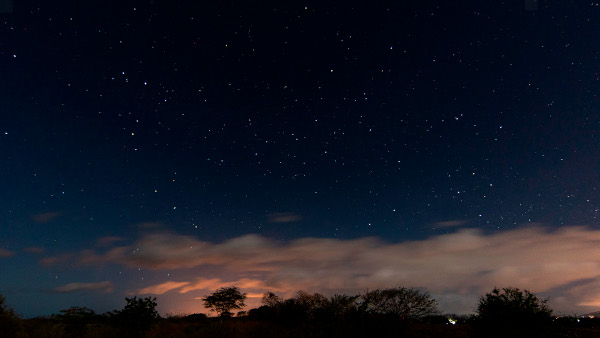
Sky Over the Town of Nindirí, in Masaya, Nicaragua
image
Créé pour l'OAE
Légende : Honourable mention in the 2022 IAU OAE Astrophotography Contest, category Still images of celestial patterns.
This image was taken in Tisma, Nicaragua, in April 2022 during a night illuminated by the Moon. Still, some constellations are visible, but the Milky Way, which runs through the image with some of its brightest regions, hides in the celestial background, partially obscured by terrestrial clouds.
The Scorpion, one of the constellations of the Zodiac, is seen on the left side. We can first spot the brightest star, Antares, in the middle of a group of three in an asterism that looks like the stem of a flower growing from the clouds upwards. Its petals are the head of the scorpion. In the brightness of moonlight, the orange colour of Antares is not clearly visible. The three stars that comprise the head of the scorpion are called Acrab, Dschubba and Fang. They were recently named by the IAU in order to show the global diversity of constellations. Acrab is the Arabic term for the scorpion and Fang (The Room) is the name of the Chinese constellation made out of these stars. The Scorpion’s tail extends to the bottom of the image with the sting just above the horizon in the gap between clouds.
The constellation Centaurus is visible in the middle of this image. We can first recognise Crux and the two pointer stars, Alpha and Beta Centauri right above the clouds. The pointers are the front hooves of the centaur, while the stars of Crux were originally (before Christanity, in antiquity) considered one of the rear legs of the centaur. The stars in the front hooves are Rigil Kentaurus (mixed Arabic and Latin meaning The Foot of the Centaur), to the left, and Hadar, to the right. With Crux at the rear they comprise the legs of the mythological creature’s horse body. The humanoid torso is represented by two bright stars on the shoulders and three fainter stars for the head. The star tale says that this figure represents Chiron, the only decent one among the centaurs who was well educated and the teacher of all great heroes.
The Christian navigators who sailed to the New World around 1500 used these asterisms, although they had never seen them before in Europe. These included explorer Amerigo Vespucci whose name was given to the continent America. His shipmate Andrea Corsali, who came from Florence, where the poet Dante Alighieri was famous for his Divine Comedy written two centuries earlier, was reminded of Dante's poem by the four bright stars of Crux. It was probably in this context that they happened to invent the constellation Crux. Originally, the navigators only used the asterism for practical purposes but some time later, in the period of Christian religious wars between several new churches, celestial cartographers used the cross as a symbol of unity and against war.
Crédit : René Antonio Urroz Álvarez/IAU OAE
Termes du glossaire:
Scorpius , Alpha du Centaure
Catégories :
Astronomie à l'œil nu
Licence : Creative Commons (CC) Attribution 4.0 International (CC BY 4.0) Creative Commons (CC) Attribution 4.0 International (CC BY 4.0) Icônes
Ce fichier est sur Zenodo ( image 1.72 MB)








- Ressources
- Moteur de recherche des ressources pédagogiques
- Parcourir les ressources pédagogiques par Sujet
- Parcourir les images
- AstroEdu - Activités en classe
- Grandes Idées - Littéracie en astronomie
- Glossaire
- Rapports de l'OAE
- L'astronomie pour l'Education à travers le monde
- Sélection de ressources externes