Documents & Ressources - Résultat de la recherche
Résultats de la recherche

Carte de la constellation du Capricorne
image
Légende : La constellation du Capricorne (communément appelée Capricorne) inclut ses étoiles brillantes et les constellations environnantes. Le Capricorne est entouré (dans le sens des aiguilles d'une montre à partir du haut) du Verseau, de l'Aigle, du Sagittaire, de Microscope et du Poisson Austral. Le Capricorne se trouve sur l'écliptique (représenté ici par une ligne bleue), c'est-à-dire la trajectoire que le Soleil semble suivre dans le ciel au cours d'une année. Le Soleil se trouve dans le Capricorne de la mi-janvier à la mi-février. Les autres planètes du système solaire se trouvent souvent dans le Capricorne.
Le Capricorne se trouve juste au sud de l'équateur céleste et est visible pour tous les observateurs situés au sud du cercle polaire arctique. Le Capricorne est surtout visible le soir, en automne dans l'hémisphère nord et au printemps dans l'hémisphère sud.
Au sud-est (en bas à gauche sur ce diagramme) de la constellation se trouve l'amas globulaire M30 (représenté ici par un cercle jaune sur lequel est superposé un signe plus).
L'axe des y de ce diagramme est en degrés de déclinaison avec le nord en haut et l'axe des x est en heures d'ascension droite avec l'est à gauche. La taille des étoiles marquées ici correspond à la magnitude apparente de l'étoile, une mesure de sa luminosité apparente. Les points les plus gros représentent les étoiles les plus brillantes. Les lettres grecques indiquent les étoiles les plus brillantes de la constellation. Elles sont classées par ordre de luminosité, l'étoile la plus brillante étant étiquetée alpha, la deuxième plus brillante bêta, etc., bien que cet ordre ne soit pas toujours respecté à la lettre. Les lignes pointillées marquent les limites des constellations selon l'UAI et les lignes vertes pleines marquent l'une des formes couramment utilisées pour représenter les figures des constellations. Ni les limites des constellations, ni les lignes reliant les étoiles n'apparaissent sur le ciel.
Crédit : Adapté par le Bureau de l'astronomie pour l'éducation de l'AIU à partir de l'original de l'AIU/Sky & Telescope
Lien du crédit
Termes du glossaire:
Magnitude apparente , Capricorne , Coordonnées célestes , Constellation , Déclinaison , Ecliptique , Amas globulaire , Ascension droite (AD) , Zodiaque , Verseau , Sagittaire , Tropique du Capricorne
Catégories :
Astronomie à l'œil nu
Licence : Creative Commons (CC) Attribution 4.0 International (CC BY 4.0) Creative Commons (CC) Attribution 4.0 International (CC BY 4.0) Icônes
Fichier
( image
97.45 kB)
Fichier PDF
(PDF file
195.42 kB)
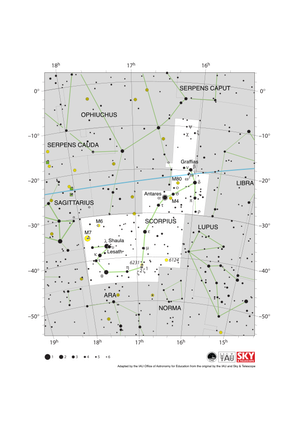
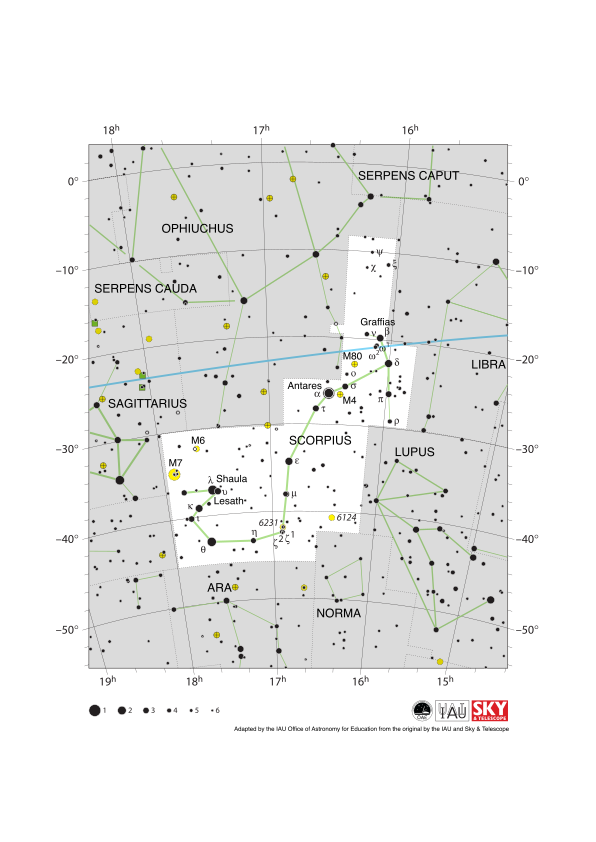
Scorpius Constellation Map
image
Légende : The constellation Scorpius (often commonly called Scorpio) along with its bright stars and surrounding constellations. Scorpius is surrounded by (going clockwise from the top) Ophiuchus, Serpens Caput, Libra, Lupus, Norma, Ara, Corona Australis and Sagittarius. Scorpius’s brightest star Antares appears in the heart of the constellation with the famous tail of Scoprius in the south-east (lower left). Scorpius lies on the ecliptic (shown here as a blue line), this is the path the Sun appears to take across the sky over the course of a year. The Sun only spends a short amount of time in late November in Scorpius. The other planets of the Solar System can often be found in Scorpius.
Scorpius lies south of the celestial equator. The whole constellation is not visible from the most arctic regions of the world with parts of Scorpius obscured for observers in northern parts of Asia, Europe and North America. Scorpius is most visible in the evenings in the northern hemisphere summer and southern hemisphere winter.
The yellow circles mark the positions of the open clusters M6, M7 & NGC 6231 while the yellow circles with plus signs superimposed on them mark the globular clusters M4 and M80.
The y-axis of this diagram is in degrees of declination with north as up and the x-axis is in hours of right ascension with east to the left. The sizes of the stars marked here relate to the star's apparent magnitude, a measure of its apparent brightness. The larger dots represent brighter stars. The Greek letters mark the brightest stars in the constellation. These are ranked by brightness with the brightest star being labeled alpha, the second brightest beta, etc., although this ordering is not always followed exactly. The circle around Antares indicates that it is a variable star. The dotted boundary lines mark the IAU's boundaries of the constellations and the solid green lines mark one of the common forms used to represent the figures of the constellations. The blue line marks the ecliptic, the path the Sun appears to travel across the sky over the course of one year. Neither the constellation boundaries, nor the line marking the ecliptic, nor the lines joining the stars appear on the sky.
Crédit : Adapted by the IAU Office of Astronomy for Education from the original by IAU/Sky & Telescope
Lien du crédit
Termes du glossaire:
Magnitude apparente , Coordonnées célestes , Constellation , Déclinaison , Ecliptique , Amas globulaire , La Balance , Ascension droite (AD) , Scorpius , Zodiaque , Amas ouvert , Sagittaire , Étoile variable
Catégories :
Astronomie à l'œil nu
Licence : Creative Commons (CC) Attribution 4.0 International (CC BY 4.0) Creative Commons (CC) Attribution 4.0 International (CC BY 4.0) Icônes
Fichier
( image
152.59 kB)
Fichier PDF
(PDF file
217.25 kB)
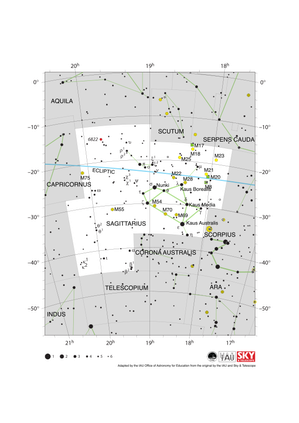
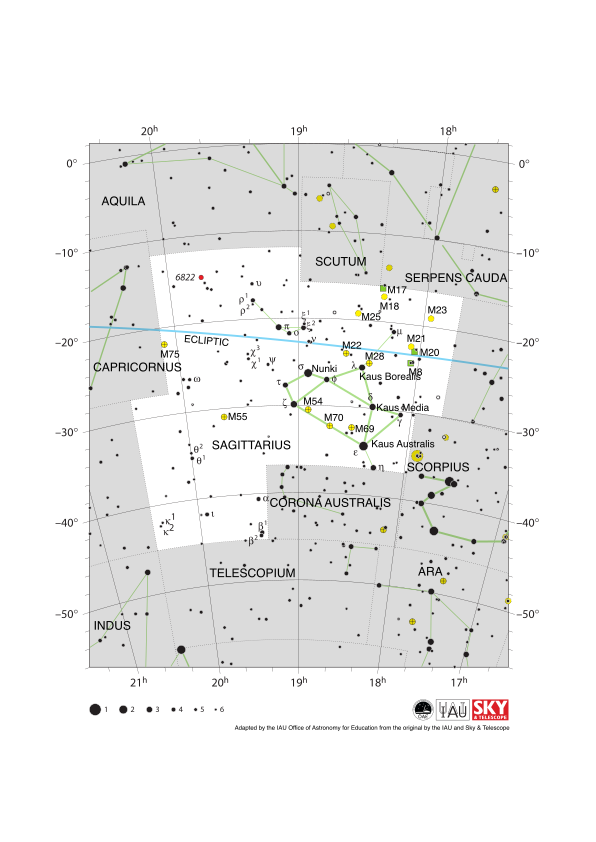
Sagittarius Constellation Map
image
Légende : The constellation Sagittarius along with its bright stars and surrounding constellations. Sagittarius is surrounded by (going clockwise from the top) Aquila, Scutum, Serpens Cauda, Ophiuchus, Scorpius, Corona Australis, Telescopium, Microscopium and Capricornus. The brighter stars in Sagittarius form a distinctive teapot shape. Sagittarius lies on the ecliptic (shown here as a blue line), this is the path the Sun appears to take across the sky over the course of a year. The Sun is in Sagittarius from mid December to mid January. The other planets of the Solar System can often be found in Sagittarius.
Sagittarius lies south of the celestial equator. The famous teapot asterism is visible for all but the most arctic regions of the world but the most southerly parts of the constellation are not visible in northern parts of Asia, Europe and North America. Sagittarius is most visible in the evenings in the northern hemisphere summer and southern hemisphere winter.
The supermassive black hole Sagittarius A* which lies at the center of our Milky Way Galaxy is sits on the western (here right-hand) edge of Sagittarius. Due to it covering an area at the center of our Galaxy, Sagittarius is home to many star clusters including open clusters (marked here with yellow circles) and globular clusters (marked here with yellow circles with + signs superimposed on them). Three nebulae are also marked here with green squares.
The y-axis of this diagram is in degrees of declination with north as up and the x-axis is in hours of right ascension with east to the left. The sizes of the stars marked here relate to the star's apparent magnitude, a measure of its apparent brightness. The larger dots represent brighter stars. The Greek letters mark the brightest stars in the constellation. These are ranked by brightness with the brightest star being labeled alpha, the second brightest beta, etc., although this ordering is not always followed exactly. The dotted boundary lines mark the IAU's boundaries of the constellations and the solid green lines mark one of the common forms used to represent the figures of the constellations. Neither the constellation boundaries, nor the line marking the ecliptic, nor the lines joining the stars appear on the sky.
Crédit : Adapted by the IAU Office of Astronomy for Education from the original by IAU/Sky & Telescope
Lien du crédit
Termes du glossaire:
Magnitude apparente , Capricorne , Coordonnées célestes , Constellation , Déclinaison , Ecliptique , Amas globulaire , Voie lactée , Nébuleuse , Ascension droite (AD) , Sagittarius A* , Scorpius , Trou noir supermassif , Zodiaque , Astérisme , Amas ouvert , Sagittaire
Catégories :
Astronomie à l'œil nu
Licence : Creative Commons (CC) Attribution 4.0 International (CC BY 4.0) Creative Commons (CC) Attribution 4.0 International (CC BY 4.0) Icônes
Fichier
( image
150.62 kB)
Fichier PDF
(PDF file
219.78 kB)

Telescopium Constellation Map
image
Légende : The constellation Telescopium with its bright stars and surrounding constellations. Telescopium is surrounded by (going clockwise from the top): Corona Australis, Ara, Pavo, Indus, Microscopium and Sagittarius.
Telescopium is a southern constellation and thus the whole constellation is visible at some point in the year throughout the southern hemisphere. The whole constellation is also visible in equatorial and some temperate regions of the northern hemisphere. Telescopium is best viewed in the evening in the northern hemisphere summer and southern hemisphere winter.
The y-axis of this diagram is in degrees of declination with north as up and the x-axis is in hours of right ascension with east to the left. The sizes of the stars marked here relate to the star's apparent magnitude, a measure of its apparent brightness. The larger dots represent brighter stars. The Greek letters mark the brightest stars in the constellation. These are ranked by brightness with the brightest star being labeled alpha, the second brightest beta, etc., although this ordering is not always followed exactly. The dotted boundary lines mark the IAU's boundaries of the constellations and the solid green lines mark one of the common forms used to represent the figures of the constellations. Neither the constellation boundaries, nor the lines joining the stars appear on the sky.
Crédit : Adapted by the IAU Office of Astronomy for Education from the original by the IAU and Sky & Telescope
Lien du crédit
Termes du glossaire:
Magnitude apparente , Coordonnées célestes , Constellation , Déclinaison , Ascension droite (AD) , Sagittaire
Catégories :
Astronomie à l'œil nu
Licence : Creative Commons (CC) Attribution 4.0 International (CC BY 4.0) Creative Commons (CC) Attribution 4.0 International (CC BY 4.0) Icônes
Fichier
( image
117.34 kB)
Fichier PDF
(PDF file
182.29 kB)
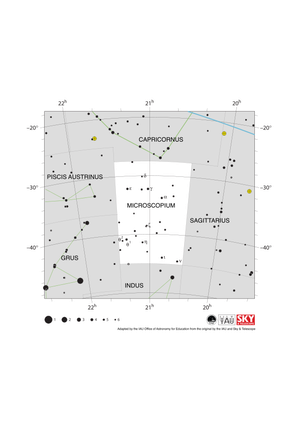
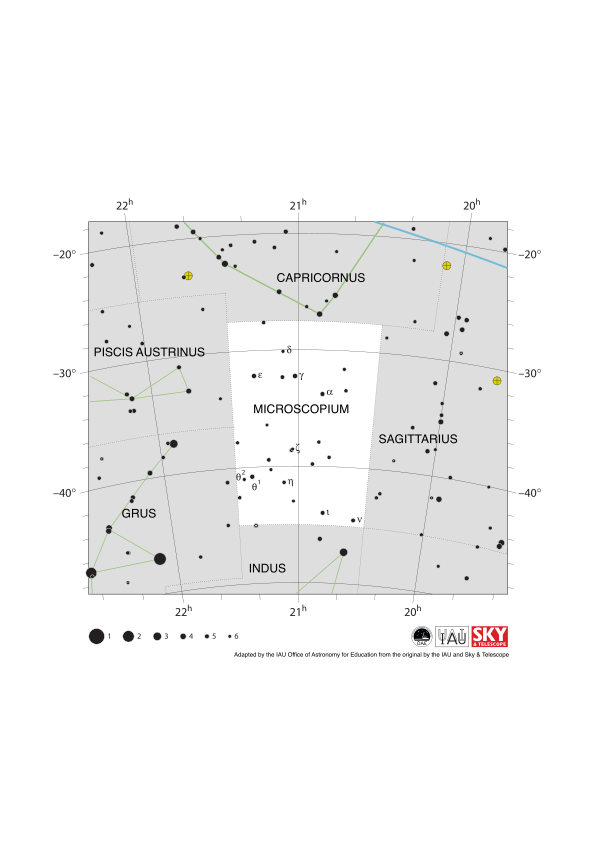
Microscopium Constellation Map
image
Légende : The constellation Microscopium with its brighter stars and surrounding constellations. Microscopium is surrounded by (going clockwise from the top): Capricornus, Sagittarius, Telescopium, Indus, Grus and Piscis Austrinus. Microscopium is a faint constellation with relatively few bright stars.
Microscopium is a southern constellation and thus the whole constellation is visible at some point in the year throughout the southern hemisphere. The whole constellation is also visible in equatorial and some temperate regions of the northern hemisphere with parts of the constellation visible from other northern temperate regions. Microscopium is best viewed in the evening in the northern hemisphere autumn and southern hemisphere spring.
The y-axis of this diagram is in degrees of declination with north as up and the x-axis is in hours of right ascension with east to the left. The sizes of the stars marked here relate to the star's apparent magnitude, a measure of its apparent brightness. The larger dots represent brighter stars. The Greek letters mark the brightest stars in the constellation. These are ranked by brightness with the brightest star being labeled alpha, the second brightest beta, etc., although this ordering is not always followed exactly. The dotted boundary lines mark the IAU's boundaries of the constellations and the solid green lines mark one of the common forms used to represent the figures of the constellations. Neither the constellation boundaries, nor the line marking the ecliptic, nor the lines joining the stars appear on the sky. The ecliptic is marked with a blue line in the top right.
Crédit : Adapted by the IAU Office of Astronomy for Education from the original by the IAU and Sky & Telescope
Lien du crédit
Termes du glossaire:
Magnitude apparente , Capricorne , Coordonnées célestes , Constellation , Déclinaison , Ecliptique , Ascension droite (AD) , Sagittaire
Catégories :
Astronomie à l'œil nu
Licence : Creative Commons (CC) Attribution 4.0 International (CC BY 4.0) Creative Commons (CC) Attribution 4.0 International (CC BY 4.0) Icônes
Fichier
( image
77.31 kB)
Fichier PDF
(PDF file
147.46 kB)








- Ressources
- Moteur de recherche des ressources pédagogiques
- Parcourir les ressources pédagogiques par Sujet
- Parcourir les images
- AstroEdu - Activités en classe
- Grandes Idées - Littéracie en astronomie
- Glossaire
- Rapports de l'OAE
- L'astronomie pour l'Education à travers le monde
- Sélection de ressources externes