Documentos y recursos - Buscar resultados
Buscar resultados
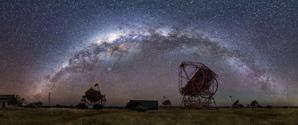
La Vía Láctea sobre el observatorio H.E.S.S.
imagen
Creado para la OAE
Pie de foto: Mención de honor en el Concurso de Astrofotografía de la IAU OAE 2023, en la categoría de imágenes fijas tomadas exclusivamente con smartphones o dispositivos móviles.
La oscuridad del cielo sobre el Observatorio H.E.S.S. permite apreciar las aparentemente innumerables estrellas que conforman la Vía Láctea, cuya abundancia dificulta la identificación de las constelaciones, como se observa en esta fotografía tomada con un teléfono inteligente en Namibia, en junio de 2023. Las estrellas Alfa y Beta Centauri son visibles en la parte inferior izquierda de la imagen, justo por encima de la torre. Antares, una gigante roja perteneciente a la constelación de Escorpio, destaca por su tonalidad anaranjada, justo por encima y a la derecha del telescopio situado a la izquierda de la imagen.
Crédito: Jianfeng Dai/IAU OAE (CC BY 4.0)
Términos del glosario:
Astronomía , Vía Láctea , Observación , Cielo , Alfa Centauri
Categorías:
Astronomía a simple vista
Etiquetas:
astrophotography
Licencia: Creative Commons Reconocimiento 4.0 Internacional (CC BY 4.0) Creative Commons Reconocimiento 4.0 Internacional (CC BY 4.0) íconos
Este archivo en Zenodo ( imagen 44.61 MB)
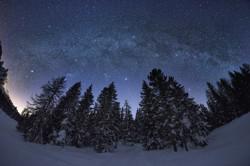
Winter Milky Way
imagen
Creado para la OAE
Pie de foto: Winner in the 2022 IAU OAE Astrophotography Contest, category Still images of celestial patterns.
Taken near Lake Misurina in the Veneto region of Italy in February 2019, this image shows a clear and starry sky over a winter landscape.
We can see part of the Milky Way arc. From the left side, towards the south-east, we see Sirius, "The Burner" in Greek, the brightest star in the night sky. It is part of the constellation Canis Major, The Great Dog, one of the dogs of Orion, the great hunter, in Greek mythology. Orion’s other dog, Canis Minor, the Small Dog, is represented by the bright star Procyon and its fainter neighbours. The Greek star name means “The One [rising] before The Dog” and the star is seen at the top left side of the image just above the arc of the Galaxy. Orion lies to the right of Canis Major. We can spot its characteristic “belt”, an asterism composed of three bright stars aligned in a straight line.
Above the treetops to the right of Orion, the open star clusters of the Hyades and the Pleiades in the constellation Taurus, the Bull, are visible. According to ancient lore, these two clusters form a Celestial Gate directly next to the intersection of the great circles of the ecliptic and the Milky Way. In Greco-Roman mythology, Taurus is associated with the god Zeus who is said to have used a bull to seduce the Phoenician princess Europa.
Above the constellation Taurus, we can see a bright star just above the arc of the Galaxy. This is Capella, the brightest star of the constellation Auriga, The Charioteer. This is one of the 88 modern constellations and is associated with the Greek hero Erichthonius of Athens. Hindu astronomy considers Capella as the heart of Brahma, one of the three major gods. The indigenous people of Bororo in Brazil have a constellation representing a cayman, comprising some of the stars of Auriga and some stars from neighbouring constellations.
To the right of Taurus, we find the modern constellation Perseus with the bright double star cluster h+chi Perseii, which represents the metal of Perseus’s sabre in Greek mythology. Perseus is the hero who was sent out to prove himself, and happened to rescue Andromeda from the sea monster Cetus as the Roman poet Ovid wrote. We can also see the constellation Cassiopeia, associated with the queen and mother of Andromeda in Greek mythology. It is composed of five bright stars in the shape of a W, which was considered the asterism of The Key by the Greeks according to the poet Aratus. The recognisable shape is also associated with other mythologies: for instance, it represents the princess Sharmishtha in Hindu astronomy, a bat in Thailand, and a camel in native Arabic astronomy.
In the gap between the trees, the Andromeda Galaxy is visible.
Crédito: Giorgia Hofer/IAU OAE
Términos del glosario:
Galaxia de Andrómeda , Vía Láctea , Tauro , Pléyades
Categorías:
Galaxias
, La Vía Láctea y el medio interestelar
, Astronomía a simple vista
Licencia: Creative Commons Reconocimiento 4.0 Internacional (CC BY 4.0) Creative Commons Reconocimiento 4.0 Internacional (CC BY 4.0) íconos
Este archivo en Zenodo ( imagen 1.18 MB)
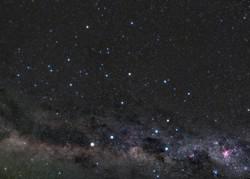
Cen-Lup-Cru-Panorama: Centaurus Carrying the Beast and Riding Along the Milky Way
imagen
Creado para la OAE
Pie de foto: Winner in the 2022 IAU OAE Astrophotography Contest, category Still images of celestial patterns.
This image was taken in February 2020 in the Coquimbo Region along the northern coast of Chile. It is one of the best places on Earth for astronomical observations, thanks to its clear skies, lack of light pollution and lack of precipitation, as it is close to the Atacama desert, one of the driest places on our planet. It is no coincidence that many of the most modern professional observatories are located here. The picture shows prominent patterns visible in the southern latitudes, containing rich cultural significance for various Indigenous groups of the southern world. In the bottom of the image towards the right, the Southern Cross is prominent. The orange star at the top of the Southern Cross is called Gacrux (gamma crux). The people in Chile celebrate the beginning of winter at the beginning of May when the constellation Crux is high up in the sky; for them it is a symbol of the start of the cold season. For the festival of the Cruz de Mayo (the Great Cross), they put candles next to crosses in their villages when the constellation Crux is high. As in Christianity, the four endpoints (stars) of the cross symbolise the cardinal virtues. For some indigenous Chileans, they represent the fundamental cultural principles: force, reciprocity, wisdom, and spirituality.
Unlike modern constellations that are arrangements of several stars, Indigenous peoples sometimes associate stories with individual stars. In the case of the Southern Cross for example, the Boorong, Djab Wurrung and Jardwadjali peoples of Australia refer to the star Gacrux as Bunya (the ring-tailed possum). From the Southern Cross to the left of the image are two bright stars, these are called the pointer stars (as they point to the Southern Cross). The Djab Wurrung and Jardwadjali people refer to the pointer stars as the Bram-bram-bult brothers, who hunted and killed the giant Emu Tchingal. Alpha Centauri, which is the brighter and whiter of the two pointer stars, is the closest star to the Sun that we can see with our eyes, located just over four light-years away. To the bottom left of the Southern Cross is a dark nebula, which the Indigenous Australians see as the head of the Emu Tchnigal (the Coalsack Nebula). The pointers are located on the neck of the Emu. The image also shows two other IAU constellations, Centaurus (The Centaur) and Lupus (The Wolf), and HII regions of the Eta Carina Nebula (seen in pink).
Crédito: Uwe Reichert/IAU OAE
Términos del glosario:
Constelación , Vía Láctea , Cruz del Sur
Categorías:
La Vía Láctea y el medio interestelar
, Astronomía a simple vista
Licencia: Creative Commons Reconocimiento 4.0 Internacional (CC BY 4.0) Creative Commons Reconocimiento 4.0 Internacional (CC BY 4.0) íconos
Este archivo en Zenodo ( imagen 24.14 MB)
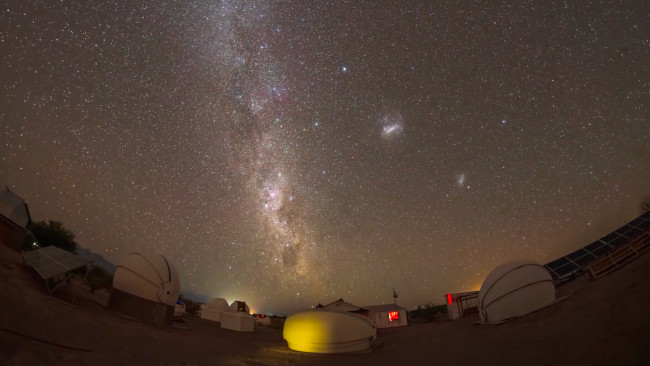
Chilean Nights
vídeo
Creado para la OAE
Pie de foto: Honourable mention in the 2022 IAU OAE Astrophotography Contest, category Time lapses of celestial patterns.
Shot in December 2020, this time-lapse shows the sky from San Pedro de Atacama, Chile, in the southern hemisphere.
Right in the first frame we can see our home galaxy, the Milky Way, as well as both the Large and Small Magellanic clouds, two satellite galaxies orbiting the Milky Way. In the bottom of the image the bright stars Rigil Kentaurus and Hadar (also known as Alpha and Beta Centauri) are visible, both in the constellation Centaurus. Just above, we can also see the small constellation Crux, visible from the northern tropical circles southwards. It is important for navigation purposes because its longer axis indicates the direction of the celestial south pole. The bright whitish star in the top of the image and to the right of the Galaxy is Canopus, one of the brightest stars in the night sky, located in the constellation Carina. Canopus is the second brightest star in the sky, while Rigil Kentaurus is the third brightest.
In some of the next frames, Orion, the great hunter, appears clearly with its bright stars and its characteristic asterism, the belt, composed of three aligned bright stars. Since this video was taken from the southern hemisphere, the Greek hero from the northern hemisphere seems to be performing a headstand.
We can also see the planets Jupiter and Saturn in a close conjunction, even finding themselves in the significant beam of Zodiacal light setting down below the horizon. There are also a few meteors blinking in some of the frames, one of them with a long-lasting and developing trail. The very bright object rising from behind the volcanoes of the Andes, creating spectacular shadows and crepuscular rays, is the Moon. In the last frame we see the Moon next to Saturn and Jupiter.
Crédito: Robert Barsa/IAU OAE
Términos del glosario:
Observatorio Astronómico , Constelación , Vía Láctea , Orión , Gran Nube de Magallanes (LMC) , Pequeña Nube de Magallanes (SMC) , Alfa Centauri
Categorías:
Galaxias
, La Vía Láctea y el medio interestelar
, Estrellas
, Telescopios, instrumentos y observatorios
Licencia: Creative Commons Reconocimiento 4.0 Internacional (CC BY 4.0) Creative Commons Reconocimiento 4.0 Internacional (CC BY 4.0) íconos
Este archivo en Zenodo ( vídeo 114.03 MB)
Constellations from the World
vídeo
Creado para la OAE
Pie de foto: Third place in the 2022 IAU OAE Astrophotography Contest, category Time lapses of celestial patterns.
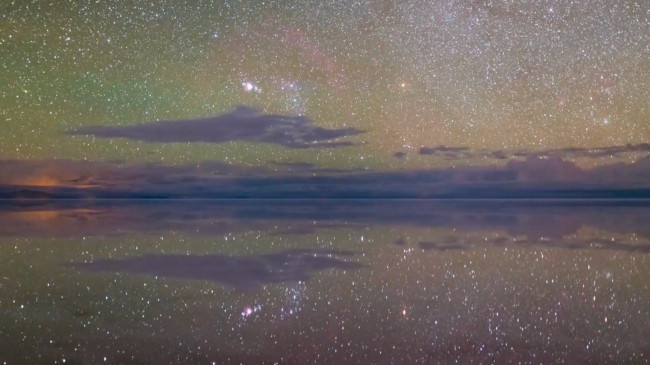
This video tries to cover a huge variety of phenomena in the night sky from different locations — Iceland and China — and is designed like a theatre play, starring mother nature herself.
It starts with a blue twilight sky that dims and unveils the starry night sky on the stage with terrestrial clouds on a beautiful landscape. The impressive parts of the southern Milky Way between Scorpius and Crux, with the pointer stars Alpha and Beta Centaurus, are shown passing by majestically. The terrestrial clouds blur the stars and allow us to recognise their colours even more clearly.
The first act presents the starry sky in human culture. One scene shows the Pleiades rising over the top of a hill, while a human moves hastily with a flashlight below. At the very moment that the Pleiades rises behind the hill, the beam of the flashlight hits the camera. There is some humour in this remarkable scene referencing the human relationship to the rise of the Pleiades in cultural history.
The next scene shows The Big Dipper, Ursa Major, as a typical northern constellation, with an arch of aurora below it. The aurora evolves and moves but does not change much fundamentally. In northern human cultures, aurorae were often interpreted as the ghosts of ancestors, but this play does not spend any time on human beliefs, instead moving the view southwards in the subsequent scenes. First we see some stars rising shortly before sunrise. The lightcone of Zodiacal light appears in Gemini/Taurus and the horizon gets brighter. In the next scene, at about 1 minute and 13 seconds, we see Orion setting over water, so that the water surface mirrors the celestial scene. Some clouds crossing the image prove that the videos were really taken on our beautiful planet, and, since Orion’s shoulder and foot are seen to set almost simultaneously, this sequence must have been captured almost at the equator. In this area, the bright stars of Orion look like a huge butterfly, with Orion’s Belt forming the body, and the quadrilateral of four bright stars interpreted as the wings.
As in a real theatre, we now see a curtain before the next act of the heavenly play, an aurora curtain. The next act presents several bright stars in original scenes: the Chinese asterisms of The Tail (of the Azure Dragon), the Winnowing Basket and the Southern Dipper, which are seen in the modern constellations Scorpius and Sagittarius. The striking shape of Corona Borealis that has been recognised as an asterism in many cultures all over the globe, is also shown, as are some planets, the stars Vega and Deneb with adjacent areas, Altair, the Milky Way, and the characteristic W shape of Cassiopeia that has also been an asterism for many cultures on Earth.
The outro presents two more scenes with a smooth and silent night sky.
Crédito: Stephanie Ye Ziyi/IAU OAE
Términos del glosario:
Osa Mayor , Constelación , Vía Láctea , Orión
Categorías:
La Vía Láctea y el medio interestelar
, Astronomía a simple vista
Licencia: Creative Commons Reconocimiento 4.0 Internacional (CC BY 4.0) Creative Commons Reconocimiento 4.0 Internacional (CC BY 4.0) íconos
Este archivo en Zenodo ( vídeo 46.52 MB)