Documentos y recursos - Buscar resultados
Buscar resultados
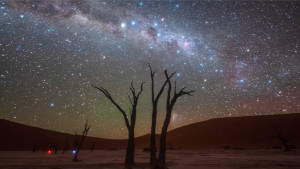
The Rotating Planet
vídeo
Creado para la OAE
Pie de foto: Second place winner in the 2023 IAU OAE Astrophotography Contest, category of Time-lapses of rotation of Big Dipper or Southern Cross.
A cosmic journey unfolds across continents in this time-lapse video which captures both iconic constellations from diverse corners of the world. Starting in China, the Big Dipper graces the night sky, a steadfast guide embedded in cultural narratives. Its luminance marks the beginning of this celestial odyssey. The two pointer stars on the end of the Big Dipper point to the North Star (Polaris) which appears to remain stationary as the sky rotates. From Nepal’s lofty peaks, the Big Dipper’s familiarity persists, a reliable fixture in the shifting panorama of the rotating planet. Moving to Chile, the Southern Cross adorns the firmament, emblematic of the southern skies. Frames from Chile showcase this constellation accompanied by the Milky Way Galaxy. In Namibia, a telescope from the H.E.S.S. Observatory appears in the video. Later, nestled beneath sheltering trees, the Big Dipper persists in its celestial prominence, appearing against a canvas of stars. Using varied techniques — fisheye lenses, static cameras, and Earth's movement-tracking — each frame unveils the Cross’s grandeur against diverse landscapes. These sequences — marked by star trails and Earth’s rotation—highlight the enduring presence of the Big Dipper and Southern Cross, bridging cultures and celestial beauty across hemispheres.
Crédito: Jianfeng Dai/IAU OAE (CC BY 4.0)
Términos del glosario:
Osa Mayor , Polo Celeste , Esfera celeste , Rotación de la Tierra , Polo Norte Celeste (PNC) , Polaris , Cruz del Sur , Polo Sur Celeste (PSC)
Categorías:
Astronomía a simple vista
Etiquetas:
astrophotography
Licencia: Creative Commons Reconocimiento 4.0 Internacional (CC BY 4.0) Creative Commons Reconocimiento 4.0 Internacional (CC BY 4.0) íconos
Este archivo en Zenodo ( vídeo 863.53 MB)

Dreamlike Starry Sky and Airglow
imagen
Creado para la OAE
Pie de foto: Winner in the 2022 IAU OAE Astrophotography Contest, category Still images of celestial patterns.
This spectacular image shows a range of prominent constellations visible in the night sky over the desert of inner Mongolia, taken in August 2019. The yellowish star in the bottom left side is Arcturus, one of the brightest stars in the night sky, and the brightest in the constellation Boötes. The handle of the Big Dipper points towards this bright star and the Dipper is also visible above Boötes. The Northern Dipper (Bei Dou) is a traditional Chinese constellation. It is considered a chariot in which the Judges for Nobility are sitting. Arcturus is considered a single-star asterism, named the Horn, which forms part of the Chinese super-constellation for the spring, the Azure Dragon of the East. The front of the Northern Dipper points towards the star at the top of the photograph which is now called Polaris, the northern Pole Star. In ancient China, there was no bright star at the pole, so the stars in the nearest vicinity of the pole were considered to belong to the emperor and his family in the constellation the Purple Forbidden Palace. At least as early as mediaeval times, Polaris was considered part of the constellation of the Great Emperor of Heaven.
Corona Borealis is also visible in the top right corner of this image, although not in its completeness. It is called the Coiled Thong in China. With its characteristic semi-circular shape, this is one of the smaller constellations of the 88 modern ones, but also can be traced back at least three or four millennia through the Roman “Crown”, the Greek wedding “Wreath”, and the Babylonian “Asterism of Dignity”. The modern name literally means “Northern Crown” in Latin.
At the upper-right edge of the image, we find the part of the modern constellation Cassiopeia that is considered the Flying Corridor and an Auxiliary Road in ancient China. The W-shape of Cassiopeia is cut off by the edge of the photograph but the constellations to its south and southeast, Andromeda and Perseus, are clearly recognisable. Prominently we see the Andromeda galaxy, the most distant object that is visible to the unaided eye. It is located at the outermost outliers of the band of the Milky Way, which could explain why it has not been mentioned explicitly in ancient star catalogues, as it was mistakenly thought to be part of the Milky Way. The photograph also shows clearly reddish parts of the Milky Way that don’t appear bright to the naked eye, and also open clusters that are formed from the same molecular cloud, i.e., groups of stars with similar ages. This region is part of many big and small asterisms in traditional Chinese uranology.
Crédito: Likai Lin/IAU OAE
Términos del glosario:
Osa Mayor , Estrellas circumpolares , Polo Norte Celeste (PNC) , Polaris , Asterismo
Categorías:
Astronomía a simple vista
Licencia: Creative Commons Reconocimiento 4.0 Internacional (CC BY 4.0) Creative Commons Reconocimiento 4.0 Internacional (CC BY 4.0) íconos
Este archivo en Zenodo ( imagen 9.42 MB)
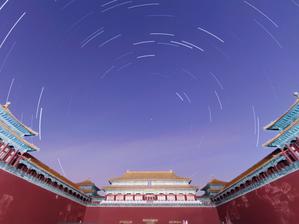
Star Trails of the Forbidden City
imagen
Creado para la OAE
Pie de foto: Honorable mention in the 2023 IAU OAE Astrophotography Contest, category of Still images taken exclusively with smartphones/mobile devices.
Beneath the celestial ballet of star trails that weave their way across the night sky, the Beijing Forbidden City stands as a testament to ancient celestial connections in this image captured in March 2022. Designed with a cosmic alignment in mind, the palace echoes the orientation of the North Star, also known as Polaris, a celestial anchor that has long guided navigators and symbolised steadiness in the sky. It was believed that the Emperor embodied the earthly representation of this pole star, bridging the realms between heaven and earth. In this harmonious one-hour exposure captured with a smartphone, the streaks of stars trace their nightly journey across the firmament, converging toward the North Star, reflecting the precision of both architectural design and celestial paths.
Crédito: Stephanie Ziyi Ye/IAU OAE (CC BY 4.0)
Términos del glosario:
Polo Celeste , Esfera celeste , Estrellas circumpolares , Navegación , Polo Norte Celeste (PNC) , Polaris
Etiquetas:
astrophotography
Licencia: Creative Commons Reconocimiento 4.0 Internacional (CC BY 4.0) Creative Commons Reconocimiento 4.0 Internacional (CC BY 4.0) íconos
Este archivo en Zenodo ( imagen 4.12 MB)
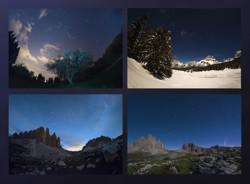
Big Dipper in Four Seasons
imagen
Creado para la OAE
Pie de foto: Winner in the 2022 IAU OAE Astrophotography Contest, category Still images of celestial patterns.
As Earth moves around the Sun, the positions of the stars in the night sky appear to change over the course of the year. This is well exemplified in this mosaic, with images taken in all four seasons throughout 2020 in the region of Veneto, Italy, showing the apparent motion of the Ursa Minor and Ursa Major constellations.
Ursa Minor, the Little Bear, is a constellation of the northern hemisphere, and it contains the northern celestial pole, in our current epoch marked by a bright star called Polaris or the Pole Star. For centuries Polaris has been used for navigation in the northern hemisphere, as it has been almost at the exact pole position for roughly 200 years. In the Middle Ages and antiquity, there was no pole star; the celestial north pole lay in a dark region and the Greeks considered the “Little She-Bear” as a companion of the “Great She-Bear”, which is more easily recognizable. The brightest stars of these constellations were alternatively also considered as chariots by the Greeks, as written in Aratus’s famous didactic poem from the 3rd century before the common era. The most famous asterism in Ursa Major, composed of seven stars, has different names across the (northern) world. While considered as a chariot by the Greeks, it is “The Northern Dipper” in China, and “The Seven Oxen” for the ancient Romans.
It was also the navigational purpose that led to the name The Great She-Bear, Ursa Major; for the Greeks, travelling towards the direction of the horizon above which Ursa Major appears meant moving towards the land of the bears (northern Europe). An animal is clearly recognizable when taking into account all the fainter stars in the vicinity of the seven bright ones. They considered it a female bear because Greek mythology connects this animal with the nymph Callisto, whose story describes the initiation rituals for women.
In the top left, we see an image taken on a spring evening, while the image below shows the same portion of the sky on a summer evening. Going counterclockwise, we see the sky during autumn in the bottom right image, while the top right finally shows this portion of the sky in the winter. Note that the relative positions of Ursa Minor and the Big Dipper don’t change, but all stars appear to be moved in a circle around Polaris. This star pointing due north lies at the point where Earth’s rotational axis intersects the celestial sphere.
The shift of constellations throughout the year is therefore a globe-clock or a globe-calendar, used by ancient civilizations to measure the year, and to predict the changes of seasons. It helps to establish, for instance, the best time for sowing and sailing as winds change with the seasons.
Crédito: Giorgia Hofer/IAU OAE
Términos del glosario:
Osa Mayor , Estrellas circumpolares , Rotación de la Tierra , Polo Norte Celeste (PNC) , Polaris , Asterismo
Categorías:
Astronomía a simple vista
Licencia: Creative Commons Reconocimiento 4.0 Internacional (CC BY 4.0) Creative Commons Reconocimiento 4.0 Internacional (CC BY 4.0) íconos
Este archivo en Zenodo ( imagen 2.39 MB)
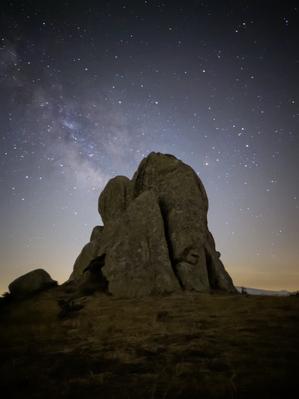
La Vía Láctea en el mundo inteligente
imagen
Creado para la OAE
Pie de foto: Ganadora del Concurso de Astrofotografía de la IAU OAE 2023, en la categoría de imágenes fijas tomadas exclusivamente con smartphones o dispositivos móviles.
En esta tranquila imagen, tomada en julio de 2022 en la oscuridad del Parque de los Nebrodi, en Sicilia, la grandeza de la Vía Láctea se extiende sobre los megalitos naturales de la meseta de Argimusco, a modo de un Stonehenge siciliano. Este tapiz celeste muestra una multitud de fenómenos astronómicos: las constelaciones de Sagitario (en la parte inferior izquierda de la imagen) y Escorpio (parcialmente oculta por el megalito), la Nebulosa de la Laguna (la zona rosada en la parte superior izquierda del megalito) y la pequeña Nube de Sagitario (la zona difusa en la parte superior izquierda de la Nebulosa de la Laguna). Sorprendentemente, la foto fue tomada con un smartphone y sirve como testimonio de las maravillas que se esconden en la noche, accesibles para quienes se alejan del resplandor de las luces de la ciudad y se adentran en el sereno abrazo de la oscuridad intacta.
Crédito: Biagio Meli/IAU OAE (CC BY 4.0)
Términos del glosario:
Vía Láctea
Etiquetas:
astrophotography
Licencia: Creative Commons Reconocimiento 4.0 Internacional (CC BY 4.0) Creative Commons Reconocimiento 4.0 Internacional (CC BY 4.0) íconos
Este archivo en Zenodo ( imagen 1.44 MB)