Documentos y recursos - Buscar resultados
Buscar resultados

Milky Way Arch over La Palma
imagen
Creado para la OAE
Pie de foto: Winner in the 2022 IAU OAE Astrophotography Contest, category Still images of celestial patterns.
This image, which shows the majestic band of the Milky Way and a range of culturally significant patterns, was taken in May 2022 at a very high altitude from the Roque de los Muchachos Observatory in La Palma, from which one can see the clouds below. Some prominent star patterns include Scorpius, Sagittarius, Lyra, Cygnus, Aquila, the Summer Triangle asterism, and the Teapot asterism.
As the Canary Islands used to be a starting point for European sailors to explore the world, we use this place to point to the many indigenous cultures they encountered. Most notably it is the dark patterns within the band of the Milky Way that hold significance for many Indigenous cultures around the world. The dark patterns are in fact dense, cool clouds of gas and dust that block the light from stars. Indigenous people see caves, waterways and various patterns associated with the dark regions of the Milky Way.
The constellations and patterns hold different cultural significance and interpretations for different people. For example, the constellation Scorpius is referred to by Polynesian people as the demigod Maui’s Fishhook. The Yolnu people of Arnhem Land associate Scorpius with a crocodile called Ingalpir. Some Indigenous Australian groups associate stories with individual stars within Scorpius, most notably Antares, the orange-red star in the top right of the image above the band of the Milky Way. Next to the Scorpion and above the bright centre of the Milky Way, there is a prominent dark cloud that is called the Pipe Nebula by modern astrophotographers. The smoke of this pipe goes up to rho Ophiuchi. This and all the other dark clouds in the Milky Way together form the backbone of heaven for some tribes, and an animal with black-and-white skin for South African Zulu people.
The nomenclature of bright stars also has cross-cultural roots. For example, Vega (the bright blue star towards the top of the image) comes from the Arabic waqi, from al-nasr al-waqi, the Eagle who throws himself down (in order to hunt). This contrasts with the Flying Eagle, Altair, also derived from Arabic. Antares is a Greek word meaning “the one similar to Mars”, referring to its colour. The star name Shaula in the stinger of the Scorpion is a modern version of the Babylonian or even Sumerian star name.
Crédito: Amirreza Kamkar/IAU OAE
Términos del glosario:
Constelación , Polvo , Vía Láctea , Escorpio , Asterismo , Nube de polvo , Extinción interestelar , Sagitario
Categorías:
La Vía Láctea y el medio interestelar
, Astronomía a simple vista
, Telescopios, instrumentos y observatorios
Licencia: Creative Commons Reconocimiento 4.0 Internacional (CC BY 4.0) Creative Commons Reconocimiento 4.0 Internacional (CC BY 4.0) íconos
Este archivo en Zenodo ( imagen 3.31 MB)

Lyrid of the Lake
imagen
Creado para la OAE
Pie de foto: Winner in the 2022 IAU OAE Astrophotography Contest, category Still images of celestial patterns.
Taken in the early hours of 24 April 2022, this image captures the sky of Yunnan Province, China, with a reflection on Lake Nian. The Milky Way is visible on the left side, while whitish Earth clouds are visible on the right. A Lyrid meteor crosses the sky along the Milky Way, its tail pointing back toward the shower's radiant in the constellation Lyra, which lies outside the image above the upper edge. The natural colours of the meteor are impressively clear.
A few constellations are also visible. In the top left corner we can recognise the small constellation of the Dolphin, in which five brightest stars comprise the asterism. This asterism forms the head-part of the larger Greek constellation of the Dolphin and was considered the Dolphin since Roman times, when Ptolemy formed the new constellation of Equuleus in the southern part of the original figure. In mediaeval China, this asterism was considered the Good and the Rotten Gourd, the good one being formed by the brighter rhombus on the top and the rotten one made of faint stars in the tail of the Roman dolphin.
The bright star to the right of the Dolphin and at the top of the image is Altair, the brightest star in the constellation Aquila. In Chinese uranology, Altair, together with some adjacent areas, forms the constellation of the Drum at the River. However, in Chinese folklore, the bright star stands for a boy in love with a girl, who is represented by the bright star Vega (in Lyra) on the other side of a huge celestial stream, the Milky Way. Vega is not visible in this image but the Lyrid meteor is like a teardrop of the unlucky girl who cannot reach her lover.
In the upper right of the image, the constellation Scorpius shines with its bright reddish star Antares. With some of its neighbouring stars, it was regarded in China as the asterism of The Heart, which was also one of the Lunar Mansions. It was considered the heart of the Azure Dragon, the super-constellation of spring, in ancient China.
Scorpius and Sagittarius, in the middle of the image, contain the brightest clouds of the Milky Way, the Galactic Centre, which also has clearly visible dark clouds in front of the bright ones.
There is no classical Greco-Roman constellation between Aquila and Scorpius, but in the 17th century, two Polish astronomers, the couple Jan and Elizabeta Hevelius, named this area of bright clouds in the Milky Way Scutum, the Shield, in memory of a Polish king. In China, however, this area directly outside the super-constellation (or heavenly enclosure) of the Celestial Market Place was seen as depicting Market Officers.
Crédito: Jianfeng Dai/IAU OAE
Términos del glosario:
Vía Láctea , Escorpio , Estrella fugaz , Sagitario
Categorías:
La Vía Láctea y el medio interestelar
, Astronomía a simple vista
Licencia: Creative Commons Reconocimiento 4.0 Internacional (CC BY 4.0) Creative Commons Reconocimiento 4.0 Internacional (CC BY 4.0) íconos
Este archivo en Zenodo ( imagen 7.19 MB)
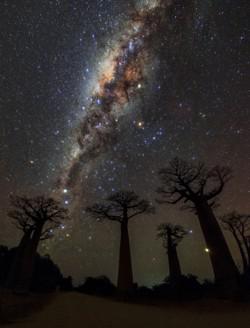
Milky Way over Avenue of Baobabs
imagen
Creado para la OAE
Pie de foto: Winner in the 2022 IAU OAE Astrophotography Contest, category Still images of celestial patterns.
This image, taken from the Avenue of Baobabs, Morondava, Madagascar, in July 2017, shows the majestic band of the Milky Way, our home galaxy, together with a rich collection of constellations and asterisms: Crux, Centaurus, Scorpius, Sagittarius and the Teapot asterism. Towards the bottom left of the image we can see the Southern Cross and the pointer stars Alpha (the brighter of the two) and Beta Centauri, which help to distinguish it from similar-looking configurations. Some cultures in Africa associate the Southern Cross with a giraffe, while others associate the constellations with a pride of lions or even with the Tree of Life.
Antares, the brightest star in the constellation Scorpius, is the orange-red star straight up from the middle baobab tree.
To the Pokomo people from southwestern Kenya, Africa, the Milky Way is associated with the smoke emanating from a campfire lit by ancient people. The various people in South Africa, in contrast, have different star tales; the Khoikhoi from the region around Cape Town explained the colours of the red and white stars as red and white roots that were roasted on a fire and thrown towards the sky together with the ashes of the fire. The Xhosa from further east consider the Milky Way the raised bristle of a huge angry dog, while the Zulu from near Johannesburg interpret it as a stream of spears of their strongest warriors.
Polynesian people, who were adept seafarers and navigators, see the constellation Scorpius as a fish hook, and refer to it as the demigod Maui’s Fish Hook. For the Djab Wurrung and the Jardwadjali people, the Southern Cross is part of a Dreamtime Story involving Tchingal, the Bram-bram-bult brothers (the pointer stars), their mother Druk (Delta Crux), and Bunya, the hunter who gets changed into a possum (Gacrux, red star at the top of the Southern Cross).
In this image, the planets Saturn (the bright point above Antares) and Jupiter (the bright point at the bottom-right of the image close to the trunk of the baobab tree) are visible. Indigenous cultures have various stories associated with the planets, for example Kamilaroi and Wailan people associate Saturn with wunygal, a small bird. The Boorong people of Western Victoria associate Jupiter with Ginabongbearp, the chief of the old spirits (Nurrumbunguttias), who takes the totemic form of the sulphur-crested white cockatoo.
Crédito: Amirreza Kamkar/IAU OAE
Términos del glosario:
Color , Polvo , Júpiter , Vía Láctea , Saturno , Escorpio , Cruz del Sur , Nube de polvo , Extinción interestelar , Alfa Centauri
Categorías:
La Vía Láctea y el medio interestelar
, Astronomía a simple vista
Licencia: Creative Commons Reconocimiento 4.0 Internacional (CC BY 4.0) Creative Commons Reconocimiento 4.0 Internacional (CC BY 4.0) íconos
Este archivo en Zenodo ( imagen 3.20 MB)
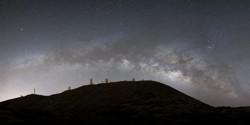
Teide Observatory
imagen
Creado para la OAE
Pie de foto: Honourable mention in the 2022 IAU OAE Astrophotography Contest, category Still images of celestial patterns.
Taken in May 2022 in Teide National Park in Tenerife, Spain, this image shows the arc of the Milky Way galaxy crossing the sky, accompanied by prominent constellations over the professional telescopes located on the mountains of that island. While the telescopes and the people working with them may ignore the constellations, the photographer managed to catch the Milky Way in such a way that it almost matches the shape of the mountain.
The bright star in the top-left side of the image is Vega, one of the brightest stars in the night sky and located in the small constellation Lyra. Being a white star, it is the standard star astrophysicists use to define the colour scale. As it is also a relatively close star, only about 25 light-years away, with a relatively simple name, it frequently appears in modern science fiction, for example in Carl Sagan’s famous novel “Contact”, which was filmed in 1997 with Jodie Foster starring as a radio astronomer.
The bright star seen below the galaxy and on the left half of the image is Altair, also one of the brightest stars in the night sky and located in the constellation Aquila. Together with Deneb — a star in the constellation Cygnus (the Swan) that is not visible in this image — Altair and Vega form the Summer Triangle, a characteristic asterism of popular astronomy in the northern hemisphere, where these telescopes are located.
On the right side of the image we can see the constellation Scorpius. This is easily identified by its brightest star, Antares, the reddish star in the Scorpion’s heart. Below it, the whole body and tail of the Scorpion can be found and above it the celestial Scorpion's head is represented by three bright bluish stars. Below the tail and above the horizon, the constellation of Ara, the Altar, is half-visible, but like all the stars of Sagittarius in the Milky Way and the much fainter ones in Hercules and Ophiuchus above it, these constellations are more difficult to pinpoint in this photograph full of stars. The head of Ophiuchus is the relatively bright star in the middle between Vega and Antares. In addition to the huge size of this constellation, it is also important because it is the thirteenth one of the Zodiac, and the Sun spends roughly three weeks in Ophiuchus, after only five days in Scorpius. Furthermore, Ophiuchus represents the model for the mythological best doctor in the world, called Asklepios in Greek mythology, and Aesculab in Latin. His constellation praises all people working in medical professions, including nurses, pharmacists and doctors.
Crédito: Curd-Christian Tengeler/IAU OAE
Términos del glosario:
Observatorio Astronómico , Astronomía , Polvo , Vía Láctea , Escorpio , Nube de polvo , Extinción interestelar
Categorías:
La Vía Láctea y el medio interestelar
, Astronomía a simple vista
, Telescopios, instrumentos y observatorios
Licencia: Creative Commons Reconocimiento 4.0 Internacional (CC BY 4.0) Creative Commons Reconocimiento 4.0 Internacional (CC BY 4.0) íconos
Este archivo en Zenodo ( imagen 54.90 MB)
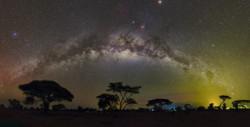
Milky Way Arch over Amboseli National Park
imagen
Creado para la OAE
Pie de foto: Winner in the 2022 IAU OAE Astrophotography Contest, category Still images of celestial patterns.
This image was taken in July 2016 from the Amboseli National Park in Kenya, located close to the equator.
In Egyptian mythology from northern Africa, the Milky Way was associated with a river sailed by gods and souls. The Zulu in South Africa interpret this pattern of dark and bright clouds of stars as an animal with black and white skin, whereas the South African Khoikhoi and San considered it “The Star’s Road”. In several South African cultures, the arch of the Milky Way is a pathway to the heavens formed by a mother goddess, according to a South African creation myth that was adopted in the 19th century from early ethnological research, but has vanished today.
In the middle-right of the image we find the bright red star Antares in the modern constellation of the Scorpion and at the upper-left edge is the white star Vega that is considered a Male Steenbok by the peoples around Cape Town.
Indigenous Australians have many names for the Milky Way. The Yolnu people of Arnhem Land in Australia’s Northern Territory refer to the Milky Way as Milnguya, the sky river. One of the prominent patterns in this image is associated with the contrast between the light and dark regions of the Milky Way.
These dark regions are cool dense clouds of interstellar dust and gas, which block the light from stars behind them. One of the prominent patterns is that of the Celestial Emu referred to as Tchingal by several Indigenous peoples of south Australia. The head and beak of the emu (the Coalsack Nebula) lie to the bottom-left of the Southern Cross (seen in the far bottom-right of the image), and the body and legs stretch leftward from it. Other indigenous groups associate the dark regions with caves or waterways. The orientation of the emu over the year provides important clues as to when it is time to pick emu eggs, and when the eggs are hatching. In some months, when these clouds of the Milky Way are close to the horizon, they are not considered as emu at all but as two creeping crocodiles.
The modern figure of the dark Pipe Nebula is clearly visible above the centre of the Galaxy; the smoke of this pipe reaches the colourful rho Ophiuchi region next to Antares in Scorpius, the orange-red star just above the Milky Way. Antares is referred to by the Boorong people as Djuit, the red-rumped parrot, while the Kokatha people of the Western Desert refer to Antares as Kogolongo, the red-tailed black cockatoo.
In addition, some notable constellations can be seen: Cygnus, Aquila, Lyra, Scorpius, Sagittarius, Crux, and Centaurus. The pointer stars, Alpha and Beta Centauri, are occasionally interpreted as The Eyes of the Beast in some South African traditions.
Crédito: Amirreza Kamkar/IAU OAE
Términos del glosario:
Constelación , Polvo , Vía Láctea , Escorpio , Cruz del Sur , Nube de polvo , Extinción interestelar , Sagitario , Alfa Centauri
Categorías:
La Vía Láctea y el medio interestelar
, Astronomía a simple vista
Licencia: Creative Commons Reconocimiento 4.0 Internacional (CC BY 4.0) Creative Commons Reconocimiento 4.0 Internacional (CC BY 4.0) íconos
Este archivo en Zenodo ( imagen 5.13 MB)