Dokumente & Ressourchen - Suchergebnisse
Suchergebnisse
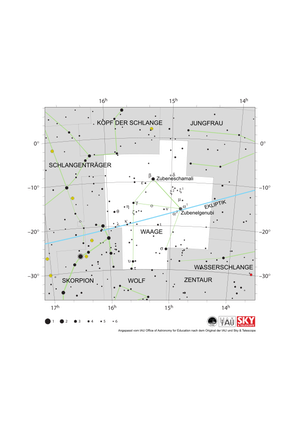
Waage-Sternbildkarte
Bild
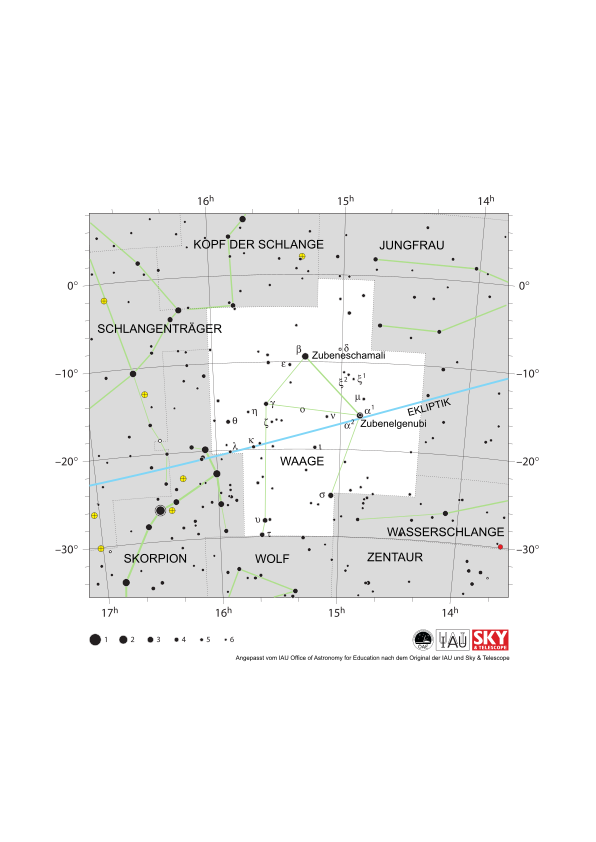
Unterschrift: Das Sternbild Waage mit seinen hellen Sternen und den umliegenden Sternbildern. Die Waage ist im Uhrzeigersinn von oben gehend umgeben von dem Kopf der Schlange, Jungfrau, Wasserschlange, Zentaur, Wolf, Skorpion und Schlangenträger. Die Waage liegt auf der Ekliptik (hier als blaue Linie dargestellt), das ist der Weg, den die Sonne im Laufe eines Jahres über den Himmel zu nehmen scheint. Die Sonne befindet sich von Ende Oktober bis Ende November in der Waage. Die anderen Planeten des Sonnensystems sind oft in der Waage zu finden.
Die Waage liegt knapp südlich des Himmelsäquators und ist daher in allen Regionen mit Ausnahme der arktischsten im Laufe des Jahres irgendwann einmal sichtbar. Am besten zu sehen ist die Waage abends auf der Nordhalbkugel im späten Frühling/Frühsommer und auf der Südhalbkugel im Spätherbst/Frühwinter.
Die y-Achse dieses Diagramms ist in Deklinationsgraden mit Norden nach oben und die x-Achse in Stunden der Rektaszension mit Osten nach links. Die Größe der hier markierten Sterne bezieht sich auf die scheinbare Helligkeit des Sterns. Je größer die Punkte, desto heller scheinen die Sterne die sie darstellen. Die griechischen Buchstaben kennzeichnen die hellsten Sterne des Sternbildes. Diese sind nach Helligkeit geordnet, wobei der hellste Stern mit Alpha, der zweithellste mit Beta usw. bezeichnet wird, obwohl diese Reihenfolge nicht immer genau eingehalten wird. Die gepunkteten Begrenzungslinien markieren die IAU-Grenzen der Sternbilder und die durchgezogenen grünen Linien markieren eine der üblichen Formen, die zur Darstellung der Sternbilder verwendet werden. Weder die Sternbildgrenzen, noch die Linie, die die Ekliptik markiert, noch die Linien, die die Sterne verbinden, sind am Himmel sichtbar.
Bild: Angepasst vom IAU Office of Astronomy for Education nach dem Original von IAU/Sky & Telescope
Link zur Quelle
Glossar-Begriffe:
Scheinbare Helligkeit , Himmelskoordinaten , Sternbild , Deklination , Ekliptik , Waage , Rektaszension (RA) , Skorpion , Tierkreis , Jungfrau
Kategorien:
Astronomie mit bloßem Auge
Lizenz: Creative Commons Namensnennung 4.0 International (CC BY 4.0) Creative Commons Namensnennung 4.0 International (CC BY 4.0) Symbole
Datei
( Bild
104.23 kB)
PDF-Datei
(PDF file
196.85 kB)
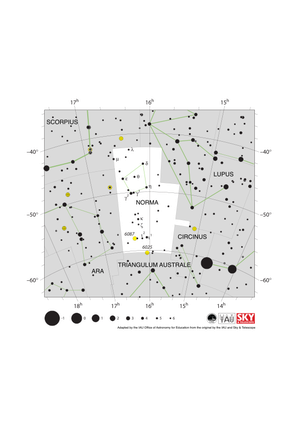
Norma Constellation Map
Bild
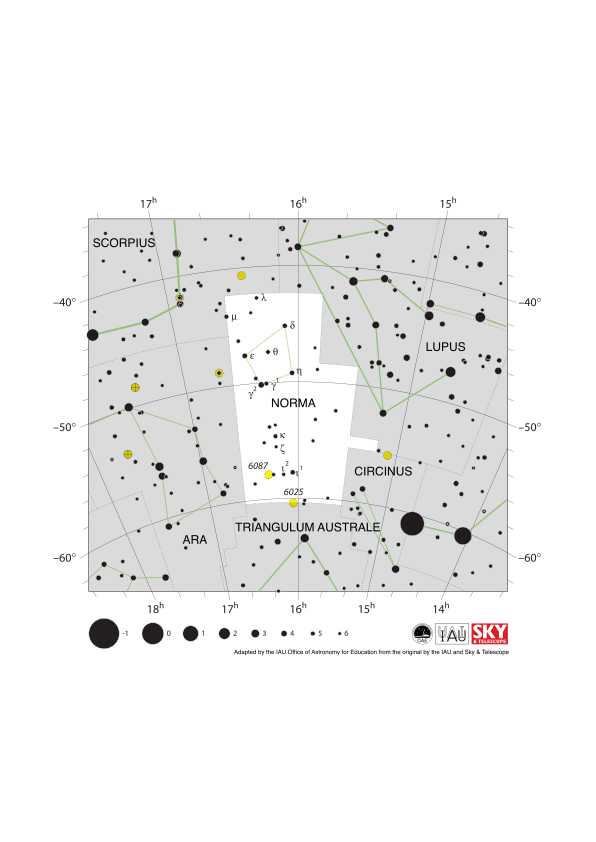
Unterschrift: The constellation Norma with its brighter stars and surrounding constellations. Norma is surrounded by (going clockwise from the top): Scorpius, Lupus, Circinus, Triangulum Australe and Ara. Norma is a faint constellation with relatively few bright stars.
Norma is a southern constellation and thus the whole constellation is visible at some point in the year throughout the southern hemisphere. The whole constellation is also visible from equatorial regions of the northern hemisphere with parts of the constellation visible from some northern hemisphere temperate regions. Norma is best viewed in the evening in the northern hemisphere summer and southern hemisphere winter.
The open clusters NGC 6025 and NGC 6087 lie in Norma and are marked here with yellow circles.
The y-axis of this diagram is in degrees of declination with north as up and the x-axis is in hours of right ascension with east to the left. The sizes of the stars marked here relate to the star's apparent magnitude, a measure of its apparent brightness. The larger dots represent brighter stars. The Greek letters mark the brightest stars in the constellation. These are ranked by brightness with the brightest star being labeled alpha, the second brightest beta, etc., although this ordering is not always followed exactly. The dotted boundary lines mark the IAU's boundaries of the constellations and the solid green lines mark one of the common forms used to represent the figures of the constellations. Neither the constellation boundaries, nor the lines joining the stars appear on the sky.
Bild: Adapted by the IAU Office of Astronomy for Education from the original by the IAU and Sky & Telescope
Link zur Quelle
Glossar-Begriffe:
Scheinbare Helligkeit , Himmelskoordinaten , Sternbild , Deklination , Rektaszension (RA) , Skorpion , Offener Sternhaufen
Kategorien:
Astronomie mit bloßem Auge
Lizenz: Creative Commons Namensnennung 4.0 International (CC BY 4.0) Creative Commons Namensnennung 4.0 International (CC BY 4.0) Symbole
Datei
( Bild
108.17 kB)
PDF-Datei
(PDF file
166.47 kB)
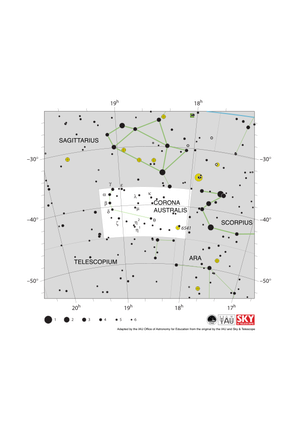
Corona Australis Constellation Map
Bild
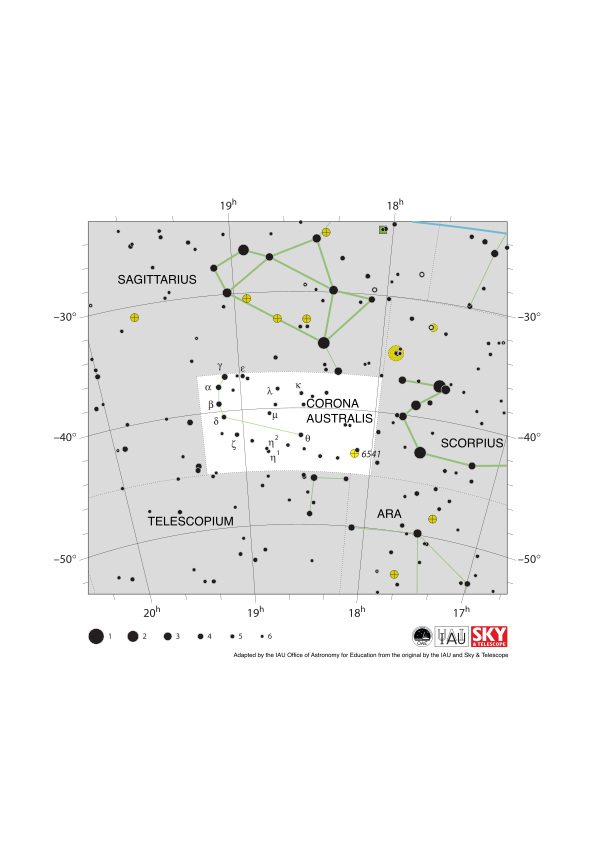
Unterschrift: The constellation Corona Australis with its brighter stars and surrounding constellations. Corona Australis is surrounded by (going clockwise from the top): Sagittarius, Scorpius, Ara and Telescopium. This constellation has relatively few bright stars.
Corona Australis is a southern constellation and thus the whole constellation is visible in the southern hemisphere at some point in the year. The constellation can also be viewed from equatorial and some temperate regions of the northern hemisphere. The constellation is best viewed in the evening in the northern hemisphere summer and southern hemisphere winter.
The globular cluster NGC 6541 lies in Corona Australis and is marked here with a yellow circle with a plus sign superimposed on it.
The y-axis of this diagram is in degrees of declination with north as up and the x-axis is in hours of right ascension with east to the left. The sizes of the stars marked here relate to the star's apparent magnitude, a measure of its apparent brightness. The larger dots represent brighter stars. The Greek letters mark the brightest stars in the constellation. These are ranked by brightness with the brightest star being labeled alpha, the second brightest beta, etc., although this ordering is not always followed exactly. The dotted boundary lines mark the IAU's boundaries of the constellations and the solid green lines mark one of the common forms used to represent the figures of the constellations. Neither the constellation boundaries, nor the lines joining the stars appear on the sky. The blue line at the top right of the diagram marks the ecliptic.
Bild: Adapted by the IAU Office of Astronomy for Education from the original by the IAU and Sky & Telescope
Link zur Quelle
Glossar-Begriffe:
Scheinbare Helligkeit , Himmelskoordinaten , Sternbild , Deklination , Ekliptik , Kugelsternhaufen , Rektaszension (RA) , Skorpion , Schütze
Kategorien:
Astronomie mit bloßem Auge
Lizenz: Creative Commons Namensnennung 4.0 International (CC BY 4.0) Creative Commons Namensnennung 4.0 International (CC BY 4.0) Symbole
Datei
( Bild
88.22 kB)
PDF-Datei
(PDF file
158.70 kB)
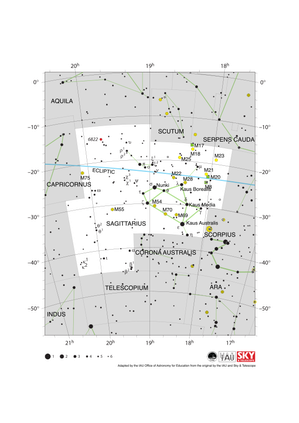
Sagittarius Constellation Map
Bild
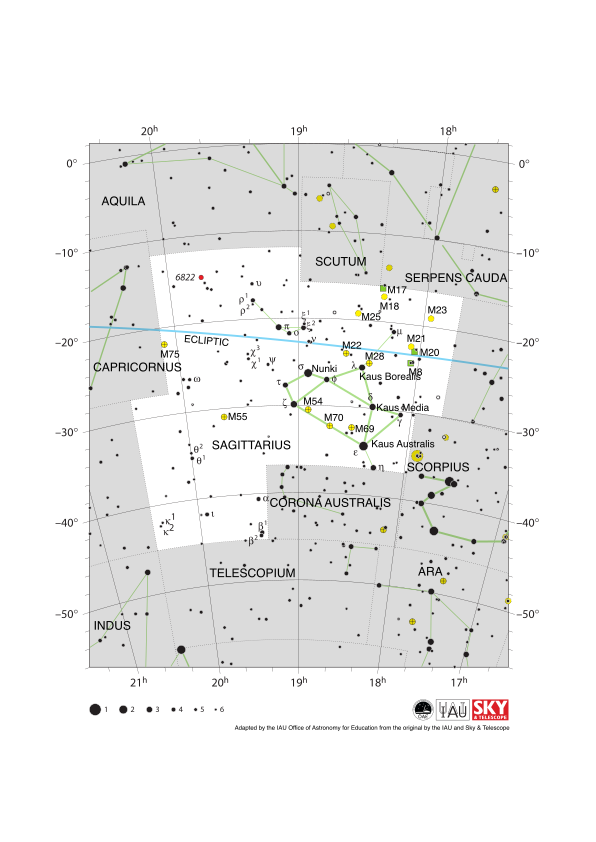
Unterschrift: The constellation Sagittarius along with its bright stars and surrounding constellations. Sagittarius is surrounded by (going clockwise from the top) Aquila, Scutum, Serpens Cauda, Ophiuchus, Scorpius, Corona Australis, Telescopium, Microscopium and Capricornus. The brighter stars in Sagittarius form a distinctive teapot shape. Sagittarius lies on the ecliptic (shown here as a blue line), this is the path the Sun appears to take across the sky over the course of a year. The Sun is in Sagittarius from mid December to mid January. The other planets of the Solar System can often be found in Sagittarius.
Sagittarius lies south of the celestial equator. The famous teapot asterism is visible for all but the most arctic regions of the world but the most southerly parts of the constellation are not visible in northern parts of Asia, Europe and North America. Sagittarius is most visible in the evenings in the northern hemisphere summer and southern hemisphere winter.
The supermassive black hole Sagittarius A* which lies at the center of our Milky Way Galaxy is sits on the western (here right-hand) edge of Sagittarius. Due to it covering an area at the center of our Galaxy, Sagittarius is home to many star clusters including open clusters (marked here with yellow circles) and globular clusters (marked here with yellow circles with + signs superimposed on them). Three nebulae are also marked here with green squares.
The y-axis of this diagram is in degrees of declination with north as up and the x-axis is in hours of right ascension with east to the left. The sizes of the stars marked here relate to the star's apparent magnitude, a measure of its apparent brightness. The larger dots represent brighter stars. The Greek letters mark the brightest stars in the constellation. These are ranked by brightness with the brightest star being labeled alpha, the second brightest beta, etc., although this ordering is not always followed exactly. The dotted boundary lines mark the IAU's boundaries of the constellations and the solid green lines mark one of the common forms used to represent the figures of the constellations. Neither the constellation boundaries, nor the line marking the ecliptic, nor the lines joining the stars appear on the sky.
Bild: Adapted by the IAU Office of Astronomy for Education from the original by IAU/Sky & Telescope
Link zur Quelle
Glossar-Begriffe:
Scheinbare Helligkeit , Steinbock , Himmelskoordinaten , Sternbild , Deklination , Ekliptik , Kugelsternhaufen , Milchstraße , Nebel , Rektaszension (RA) , Sagittarius A* , Skorpion , Supermassereiches Schwarzes Loch , Tierkreis , Asterismus , Offener Sternhaufen , Schütze
Kategorien:
Astronomie mit bloßem Auge
Lizenz: Creative Commons Namensnennung 4.0 International (CC BY 4.0) Creative Commons Namensnennung 4.0 International (CC BY 4.0) Symbole
Datei
( Bild
150.62 kB)
PDF-Datei
(PDF file
219.78 kB)