Dokumente & Ressourchen - Suchergebnisse
Suchergebnisse
Leo Minor Constellation Map
Bild
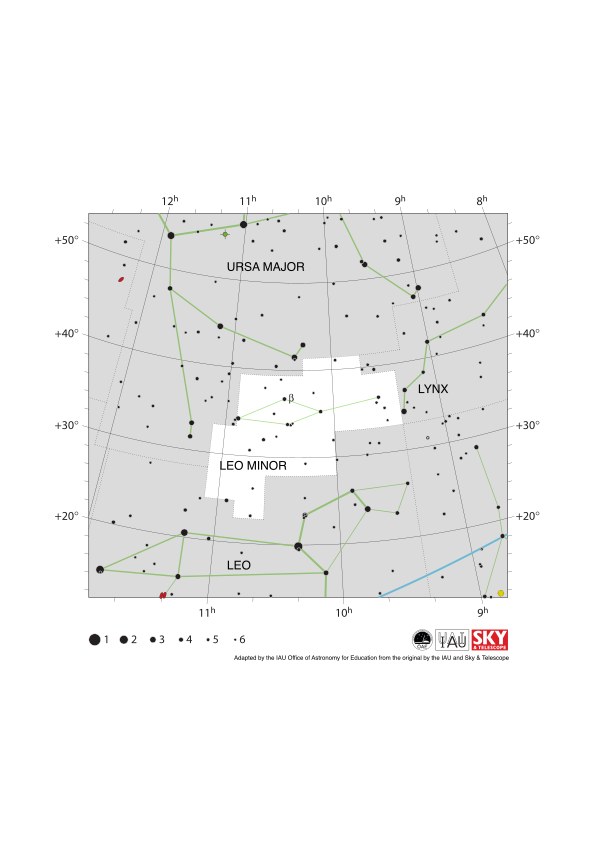
Unterschrift: The constellation Leo Minor with its brighter stars and surrounding constellations. Leo Minor is surrounded by (going clockwise from the top): Ursa Major, Lynx, Cancer and Leo. Leo Minor is a small constellation with relatively few bright stars. It is a separate constellation from and should not be confused with its larger neighbour Leo.
Leo Minor is a northern constellation and thus the whole constellation is visible at some point in the year throughout the northern hemisphere. The whole constellation is also visible from equatorial and temperate regions of the southern hemisphere. Leo Minor is circumpolar in arctic regions. This constellation is best viewed in the northern hemisphere spring and southern hemisphere autumn.
The y-axis of this diagram is in degrees of declination with north as up and the x-axis is in hours of right ascension with east to the left. The sizes of the stars marked here relate to the star's apparent magnitude, a measure of its apparent brightness. The larger dots represent brighter stars. The Greek letters mark the brightest stars in the constellation. These are ranked by brightness with the brightest star being labeled alpha, the second brightest beta, etc., although this ordering is not always followed exactly. The dotted boundary lines mark the IAU's boundaries of the constellations and the solid green lines mark one of the common forms used to represent the figures of the constellations. Neither the constellation boundaries, nor the lines joining the stars appear on the sky. The blue line in the bottom right marks the ecliptic.
Bild: Adapted by the IAU Office of Astronomy for Education from the original by the IAU and Sky & Telescope
Link zur Quelle
Glossar-Begriffe:
Scheinbare Helligkeit , Himmelskoordinaten , Zirkumpolarsterne , Sternbild , Deklination , Ekliptik , Löwe , Rektaszension (RA)
Kategorien:
Astronomie mit bloßem Auge
Lizenz: Creative Commons Namensnennung 4.0 International (CC BY 4.0) Creative Commons Namensnennung 4.0 International (CC BY 4.0) Symbole
Datei
( Bild
88.37 kB)
PDF-Datei
(PDF file
154.05 kB)
Antlia Constellation Map
Bild
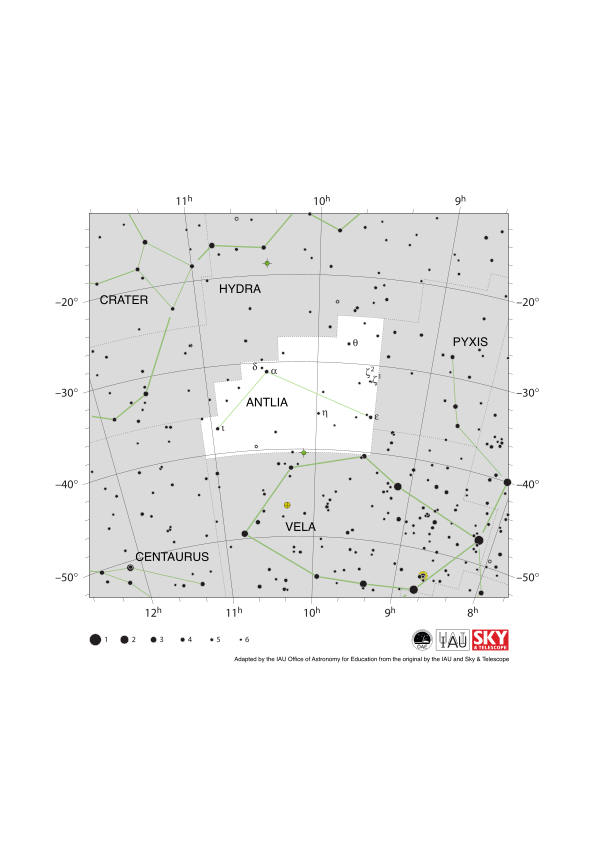
Unterschrift: The constellation Antlia along with its bright stars and surrounding constellations. Antlia is surrounded by (going clockwise from the top): Hydra, Pyxis, Vela and Centaurus.
Antlia is a southern constellation that is visible at some point in the year from the whole southern hemisphere as well as equatorial and some temperate regions of the northern hemisphere. The constellation is best viewed in the evenings in the northern hemisphere spring and southern hemisphere autumn.
The y-axis of this diagram is in degrees of declination with north as up and the x-axis is in hours of right ascension with east to the left. The sizes of the stars marked here relate to the star's apparent magnitude, a measure of its apparent brightness. The larger dots represent brighter stars. The Greek letters mark the brightest stars in the constellation. These are ranked by brightness with the brightest star being labeled alpha, the second brightest beta, etc., although this ordering is not always followed exactly. The dotted boundary lines mark the IAU's boundaries of the constellations and the solid green lines mark one of the common forms used to represent the figures of the constellations. Neither the constellation boundaries, nor the lines joining the stars appear on the sky.
Bild: Adapted by the IAU Office of Astronomy for Education from the original by IAU/Sky & Telescope
Link zur Quelle
Glossar-Begriffe:
Scheinbare Helligkeit , Himmelskoordinaten , Sternbild , Deklination , Rektaszension (RA)
Kategorien:
Astronomie mit bloßem Auge
Lizenz: Creative Commons Namensnennung 4.0 International (CC BY 4.0) Creative Commons Namensnennung 4.0 International (CC BY 4.0) Symbole
Datei
( Bild
90.89 kB)
PDF-Datei
(PDF file
172.63 kB)

Volans Constellation Map
Bild
Unterschrift: The constellation Volans with its bright stars and surrounding constellations. Volans is surrounded by (going clockwise from the top): Carina, Pictor, Dorado, Mensa and Chamaeleon.
Volans is a southern constellation and thus the whole constellation is visible at some point in year throughout the southern hemisphere. The whole constellation is also visible to a strip of the northern hemisphere near the equator. Volans is best viewed in the evening in the late northern hemisphere winter and late southern hemisphere summer.
The y-axis of this diagram is in degrees of declination with north as up and the x-axis is in hours of right ascension with east to the left. The sizes of the stars marked here relate to the star's apparent magnitude, a measure of its apparent brightness. The larger dots represent brighter stars. The Greek letters mark the brightest stars in the constellation. These are ranked by brightness with the brightest star being labeled alpha, the second brightest beta, etc., although this ordering is not always followed exactly. The dotted boundary lines mark the IAU's boundaries of the constellations and the solid green lines mark one of the common forms used to represent the figures of the constellations. Neither the constellation boundaries, nor the lines joining the stars appear on the sky.
Bild: Adapted by the IAU Office of Astronomy for Education from the original by the IAU and Sky & Telescope
Link zur Quelle
Glossar-Begriffe:
Scheinbare Helligkeit , Himmelskoordinaten , Sternbild , Deklination , Rektaszension (RA)
Kategorien:
Astronomie mit bloßem Auge
Lizenz: Creative Commons Namensnennung 4.0 International (CC BY 4.0) Creative Commons Namensnennung 4.0 International (CC BY 4.0) Symbole
Datei
( Bild
114.02 kB)
PDF-Datei
(PDF file
164.82 kB)

Grus Constellation Map
Bild
Unterschrift: The constellation Grus with its bright stars and surrounding constellations. Grus is surrounded by (going clockwise from the top): Piscis Austrinus, Microscopium, Indus, Tucana, Phoenix and Sculptor.
Grus is a southern constellation and thus the whole constellation is visible at some point in the year from the whole southern hemisphere at some point in the year. The whole constellation is also visible from equatorial and some temperate regions of the northern hemisphere. Grus is best viewed in the evening in the northern hemisphere autumn and southern hemisphere spring.
The y-axis of this diagram is in degrees of declination with north as up and the x-axis is in hours of right ascension with east to the left. The sizes of the stars marked here relate to the star's apparent magnitude, a measure of its apparent brightness. The larger dots represent brighter stars. The Greek letters mark the brightest stars in the constellation. These are ranked by brightness with the brightest star being labeled alpha, the second brightest beta, etc., although this ordering is not always followed exactly. The dotted boundary lines mark the IAU's boundaries of the constellations and the solid green lines mark one of the common forms used to represent the figures of the constellations. Neither the constellation boundaries, nor the lines joining the stars appear on the sky.
Bild: Adapted by the IAU Office of Astronomy for Education from the original by the IAU and Sky & Telescope
Link zur Quelle
Glossar-Begriffe:
Scheinbare Helligkeit , Himmelskoordinaten , Sternbild , Deklination , Rektaszension (RA)
Kategorien:
Astronomie mit bloßem Auge
Lizenz: Creative Commons Namensnennung 4.0 International (CC BY 4.0) Creative Commons Namensnennung 4.0 International (CC BY 4.0) Symbole
Datei
( Bild
105.07 kB)
PDF-Datei
(PDF file
179.81 kB)

Caelum Constellation Map
Bild
Unterschrift: The constellation Caelum with its bright stars and surrounding constellations. Caelum is surrounded by (going clockwise from the top): Eridanus, Horologium, Dorado, Pictor, Columba and Lepus. Caelum is a relatively small and faint constellation.
Caelum is a southern constellation and the whole constellation is visible at some point in the year from the whole southern hemisphere and from equatorial parts of the northern hemisphere. Parts of the constellation are visible from temperate regions of the northern hemisphere. The constellation is most visible in the evenings in the northern hemisphere winter and southern hemisphere summer.
The y-axis of this diagram is in degrees of declination with north as up and the x-axis is in hours of right ascension with east to the left. The sizes of the stars marked here relate to the star's apparent magnitude, a measure of its apparent brightness. The larger dots represent brighter stars. The Greek letters mark the brightest stars in the constellation. These are ranked by brightness with the brightest star being labeled alpha, the second brightest beta, etc., although this ordering is not always followed exactly. The dotted boundary lines mark the IAU's boundaries of the constellations and the solid green lines mark one of the common forms used to represent the figures of the constellations. Neither the constellation boundaries, nor the lines joining the stars appear on the sky.
Bild: Adapted by the IAU Office of Astronomy for Education from the original by the IAU and Sky & Telescope
Link zur Quelle
Glossar-Begriffe:
Scheinbare Helligkeit , Himmelskoordinaten , Sternbild , Deklination , Rektaszension (RA)
Kategorien:
Astronomie mit bloßem Auge
Lizenz: Creative Commons Namensnennung 4.0 International (CC BY 4.0) Creative Commons Namensnennung 4.0 International (CC BY 4.0) Symbole
Datei
( Bild
96.56 kB)
PDF-Datei
(PDF file
183.95 kB)