المستندات والموارد - نتائج البحث
نتائج البحث
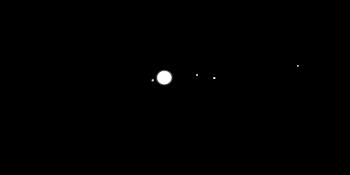
Jupiter Moons Movie2, by Nicolas Hurez, Paul-Antoine Matrangolo, and Carl Pennypacker, United States of America
فيديو
أُنشئ لصالح OAE
الشرح: Second place in the 2021 IAU OAE Astrophotography Contest, category Galilean moons.
This sequence shows the orbit of the four Galilean moons around the planet Jupiter. Almost two entire orbits of the innermost moon, Io, can be seen, with the other moons (Europa and Ganymede, but in particular Callisto) being further away, orbiting noticeably slower. The images were obtained in 2018 with the Las Cumbres Global Observatory at different locations on Earth, allowing a continuous sequence of images over approximately half a week without gaps during the day. With clear skies and over the course of several nights, the motion of the Galilean moons can also be observed with binoculars (ideally steady your elbows on a surface).
المصدر: Nicolas Hurez, Paul-Antoine Matrangolo and Carl Pennypacker/IAU OAE
مصطلحات المعجم:
أقمار غاليليو , عملاق غازي , آيو , المشتري , الأقمار , المدار , الكواكب الخارجية , الكوكب
فئات:
النظام الشمسي
الترخيص: المشاع الإبداعي نَسب المُصنَّف 4.0 دولي (CC BY 4.0) المشاع الإبداعي نَسب المُصنَّف 4.0 دولي (CC BY 4.0) أيقونات
هذا الملف على Zenodo ( فيديو 890.47 kB)
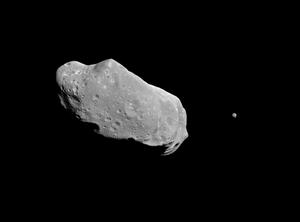
Ida and Dactyl
صورة
الشرح: This picture of the asteroid Ida with its satellite Dactyl was taken by the Galileo space probe in August 1993 from a range of 10,870 kilometers (6,755 miles). Ida is a heavily cratered, irregularly shaped asteroid in the main asteroid belt between Mars and Jupiter. This image is proof that asteroids like the 56 km large Ida can possess their own moons.
المصدر: NASA/JPL
رابط المصدر
مصطلحات المعجم:
كويكب , حزام الكويكبات , الأقمار
فئات:
النظام الشمسي
الترخيص: الملكية العامة الملكية العامة أيقونات
ملف
( صورة
56.80 kB)
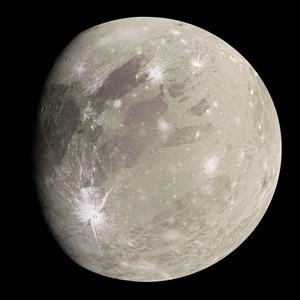
Ganymede seen by Juno spacecraft
صورة
الشرح: Ganymede is the largest and most massive natural moon of Jupiter, and at the same time, the largest moon in the solar system. It also stands out as it is the only moon in the solar system which has an internally generated magnetic field. This is likely created by a liquid iron or iron sulfide core.
With a diameter of over 5,000 kilometers, it exceeds Mercury in size. Although it has more than twice the mass of Earth's Moon, it hosts weaker surface gravity than Mercury, Io, and the Moon due to its lower mean density.
Ganymede's appearance is primarily composed of darker, heavily cratered regions, and brighter, less bombarded ones with deep grooves and ridges indicating geological activity. Whether this might be caused by tidal heating is still subject to further analysis. The brighter regions make up around two-thirds of Ganymede's surface.
The remaining area consists of dark regions, saturated with impact craters, which have been dated back to four billion years. It is assumed that the moon hosts a large saltwater ocean under its icy surface with extreme depths of up to 800 kilometers.
Ganymede likely has a very tenuous oxygen atmosphere, comparable to that found on the Jupiter moon Europa. It cannot be interpreted as a sign of life. Instead, it is thought that hydrogen and oxygen are split up by radiation on the moon's surface.
The first space probe to visit Ganymede was Pioneer 10, performing a high-speed flyby manoeuvre through the Jupiter system. Since then, it has been investigated by several other probes such as Galileo, New Horizons, and Juno. The Jupiter Icy Moons Explorer (JUICE) will be the first to actually enter orbit around Ganymede itself (in around 2034) to further study the moon's magnetic and icy surface. JUICE will impact Ganymede as the last act of its mission.
المصدر: NASA/JPL-Caltech/SwRI/MSSS/Kevin M. Gill
رابط المصدر
مصطلحات المعجم:
أقمار غاليليو , الأقمار
الترخيص: المشاع الإبداعي نَسب المُصنَّف 2.0 عام المشاع الإبداعي نَسب المُصنَّف 2.0 عام أيقونات
ملف
( صورة
1.85 MB)

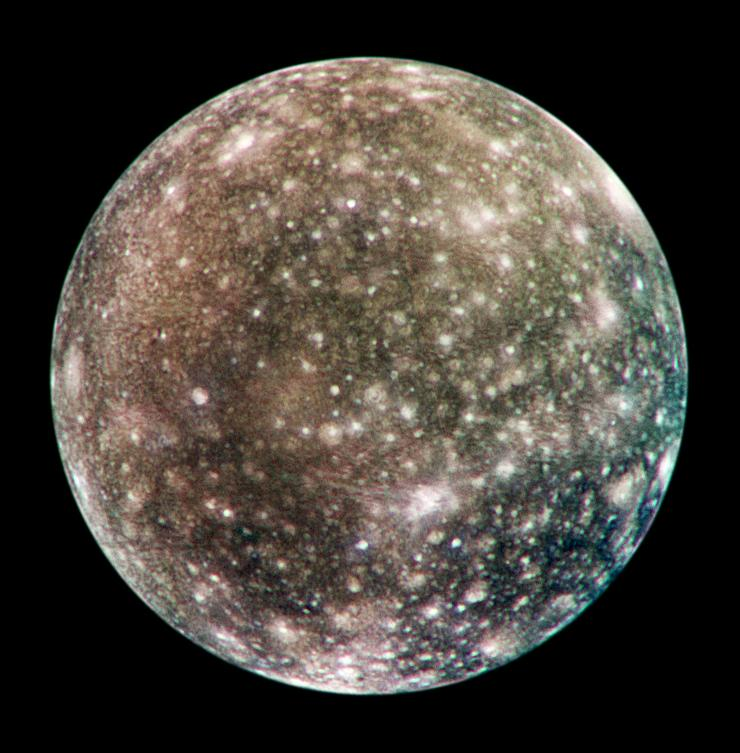
The Callisto satellite
صورة
الشرح: Callisto is the outermost of the four large Galilean moons of Jupiter and the third largest in the whole solar system, falling behind only Ganymede and Saturn's moon Titan. It orbits Jupiter at an average distance of around 1.9 million kilometers, roughly six times the distance between Earth and the Moon.
With a diameter of nearly 5,000 kilometers, it is almost as large as Mercury, the smallest planet in our solar system, but has only a third of its mass as it is composed of approximately equal amounts of rock and ice.
Callisto orbits Jupiter in a tidally locked rotation, always showing the same side to Jupiter. In contrast to the other three Galilean satellites – Io, Europa, and Ganymede – it is not in orbital resonance due to its farther outward location and is thus not appreciably tidally heated. It does not show any signs of plate tectonics or volcanic activity. Its lack of geological processes means that surface features like craters remain unchanged for billions of years. It is thought to have evolved predominantly under the influence of impacts, as its surface is the oldest and most heavily cratered object in the solar system. In fact, it is so covered in craters that any new impact will likely erase a former one.
Callisto's internal structure is still subject to discussion; it may consist of a deep salty ocean. It is thought to be composed mainly of a mix of ice and rock, which are present in various states throughout the inner layers of the moon. Callisto hosts a very thin atmosphere composed mainly of carbon dioxide and some traces of oxygen. The moon has been studied by numerous space probes, such as the Pioneer and Voyager missions and the Galileo orbiter, and will be subject to further explorations by NASA, ESA, and China’s National Space Administration (CNSA).
المصدر: NASA/JPL/DLR
رابط المصدر
مصطلحات المعجم:
أقمار غاليليو , الأقمار
الترخيص: الملكية العامة الملكية العامة أيقونات
ملف
( صورة
610.45 kB)
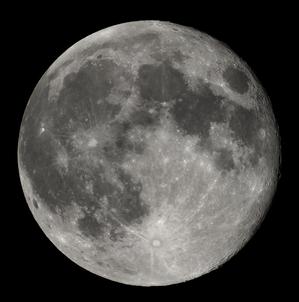
Full moon
صورة
الشرح: The image shows the nearly full Moon observed with a small telescope and a DSLR camera.
المصدر: Luc Viatour
رابط المصدر
مصطلحات المعجم:
البدر , الطور القمري , القمر , الأقمار
فئات:
النظام الشمسي
الترخيص: المشاع الإبداعي نَسب المُصنَّف - الترخيص بالمثل 3.0 غير موطَّنة المشاع الإبداعي نَسب المُصنَّف - الترخيص بالمثل 3.0 غير موطَّنة أيقونات
ملف
( صورة
924.21 kB)